 |
Peano
|
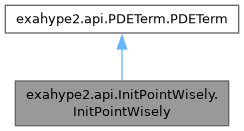
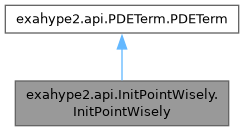
Point-wise initial condition: given the physical position of a single degree of freedom, write its initial Q there. More...
Data Structures | |
| class | Generator |
| InitPointWisely-specific code generation. More... | |
Public Member Functions | |
| __init__ (self, str implementation=None, bool stateless=False) | |
| implementation: str A C++ snippet that becomes initPointWisely()'s body (the empty string is a valid, generated no-op body, though a no-op initial condition leaves Q uninitialised), or None (the default) to leave initPointWisely() pure virtual for you to implement by hand. | |
| Public Member Functions inherited from exahype2.api.PDETerm.PDETerm | |
| __init__ (self, str name, str implementation=None, bool stateless=False) | |
| name: str The C++ method name, e.g. | |
| str | __repr__ (self) |
| str | __str__ (self) |
| "PDETerm.Generator" | generator_for (self, solver) |
| Code generator for this term within a solver, i.e. | |
| "PDETerm.Generator" | generator (self) |
| Code generator for this term: an instance of this term's own (possibly subclass-specific) Generator. | |
Static Public Attributes | |
| tuple | SIGNATURE |
| str | NAME = "initPointWisely" |
Additional Inherited Members | |
| Data Fields inherited from exahype2.api.PDETerm.PDETerm | |
| name = name | |
| implementation = implementation | |
| stateless = stateless | |
Point-wise initial condition: given the physical position of a single degree of freedom, write its initial Q there.
Unlike the legacy, cell-wise initialCondition() (handed a whole mesh cell's centre and extent plus gridIsConstructed, and expected to fill an entire patch itself - see python/exahype2/solvers/rkfd/*.template.h), this term is evaluated once per degree of freedom, exactly like Flux and MaxEigenvalue are:
Q holds the unknowns. If the solver has auxiliary variables, a pointer to each set follows right behind Q (exahype2.api.AuxiliaryVariables). The solver that owns a set receives a non-const pointer and initialises the set here, as this term has to set up everything a fresh degree of freedom needs. Solvers which share a set receive a const pointer.
Definition at line 8 of file InitPointWisely.py.
| exahype2.api.InitPointWisely.InitPointWisely.__init__ | ( | self, | |
| str | implementation = None, | ||
| bool | stateless = False ) |
implementation: str A C++ snippet that becomes initPointWisely()'s body (the empty string is a valid, generated no-op body, though a no-op initial condition leaves Q uninitialised), or None (the default) to leave initPointWisely() pure virtual for you to implement by hand.
A grid construction such as exahype2.api.fv.SetupSimulationOverRegularGrid validates that the solver it is attached to has this term registered before it does anything else, since it relies on it to fill in the initial condition.
Definition at line 42 of file InitPointWisely.py.
References __init__(), exahype2.api.blockstructured.DirichletBoundaryConditions.DirichletBoundaryConditions.NAME, exahype2.api.blockstructured.SommerfeldBoundaryConditions.SommerfeldBoundaryConditions.NAME, exahype2.api.Flux.Flux.NAME, exahype2.api.GradientRefinement.GradientRefinement.NAME, and NAME.
Referenced by __init__().
|
static |
Definition at line 40 of file InitPointWisely.py.
Referenced by __init__(), exahype2.api.MassMatrix.MassMatrix.__init__(), exahype2.api.MaxEigenvalue.MaxEigenvalue.__init__(), exahype2.api.NonconservativeProduct.NonconservativeProduct.__init__(), exahype2.api.PointSource.PointSource.__init__(), exahype2.api.RefineErasePointwisely.RefineErasePointwisely.__init__(), and exahype2.api.VolumetricSource.VolumetricSource.__init__().
|
static |
Definition at line 35 of file InitPointWisely.py.
 1.15.0