 |
Peano
|
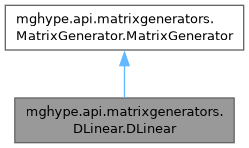
Simple matrix generator for continuous d-linear finite elements. More...

Public Member Functions | |
| __init__ (self, dimensions, unknowns_per_node) | |
| get_cell_identity_matrix (self) | |
| Return identity matrix and a 0 as the identity matrix has no intrinsic scaling, i.e. | |
| get_lumped_mass_matrix (self) | |
| Get this working for 2d. | |
| get_cell_mass_matrix (self) | |
| Create a cell-cell mass matrix. | |
| get_cell_system_matrix_for_laplacian (self) | |
| Create a cell-cell mass matrix. | |
| Public Member Functions inherited from mghype.api.matrixgenerators.MatrixGenerator.MatrixGenerator | |
| __init__ (self, dimensions, poly_degree, unknowns_per_node=1) | |
| get_polynomial1d (self) | |
| Method to create a list of 1D polynomials. | |
| get_points1d (self) | |
| Method to set the quadrature points, used for integration. | |
| get_integration_points_over_unit_interval (self) | |
| Most schemes define the integration point over the interval [-1,1] whereas MGHyPE often needs it on the unit interval. | |
| get_weights1d (self) | |
| Method to set the quadrature weights, used for integration. | |
| get_points_for_dimension (self, dim=-1) | |
| We promote the 1D quadrature points in into the dimensions of our problem by taking cartesian product. | |
| get_weights_for_dimension (self, dim=-1) | |
| We promote the 1D quadrature weights in into the dimensions of our problem by taking cartesian product. | |
| convert_index_to_dim (self, index, dim=-1) | |
| This method helps with indexing. | |
| get_polynomial (self, index, dim=-1) | |
| Promote 1d polynomials to many dimensions by taking products. | |
| get_deriv (self, index, dimForDeriv, dim=-1) | |
| dimForDeriv is the singular dimension that we wanna take a polyderiv in | |
| eval_integral (self, functions, dim=-1, factor=1) | |
Data Fields | |
| block_matrix = mghype.api.matrixgenerators.blockmatrix.DGPoisson2dPenaltyBlockMatrix(self.poly_degree) | |
| Data Fields inherited from mghype.api.matrixgenerators.MatrixGenerator.MatrixGenerator | |
| dimensions = dimensions | |
| poly_degree = poly_degree | |
| unknowns_per_node = unknowns_per_node | |
| polynomials1d = self.get_polynomial1d() | |
| list | derivatives1d = [ p.deriv() for p in self.polynomials1d ] |
| points1d = self.get_points1d() | |
| weights1d = self.get_weights1d() | |
Protected Member Functions | |
| _cell_dofs (self) | |
Simple matrix generator for continuous d-linear finite elements.
This factory method is there for convenience, i.e. users can take it to pre-assemble local matrices and then to pipe it into the Peano 4 multigrid classes. Most of the stuff in here in hard-coded, so only well-suited for relatively primitive solvers. You might want to specialise these routines, switch to a more sophisticated matrix generator, or abandon the idea of a matrix generator altogether.
Definition at line 10 of file DLinear.py.
| mghype.api.matrixgenerators.DLinear.DLinear.__init__ | ( | self, | |
| dimensions, | |||
| unknowns_per_node ) |
Definition at line 23 of file DLinear.py.
References __init__().
Referenced by __init__().
|
protected |
Definition at line 38 of file DLinear.py.
Referenced by get_cell_identity_matrix(), and mghype.api.matrixgenerators.DLinearMassIdentity.DLinearMassIdentity.get_cell_identity_matrix().

| mghype.api.matrixgenerators.DLinear.DLinear.get_cell_identity_matrix | ( | self | ) |
Return identity matrix and a 0 as the identity matrix has no intrinsic scaling, i.e.
its scaling is \( h^0 \).
Reimplemented from mghype.api.matrixgenerators.MatrixGenerator.MatrixGenerator.
Definition at line 45 of file DLinear.py.
References _cell_dofs(), convert::data::PatchData.dimensions, convert::data::Variable.dimensions, exahype2.api.dslhype2.Types.TVector.dimensions, and dimensions.
Referenced by mghype.api.matrixgenerators.DLinearMassIdentity.DLinearMassIdentity.get_cell_mass_matrix().


| mghype.api.matrixgenerators.DLinear.DLinear.get_cell_mass_matrix | ( | self | ) |
Create a cell-cell mass matrix.
This matrix does not couple the individual unknowns per degree of freedom. The resulting matrix has to be scaled by \( h^d \).
Use the mass matrix generated for DG Interior Penalty for Poisson equation.
Reimplemented from mghype.api.matrixgenerators.MatrixGenerator.MatrixGenerator.
Definition at line 76 of file DLinear.py.
References block_matrix, convert::data::PatchData.dimensions, convert::data::Variable.dimensions, exahype2.api.dslhype2.Types.TVector.dimensions, and dimensions.
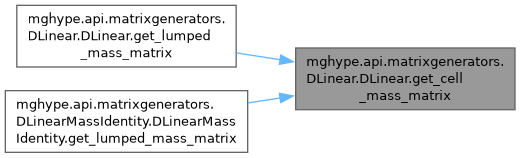
Referenced by get_lumped_mass_matrix(), and mghype.api.matrixgenerators.DLinearMassIdentity.DLinearMassIdentity.get_lumped_mass_matrix().
| mghype.api.matrixgenerators.DLinear.DLinear.get_cell_system_matrix_for_laplacian | ( | self | ) |
Create a cell-cell mass matrix.
In a finite element context, this matrix has to be scaled with \( h^{d-2} \). Therefore, we retturn d-2 as second argument.
Use the cell-cell matrix generated for DG Interior Penalty for Poisson equation.
Reimplemented from mghype.api.matrixgenerators.MatrixGenerator.MatrixGenerator.
Definition at line 91 of file DLinear.py.
References block_matrix, convert::data::PatchData.dimensions, convert::data::Variable.dimensions, exahype2.api.dslhype2.Types.TVector.dimensions, and dimensions.
Referenced by mghype.api.matrixgenerators.GaussLobatto.GaussLobattoMatrixFree.get_A_tilde().

| mghype.api.matrixgenerators.DLinear.DLinear.get_lumped_mass_matrix | ( | self | ) |
Get this working for 2d.
What about 3d? If we select an index for the first dimension and then sum over the other two (ie call np.sum( massMatrix[i,] )) it will just add up all elements along the 2 other dimensions, as if we flattened it. Is this what we want?
Definition at line 58 of file DLinear.py.
References get_cell_mass_matrix().

| mghype.api.matrixgenerators.DLinear.DLinear.block_matrix = mghype.api.matrixgenerators.blockmatrix.DGPoisson2dPenaltyBlockMatrix(self.poly_degree) |
Definition at line 35 of file DLinear.py.
Referenced by mghype.api.matrixgenerators.GaussLobatto.GaussLobattoMatrixFree.get_cell_from_face_matrix(), get_cell_mass_matrix(), mghype.api.matrixgenerators.GaussLobatto.GaussLobatto.get_cell_mass_matrix(), get_cell_system_matrix_for_laplacian(), mghype.api.matrixgenerators.DLinearMassIdentity.DLinearMassIdentity.get_cell_system_matrix_for_laplacian(), mghype.api.matrixgenerators.GaussLobatto.GaussLobatto.get_cell_system_matrix_for_laplacian(), mghype.api.matrixgenerators.GaussLobatto.GaussLobatto.get_cell_to_face_matrix(), mghype.api.matrixgenerators.GaussLobatto.GaussLobatto.get_face_to_cell_matrix(), and mghype.api.matrixgenerators.GaussLobatto.GaussLobattoMatrixFree.get_projection_matrices().
 1.15.0