#include <DoubleMessage.h>
|
| static MPI_Datatype | getForkDatatype () |
| | Hands out MPI datatype if we work without the LLVM MPI extension.
|
| static MPI_Datatype | getJoinDatatype () |
| static MPI_Datatype | getBoundaryExchangeDatatype () |
| static MPI_Datatype | getMultiscaleDataExchangeDatatype () |
| static MPI_Datatype | getGlobalCommunciationDatatype () |
| static void | freeForkDatatype () |
| static void | freeJoinDatatype () |
| static void | freeBoundaryExchangeDatatype () |
| static void | freeMultiscaleDataExchangeDatatype () |
| static void | freeGlobalCommunciationDatatype () |
| static void | initDatatype () |
| | Wrapper around getDatatype() to trigger lazy evaluation if we use the lazy initialisation.
|
| static void | shutdownDatatype () |
| | Free the underlying MPI datatype.
|
| static void | send (const tarch::mpi::DoubleMessage &buffer, int destination, int tag, MPI_Comm communicator) |
| | In DaStGen (the first version), I had a non-static version of the send as well as the receive.
|
| static void | receive (tarch::mpi::DoubleMessage &buffer, int source, int tag, MPI_Comm communicator) |
| static void | send (const tarch::mpi::DoubleMessage &buffer, int destination, int tag, std::function< void()> startCommunicationFunctor, std::function< void()> waitFunctor, MPI_Comm communicator) |
| | Alternative to the other send() where I trigger a non-blocking send an then invoke the functor until the corresponding MPI_Test tells me that the message went through.
|
| static void | receive (tarch::mpi::DoubleMessage &buffer, int source, int tag, std::function< void()> startCommunicationFunctor, std::function< void()> waitFunctor, MPI_Comm communicator) |
| static void | sendAndPollDanglingMessages (const tarch::mpi::DoubleMessage &message, int destination, int tag, MPI_Comm communicator=tarch::mpi::Rank::getInstance().getCommunicator()) |
| static void | receiveAndPollDanglingMessages (tarch::mpi::DoubleMessage &message, int source, int tag, MPI_Comm communicator=tarch::mpi::Rank::getInstance().getCommunicator()) |
|
| static MPI_Datatype | Datatype |
| | Whenever we use LLVM's MPI extension (DaStGe), we rely on lazy initialisation of the datatype.
|
Definition at line 33 of file DoubleMessage.h.
◆ ObjectConstruction
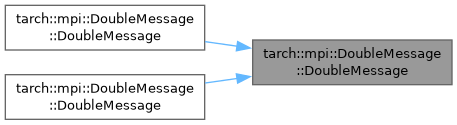
◆ DoubleMessage() [1/4]
| tarch::mpi::DoubleMessage::DoubleMessage |
( |
| ) |
|
◆ DoubleMessage() [2/4]
| tarch::mpi::DoubleMessage::DoubleMessage |
( |
double | __value | ) |
|
◆ DoubleMessage() [3/4]
| tarch::mpi::DoubleMessage::DoubleMessage |
( |
const DoubleMessage & | copy | ) |
|
|
default |
◆ DoubleMessage() [4/4]
◆ freeBoundaryExchangeDatatype()
| void tarch::mpi::DoubleMessage::freeBoundaryExchangeDatatype |
( |
| ) |
|
|
static |
◆ freeForkDatatype()
| void tarch::mpi::DoubleMessage::freeForkDatatype |
( |
| ) |
|
|
static |
◆ freeGlobalCommunciationDatatype()
| void tarch::mpi::DoubleMessage::freeGlobalCommunciationDatatype |
( |
| ) |
|
|
static |
◆ freeJoinDatatype()
| void tarch::mpi::DoubleMessage::freeJoinDatatype |
( |
| ) |
|
|
static |
◆ freeMultiscaleDataExchangeDatatype()
| void tarch::mpi::DoubleMessage::freeMultiscaleDataExchangeDatatype |
( |
| ) |
|
|
static |
◆ getBoundaryExchangeDatatype()
| MPI_Datatype tarch::mpi::DoubleMessage::getBoundaryExchangeDatatype |
( |
| ) |
|
|
static |
◆ getForkDatatype()
| MPI_Datatype tarch::mpi::DoubleMessage::getForkDatatype |
( |
| ) |
|
|
static |
Hands out MPI datatype if we work without the LLVM MPI extension.
If we work with this additional feature, this is the routine where the lazy initialisation is done and the datatype is also cached.
◆ getGlobalCommunciationDatatype()
| MPI_Datatype tarch::mpi::DoubleMessage::getGlobalCommunciationDatatype |
( |
| ) |
|
|
static |
◆ getJoinDatatype()
| MPI_Datatype tarch::mpi::DoubleMessage::getJoinDatatype |
( |
| ) |
|
|
static |
◆ getMultiscaleDataExchangeDatatype()
| MPI_Datatype tarch::mpi::DoubleMessage::getMultiscaleDataExchangeDatatype |
( |
| ) |
|
|
static |
◆ getSenderRank()
| int tarch::mpi::DoubleMessage::getSenderRank |
( |
| ) |
const |
- Returns
- The rank of the sender of an object. It only make ssense to call this routine after you've invoked receive with MPI_ANY_SOURCE.
◆ getValue()
| double tarch::mpi::DoubleMessage::getValue |
( |
| ) |
const |
◆ initDatatype()
| void tarch::mpi::DoubleMessage::initDatatype |
( |
| ) |
|
|
static |
Wrapper around getDatatype() to trigger lazy evaluation if we use the lazy initialisation.
◆ receive() [1/2]
◆ receive() [2/2]
| void tarch::mpi::DoubleMessage::receive |
( |
tarch::mpi::DoubleMessage & | buffer, |
|
|
int | source, |
|
|
int | tag, |
|
|
std::function< void()> | startCommunicationFunctor, |
|
|
std::function< void()> | waitFunctor, |
|
|
MPI_Comm | communicator ) |
|
static |
◆ receiveAndPollDanglingMessages()
◆ send() [1/2]
| void tarch::mpi::DoubleMessage::send |
( |
const tarch::mpi::DoubleMessage & | buffer, |
|
|
int | destination, |
|
|
int | tag, |
|
|
MPI_Comm | communicator ) |
|
static |
In DaStGen (the first version), I had a non-static version of the send as well as the receive.
However, this did not work with newer C++11 versions, as a member function using this as pointer usually doesn't see the vtable while the init sees the object from outside, i.e. including a vtable. So this routine now is basically an alias for a blocking MPI_Send.
◆ send() [2/2]
| void tarch::mpi::DoubleMessage::send |
( |
const tarch::mpi::DoubleMessage & | buffer, |
|
|
int | destination, |
|
|
int | tag, |
|
|
std::function< void()> | startCommunicationFunctor, |
|
|
std::function< void()> | waitFunctor, |
|
|
MPI_Comm | communicator ) |
|
static |
Alternative to the other send() where I trigger a non-blocking send an then invoke the functor until the corresponding MPI_Test tells me that the message went through.
In systems with heavy MPI usage, this can help to avoid deadlocks.
◆ sendAndPollDanglingMessages()
◆ setValue()
| void tarch::mpi::DoubleMessage::setValue |
( |
double | value | ) |
|
◆ shutdownDatatype()
| void tarch::mpi::DoubleMessage::shutdownDatatype |
( |
| ) |
|
|
static |
Free the underlying MPI datatype.
◆ toString()
| std::string tarch::mpi::DoubleMessage::toString |
( |
| ) |
const |
◆ _senderDestinationRank
| int tarch::mpi::DoubleMessage::_senderDestinationRank |
|
private |
◆ _value
| double tarch::mpi::DoubleMessage::_value |
|
private |
◆ Datatype
| MPI_Datatype tarch::mpi::DoubleMessage::Datatype |
|
staticprivate |
Whenever we use LLVM's MPI extension (DaStGe), we rely on lazy initialisation of the datatype.
However, Peano calls init explicitly in most cases. Without the LLVM extension which caches the MPI datatype once constructed, this field stores the type.
Definition at line 152 of file DoubleMessage.h.
The documentation for this struct was generated from the following file:


 1.15.0


