 |
Peano
|
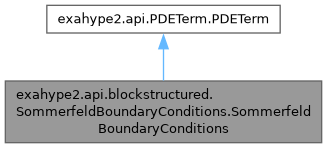
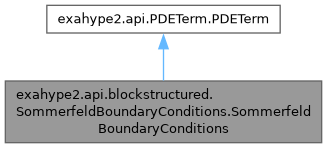
Sommerfeld (radiative, outgoing) boundary conditions: waves leave the domain with little reflection, and the solution approaches a far-field solution towards infinity. More...
Data Structures | |
| class | Generator |
| SommerfeldBoundaryConditions-specific code generation. More... | |
Public Member Functions | |
| __init__ (self, str implementation=None, Sequence[float] origin=None, bool stateless=False) | |
| get_origin (self, int dimensions) | |
| The origin with one entry per dimension. | |
| Public Member Functions inherited from exahype2.api.PDETerm.PDETerm | |
| __init__ (self, str name, str implementation=None, bool stateless=False) | |
| name: str The C++ method name, e.g. | |
| str | __repr__ (self) |
| str | __str__ (self) |
| "PDETerm.Generator" | generator_for (self, solver) |
| Code generator for this term within a solver, i.e. | |
| "PDETerm.Generator" | generator (self) |
| Code generator for this term: an instance of this term's own (possibly subclass-specific) Generator. | |
Data Fields | |
| origin = None if origin is None else [float(x) for x in origin] | |
| The origin with one entry per dimension. | |
| Data Fields inherited from exahype2.api.PDETerm.PDETerm | |
| name = name | |
| implementation = implementation | |
| stateless = stateless | |
Static Public Attributes | |
| tuple | SIGNATURE |
| str | NAME = "sommerfeldFarFieldSolution" |
Sommerfeld (radiative, outgoing) boundary conditions: waves leave the domain with little reflection, and the solution approaches a far-field solution towards infinity.
The term is an alternative to exahype2.api.DirichletBoundaryConditions. exahype2.blockstructured.applySommerfeldBoundaryConditions() documents the conditions, their discretisation, and how block-structured schemes realise them. The user specifies the far-field solution \( u_\\infty \):
Only the first NUMBER_OF_UNKNOWNS entries of Q are read, i.e. the implementation does not have to set the auxiliary variables.
The wave speed is the solver's maximum eigenvalue along the face normal, i.e. the solver has to hold an exahype2.api.MaxEigenvalue term. The wave speed does not need any solver state, so the boundary conditions use the stateless variant of the term if the solver holds one, and the variant with state otherwise (
Different to Dirichlet conditions, there is no separate boundary task in the time step. The Sommerfeld update replaces the roll over of the face data instead (
A solver needs a boundary condition term if and only if at least one axis of the domain is not periodic (
Only the non-stateless variant is supported, i.e. the term has to be added with stateless=False.
Definition at line 10 of file SommerfeldBoundaryConditions.py.
| exahype2.api.blockstructured.SommerfeldBoundaryConditions.SommerfeldBoundaryConditions.__init__ | ( | self, | |
| str | implementation = None, | ||
| Sequence[float] | origin = None, | ||
| bool | stateless = False ) |
| implementation | str A C++ snippet that becomes sommerfeldFarFieldSolution()'s body, or None (the default) to leave sommerfeldFarFieldSolution() pure virtual for you to implement by hand. |
| origin | Sequence[float] Centre of the system, i.e. the point the outgoing spherical waves emanate from. One entry per dimension. None (the default) is the origin of the coordinate system. |
| stateless | bool Has to be False, |
Definition at line 64 of file SommerfeldBoundaryConditions.py.
References __init__(), exahype2.api.blockstructured.DirichletBoundaryConditions.DirichletBoundaryConditions.NAME, and NAME.
Referenced by __init__().
| exahype2.api.blockstructured.SommerfeldBoundaryConditions.SommerfeldBoundaryConditions.get_origin | ( | self, | |
| int | dimensions ) |
The origin with one entry per dimension.
| dimensions | int Number of dimensions of the domain. |
Definition at line 93 of file SommerfeldBoundaryConditions.py.
References origin.
|
static |
Definition at line 62 of file SommerfeldBoundaryConditions.py.
Referenced by __init__(), exahype2.api.Flux.Flux.__init__(), exahype2.api.GradientRefinement.GradientRefinement.__init__(), exahype2.api.InitPointWisely.InitPointWisely.__init__(), exahype2.api.MassMatrix.MassMatrix.__init__(), exahype2.api.MaxEigenvalue.MaxEigenvalue.__init__(), exahype2.api.NonconservativeProduct.NonconservativeProduct.__init__(), exahype2.api.PointSource.PointSource.__init__(), exahype2.api.RefineErasePointwisely.RefineErasePointwisely.__init__(), and exahype2.api.VolumetricSource.VolumetricSource.__init__().
| exahype2.api.blockstructured.SommerfeldBoundaryConditions.SommerfeldBoundaryConditions.origin = None if origin is None else [float(x) for x in origin] |
The origin with one entry per dimension.
| dimensions | int Number of dimensions of the domain. |
Definition at line 91 of file SommerfeldBoundaryConditions.py.
Referenced by get_origin().
|
static |
Definition at line 58 of file SommerfeldBoundaryConditions.py.
 1.15.0