 |
Peano
|
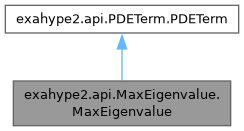
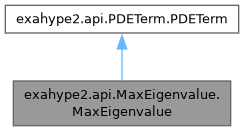
The maximum absolute eigenvalue of the flux Jacobian in a given direction, i.e. More...
Data Structures | |
| class | Generator |
| MaxEigenvalue-specific code generation. More... | |
Public Member Functions | |
| __init__ (self, str implementation=None, bool stateless=False) | |
| implementation: str A C++ snippet that becomes maxEigenvalue()'s body (the empty string is a valid, generated no-op body), or None (the default) to leave maxEigenvalue() pure virtual for you to implement by hand. | |
| Public Member Functions inherited from exahype2.api.PDETerm.PDETerm | |
| __init__ (self, str name, str implementation=None, bool stateless=False) | |
| name: str The C++ method name, e.g. | |
| str | __repr__ (self) |
| str | __str__ (self) |
| "PDETerm.Generator" | generator_for (self, solver) |
| Code generator for this term within a solver, i.e. | |
| "PDETerm.Generator" | generator (self) |
| Code generator for this term: an instance of this term's own (possibly subclass-specific) Generator. | |
Static Public Attributes | |
| tuple | SIGNATURE |
| str | NAME = "maxEigenvalue" |
Additional Inherited Members | |
| Data Fields inherited from exahype2.api.PDETerm.PDETerm | |
| name = name | |
| implementation = implementation | |
| stateless = stateless | |
The maximum absolute eigenvalue of the flux Jacobian in a given direction, i.e.
the spectral radius used by Rusanov-type numerical fluxes and by the CFL-driven admissible time step size.
See python/exahype2/solvers/fv/riemann/kernels.py's eigenvalues(), which returns the full eigenvalue vector L rather than just its maximum - this new API deliberately asks for the reduced quantity solvers actually need for their numerical flux, and reduces the legacy signature the same way Flux does:
Definition at line 8 of file MaxEigenvalue.py.
| exahype2.api.MaxEigenvalue.MaxEigenvalue.__init__ | ( | self, | |
| str | implementation = None, | ||
| bool | stateless = False ) |
implementation: str A C++ snippet that becomes maxEigenvalue()'s body (the empty string is a valid, generated no-op body), or None (the default) to leave maxEigenvalue() pure virtual for you to implement by hand.
Don't add this term to a solver at all if it needs no eigenvalue estimate.
Definition at line 41 of file MaxEigenvalue.py.
References __init__(), exahype2.api.blockstructured.DirichletBoundaryConditions.DirichletBoundaryConditions.NAME, exahype2.api.blockstructured.SommerfeldBoundaryConditions.SommerfeldBoundaryConditions.NAME, exahype2.api.Flux.Flux.NAME, exahype2.api.GradientRefinement.GradientRefinement.NAME, exahype2.api.InitPointWisely.InitPointWisely.NAME, exahype2.api.MassMatrix.MassMatrix.NAME, and NAME.
Referenced by __init__().
|
static |
Definition at line 39 of file MaxEigenvalue.py.
Referenced by __init__(), exahype2.api.NonconservativeProduct.NonconservativeProduct.__init__(), exahype2.api.PointSource.PointSource.__init__(), exahype2.api.RefineErasePointwisely.RefineErasePointwisely.__init__(), and exahype2.api.VolumetricSource.VolumetricSource.__init__().
|
static |
Definition at line 32 of file MaxEigenvalue.py.
 1.15.0