 |
Peano
|
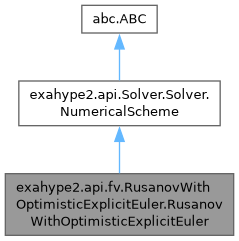
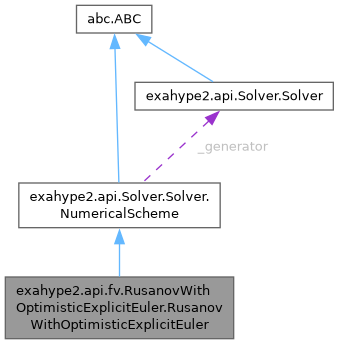
Finite Volumes with a Rusanov Riemann solver and optimistic explicit Euler time stepping, realised over a block-structured mesh. More...
Public Member Functions | |
| __init__ (self, Solver solver, int patch_size, int overlap=1, float cfl_constant=0.9, float damp_time_step_size=0.95, bool spawn_optimistic_calculations_as_task=True, float min_volume_size=None, float max_volume_size=None) | |
| The constructor memorises the attributes. | |
| str | kernel_function_name (self) |
| Name of the generated time step kernel. | |
| str | max_eigenvalue_kernel_function_name (self) |
| Name of the generated kernel which determines the maximum eigenvalue over the whole patch. | |
| Solver.MeshAdaptation | create_default_mesh_adaptation (self) |
| The Finite Volume schemes adapt the mesh and balance the load through exahype2.api.fv.AdaptMeshAndBalanceLoad by default. | |
| construct_output (self, exahype2_project, peano_project, time_step, add_global_tasks=True) | |
| Has to be implemented by subclass. | |
| Public Member Functions inherited from exahype2.api.Solver.Solver.NumericalScheme | |
| __init__ (self, "Solver" solver) | |
| wrap_task_graph_in_load_balancing_and_amr_tasks (self, time_step) | |
| Embed the time step's task graph into the global load balancing and AMR tasks. | |
Data Fields | |
| min_volume_size = min_volume_size | |
| max_volume_size = max_volume_size | |
| patch_size = patch_size | |
| Optimistic branch: insert the patch interior once the shell is updated. | |
| halo_size = overlap | |
| overlap = overlap | |
| Optimistic branch: insert the patch interior once the shell is updated. | |
| kernel_namespace = None | |
| max_eigenvalue_kernel_call = None | |
| cfl_constant = cfl_constant | |
| Both branches: derive the next time step size from the reduced eigenvalue. | |
| damp_time_step_size = damp_time_step_size | |
| Both branches: spawn the next time step's patch interior update. | |
| spawn_optimistic_calculations_as_task = spawn_optimistic_calculations_as_task | |
Private Member Functions | |
| __create_data_structures (self) | |
| Create the mesh data structures (a Finite Volume patch per cell, plus the face-based overlap patches used to reconstruct its halo) this numerical scheme requires. | |
| __add_data_to_repository (self, peano_project) | |
| Consult page_exahype_programmers_guide_new_solver for some information how this routine fits to the typical workflow when we introduce a new solver. | |
| __create_time_step_functions (self, output_directory) | |
| Calling this function is delayed until all PDE term information is provided. | |
| __construct_kernel_call (self, Target target, bool stateless, str function_name=None) | |
| This function constructs the calls to the compute kernels based on the application PDE terms and the version chosen. | |
Additional Inherited Members | |
| Static Public Attributes inherited from exahype2.api.Solver.Solver.NumericalScheme | |
| str | DYNAMIC_MESH_REFINEMENT_TASK_NAME = "Dynamic mesh refinement and load balancing" |
| Name of the last task of each time step without the solver's name as prefix, i.e. | |
| Protected Attributes inherited from exahype2.api.Solver.Solver.NumericalScheme | |
| _solver = solver | |
| Solver.NumericalScheme.NumericalSchemeGenerator | _generator = None |
Finite Volumes with a Rusanov Riemann solver and optimistic explicit Euler time stepping, realised over a block-structured mesh.
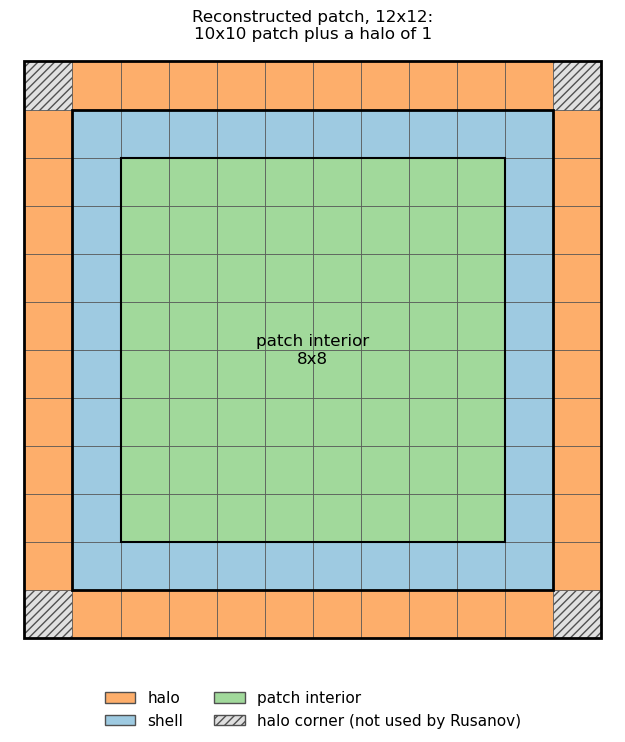
The finite volume solver operates over a block-structured mesh, where each cell of the mesh holds a patch of finite volumes. This solver's fundamental idea is that it splits up the patch into three classes of volumes. Assume we have a NxNxN patch of volumes, where N is the patch_size, and this patch is surrounded by a halo of size H. So we have in total a (N+2H)x(N+2H)x(N+2H) patch that feeds into the time stepping as reconstructed patch. We now distinguish three classes of volumes:
The sketch below shows the three classes for a 2d patch with N=10 and H=1. It is generated by src/exahype2/api/fv/rusanov-with-optimistic-explicit-euler-illustrations.py.
For the new solver, we now define two new update kernels:
The 3D variants follow equivalently.
Every time step either runs the traditional branch (Update cell and Discard patch interior) or the optimistic branch (Update cell shell and Insert patch interior). The traditional branch runs if the solver's time step size is zero, or if the estimated time step size, i.e. the second entry of the eigenvalue data, exceeds it. The optimistic branch runs otherwise. Project on faces, Compute global CFL condition and Spawn patch interior update follow either branch. If at least one axis of the domain is not periodic and the solver uses Dirichlet boundary conditions, Apply Dirichlet BCs sets the ghost volumes along the domain boundary before Reconstruct reads them (
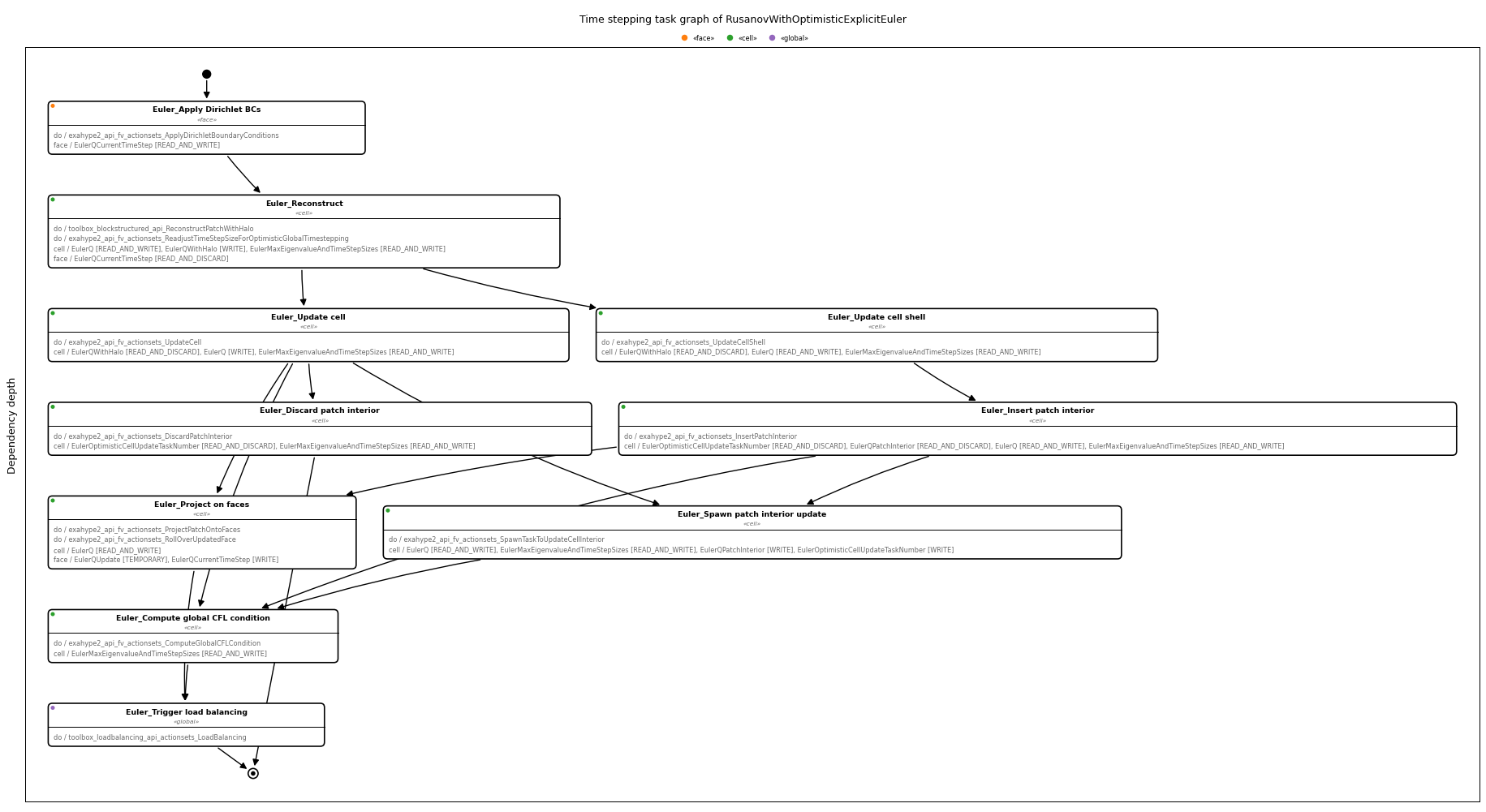
The estimate is the admissible time step size of the current time step, i.e. the one the solver could have chosen if it had not been enforced to use a smaller one, times damp_time_step_size. Reconstruct memorises the admissible time step size per cell (
Compute global CFL condition does not only compute the next time step size, it also makes it the solver's time step size and time stamp straightaway (
If spawn_optimistic_calculations_as_task is set, the spawn runs the patch interior update as a task. Insert patch interior waits for this task before it copies the patch interior into the patch, and Discard patch interior waits for it, too, so no task is still running when the next one is spawned. The task numbers are held per cell.
Definition at line 693 of file RusanovWithOptimisticExplicitEuler.py.
| exahype2.api.fv.RusanovWithOptimisticExplicitEuler.RusanovWithOptimisticExplicitEuler.__init__ | ( | self, | |
| Solver | solver, | ||
| int | patch_size, | ||
| int | overlap = 1, | ||
| float | cfl_constant = 0.9, | ||
| float | damp_time_step_size = 0.95, | ||
| bool | spawn_optimistic_calculations_as_task = True, | ||
| float | min_volume_size = None, | ||
| float | max_volume_size = None ) |
The constructor memorises the attributes.
However, it does not do this within this class, but it adds the important properties straight to the solver, so anybody else working against this solver knows about the properties introduced by the numerical scheme.
patch_size: int Number of Finite Volumes per axis within one patch (i.e. within one mesh cell).
overlap: int Number of Finite Volumes the halo layer reconstructed around a patch - from the neighbouring patches' faces - is wide.
cfl_constant: float Safety factor the admissible time step size (
damp_time_step_size: float Factor, smaller or equal to one, which the current time step size is multiplied with to estimate the time step size of the patch interior update (
spawn_optimistic_calculations_as_task: bool If True, Spawn patch interior update spawns the patch interior update as a task, and Insert patch interior and Discard patch interior wait for this task. The task number is held per cell (
min_volume_size: float The time step asks for a refinement of a cell only if its volumes are at least of this size (exahype2.api.blockstructured.DynamicMeshRefinement). None (the default) does not bound the refinement.
max_volume_size: float The time step asks for an erase, i.e. coarsening, of a cell only if the volumes of the coarser cell would be strictly smaller than this size. None (the default) does not bound the coarsening.
Definition at line 789 of file RusanovWithOptimisticExplicitEuler.py.
References __init__().
Referenced by __init__().
|
private |
Consult page_exahype_programmers_guide_new_solver for some information how this routine fits to the typical workflow when we introduce a new solver.
Definition at line 1031 of file RusanovWithOptimisticExplicitEuler.py.
References exagrype.api.FD4WithKODissipation.FD4WithKODissipation._solver, exahype2.api.blockstructured.AdaptMeshAndBalanceLoad.AdaptMeshAndBalanceLoad._solver, exahype2.api.blockstructured.ConsumeRefinementRequests.ConsumeRefinementRequests._solver, exahype2.api.blockstructured.DynamicMeshRefinement.DynamicMeshRefinement._solver, exahype2.api.blockstructured.LoadCheckpoint._LoadPatchesFromCheckpoint._solver, exahype2.api.blockstructured.LoadCheckpoint.LoadCheckpoint._solver, exahype2.api.fv.actionsets.AbstractFVActionSet.AbstractFVActionSet._solver, exahype2.api.fv.actionsets.ApplyDirichletBoundaryConditions.ApplyDirichletBoundaryConditions._solver, exahype2.api.fv.actionsets.DiscardPatchInterior.DiscardPatchInterior._solver, exahype2.api.fv.AdaptMeshAndBalanceLoad.AdaptMeshAndBalanceLoad._solver, exahype2.api.fv.PlotAsVTKFile.PlotAsVTKFile._solver, exahype2.api.fv.RusanovWithExplicitEuler.RusanovWithExplicitEuler._solver, exahype2.api.fv.RusanovWithExplicitEuler.RusanovWithExplicitEulerGenerator._solver, and _solver.
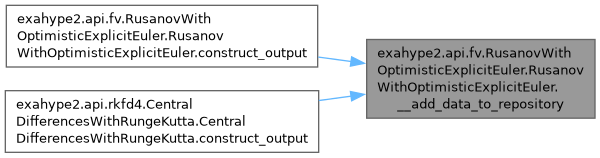
Referenced by construct_output(), and exahype2.api.rkfd4.CentralDifferencesWithRungeKutta.CentralDifferencesWithRungeKutta.construct_output().
|
private |
This function constructs the calls to the compute kernels based on the application PDE terms and the version chosen.
| function_name | str Name of the kernel to call. Defaults to kernel_function_name, i.e. the kernel updating the whole patch. |
Definition at line 1525 of file RusanovWithOptimisticExplicitEuler.py.
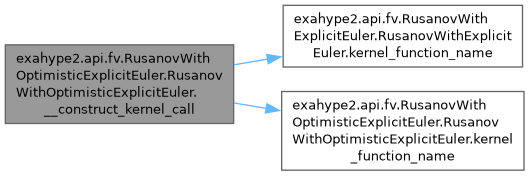
References exagrype.api.FD4WithKODissipation.FD4WithKODissipation._solver, exahype2.api.blockstructured.AdaptMeshAndBalanceLoad.AdaptMeshAndBalanceLoad._solver, exahype2.api.blockstructured.ConsumeRefinementRequests.ConsumeRefinementRequests._solver, exahype2.api.blockstructured.DynamicMeshRefinement.DynamicMeshRefinement._solver, exahype2.api.blockstructured.LoadCheckpoint._LoadPatchesFromCheckpoint._solver, exahype2.api.blockstructured.LoadCheckpoint.LoadCheckpoint._solver, exahype2.api.fv.actionsets.AbstractFVActionSet.AbstractFVActionSet._solver, exahype2.api.fv.actionsets.ApplyDirichletBoundaryConditions.ApplyDirichletBoundaryConditions._solver, exahype2.api.fv.actionsets.DiscardPatchInterior.DiscardPatchInterior._solver, exahype2.api.fv.AdaptMeshAndBalanceLoad.AdaptMeshAndBalanceLoad._solver, exahype2.api.fv.PlotAsVTKFile.PlotAsVTKFile._solver, exahype2.api.fv.RusanovWithExplicitEuler.RusanovWithExplicitEuler._solver, exahype2.api.fv.RusanovWithExplicitEuler.RusanovWithExplicitEulerGenerator._solver, _solver, exahype2.api.fv.RusanovWithExplicitEuler.RusanovWithExplicitEuler.kernel_function_name(), and kernel_function_name().
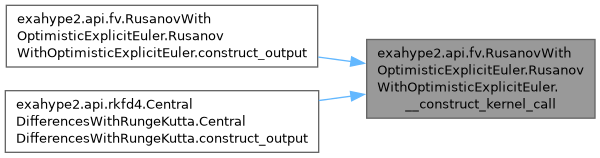
Referenced by construct_output(), and exahype2.api.rkfd4.CentralDifferencesWithRungeKutta.CentralDifferencesWithRungeKutta.construct_output().
|
private |
Create the mesh data structures (a Finite Volume patch per cell, plus the face-based overlap patches used to reconstruct its halo) this numerical scheme requires.
Ported from the legacy exahype2.solvers.fv.FV.create_data_structures(): one peano4.api.datamodel.Patch of patch_size^d Finite Volumes per mesh cell (_patch), plus a halo-augmented copy of it (_patch_with_halo, (patch_size+2*overlap)^d,
All six are assigned onto self._solver (the shared exahype2.api.Solver instance both this numerical scheme and its surrounding solver's Solver.GridConstruction/Solver.Plotter counterparts hold a reference to as self._solver), not onto self, since the remaining FV action sets that need them -
Storage is hardwired to smart pointers (peano4.api.datamodel's PatchToDoubleArrayWithSmartPointer), matching the legacy default (Storage.SmartPointers for both cell and face data) - the legacy Storage enum's other two backends (CallStack, Heap) are not exposed here.
Two pieces of the legacy method are deliberately not ported yet:
Definition at line 882 of file RusanovWithOptimisticExplicitEuler.py.
References exagrype.api.FD4WithKODissipation.FD4WithKODissipation._solver, exahype2.api.blockstructured.AdaptMeshAndBalanceLoad.AdaptMeshAndBalanceLoad._solver, exahype2.api.blockstructured.ConsumeRefinementRequests.ConsumeRefinementRequests._solver, exahype2.api.blockstructured.DynamicMeshRefinement.DynamicMeshRefinement._solver, exahype2.api.blockstructured.LoadCheckpoint._LoadPatchesFromCheckpoint._solver, exahype2.api.blockstructured.LoadCheckpoint.LoadCheckpoint._solver, exahype2.api.fv.actionsets.AbstractFVActionSet.AbstractFVActionSet._solver, exahype2.api.fv.actionsets.ApplyDirichletBoundaryConditions.ApplyDirichletBoundaryConditions._solver, exahype2.api.fv.actionsets.DiscardPatchInterior.DiscardPatchInterior._solver, exahype2.api.fv.AdaptMeshAndBalanceLoad.AdaptMeshAndBalanceLoad._solver, exahype2.api.fv.PlotAsVTKFile.PlotAsVTKFile._solver, exahype2.api.fv.RusanovWithExplicitEuler.RusanovWithExplicitEuler._solver, exahype2.api.fv.RusanovWithExplicitEuler.RusanovWithExplicitEulerGenerator._solver, _solver, exahype2.api.fv.actionsets.InsertPatchInterior.InsertPatchInterior.overlap, exahype2.api.fv.RusanovWithExplicitEuler.RusanovWithExplicitEuler.overlap, overlap, exagrype.api.scalarfield.FiniteVolumesInnerCoupling._FiniteVolumes.patch_size, exagrype.api.scalarfield.InnerCouplingGenerator.InnerCouplingGenerator.patch_size, exagrype.api.scalarfield.RungeKuttaFD4InnerCoupling._RungeKuttaFD4.patch_size, exahype2.api.blockstructured.DynamicMeshRefinement.DynamicMeshRefinement.patch_size, exahype2.api.fv.actionsets.ComputeGlobalCFLCondition.ComputeGlobalCFLCondition.patch_size, exahype2.api.fv.actionsets.InsertPatchInterior.InsertPatchInterior.patch_size, exahype2.api.fv.RusanovWithExplicitEuler.RusanovWithExplicitEuler.patch_size, and patch_size.
|
private |
Calling this function is delayed until all PDE term information is provided.
In this way we can avoid generating code that will not be used. The following information is required to translate a Python function using DSLHyPE:
TODO: Currently the MLIR types are passed manually here, this should ideally be inferred
Definition at line 1394 of file RusanovWithOptimisticExplicitEuler.py.
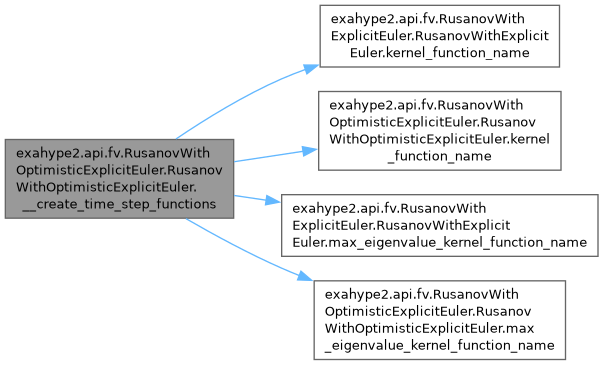
References exagrype.api.FD4WithKODissipation.FD4WithKODissipation._solver, exahype2.api.blockstructured.AdaptMeshAndBalanceLoad.AdaptMeshAndBalanceLoad._solver, exahype2.api.blockstructured.ConsumeRefinementRequests.ConsumeRefinementRequests._solver, exahype2.api.blockstructured.DynamicMeshRefinement.DynamicMeshRefinement._solver, exahype2.api.blockstructured.LoadCheckpoint._LoadPatchesFromCheckpoint._solver, exahype2.api.blockstructured.LoadCheckpoint.LoadCheckpoint._solver, exahype2.api.fv.actionsets.AbstractFVActionSet.AbstractFVActionSet._solver, exahype2.api.fv.actionsets.ApplyDirichletBoundaryConditions.ApplyDirichletBoundaryConditions._solver, exahype2.api.fv.actionsets.DiscardPatchInterior.DiscardPatchInterior._solver, exahype2.api.fv.AdaptMeshAndBalanceLoad.AdaptMeshAndBalanceLoad._solver, exahype2.api.fv.PlotAsVTKFile.PlotAsVTKFile._solver, exahype2.api.fv.RusanovWithExplicitEuler.RusanovWithExplicitEuler._solver, exahype2.api.fv.RusanovWithExplicitEuler.RusanovWithExplicitEulerGenerator._solver, _solver, exahype2.api.fv.RusanovWithExplicitEuler.RusanovWithExplicitEuler.kernel_function_name(), kernel_function_name(), exahype2.api.fv.RusanovWithExplicitEuler.RusanovWithExplicitEuler.kernel_namespace, kernel_namespace, exahype2.api.fv.RusanovWithExplicitEuler.RusanovWithExplicitEuler.max_eigenvalue_kernel_function_name(), and max_eigenvalue_kernel_function_name().
Referenced by construct_output().

| exahype2.api.fv.RusanovWithOptimisticExplicitEuler.RusanovWithOptimisticExplicitEuler.construct_output | ( | self, | |
| exahype2_project, | |||
| peano_project, | |||
| time_step, | |||
| add_global_tasks = True ) |
Has to be implemented by subclass.
time_step: peano4.api.taskgraph.Graph The task graph of the surrounding exahype2_project's time stepping phase, so the numerical scheme can add its own tasks into it.
| add_global_tasks | bool Whether the scheme adds the tasks that belong to the mesh as a whole rather than to the solver: it switches the load balancing off at the begin of the time step, and its last task evaluates the adaptivity criterion and switches the load balancing on again. If set, the scheme adds these tasks by calling wrap_task_graph_in_load_balancing_and_amr_tasks() as its very last step. A host that couples several solvers passes False, as it wraps the concatenated graph itself. |
Reimplemented from exahype2.api.Solver.Solver.NumericalScheme.
Definition at line 1114 of file RusanovWithOptimisticExplicitEuler.py.
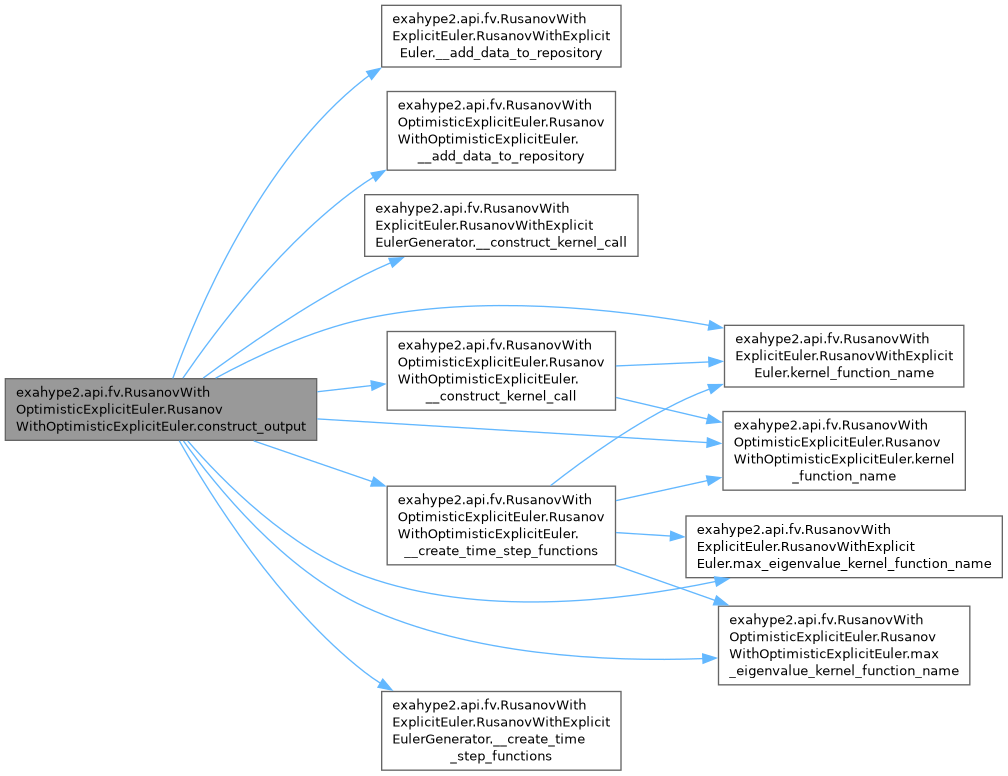
References exahype2.api.fv.RusanovWithExplicitEuler.RusanovWithExplicitEuler.__add_data_to_repository(), __add_data_to_repository(), exahype2.api.fv.RusanovWithExplicitEuler.RusanovWithExplicitEulerGenerator.__construct_kernel_call(), __construct_kernel_call(), exahype2.api.fv.RusanovWithExplicitEuler.RusanovWithExplicitEulerGenerator.__create_time_step_functions(), __create_time_step_functions(), exagrype.api.FD4WithKODissipation.FD4WithKODissipation._solver, exahype2.api.blockstructured.AdaptMeshAndBalanceLoad.AdaptMeshAndBalanceLoad._solver, exahype2.api.blockstructured.ConsumeRefinementRequests.ConsumeRefinementRequests._solver, exahype2.api.blockstructured.DynamicMeshRefinement.DynamicMeshRefinement._solver, exahype2.api.blockstructured.LoadCheckpoint._LoadPatchesFromCheckpoint._solver, exahype2.api.blockstructured.LoadCheckpoint.LoadCheckpoint._solver, exahype2.api.fv.actionsets.AbstractFVActionSet.AbstractFVActionSet._solver, exahype2.api.fv.actionsets.ApplyDirichletBoundaryConditions.ApplyDirichletBoundaryConditions._solver, exahype2.api.fv.actionsets.DiscardPatchInterior.DiscardPatchInterior._solver, exahype2.api.fv.AdaptMeshAndBalanceLoad.AdaptMeshAndBalanceLoad._solver, exahype2.api.fv.PlotAsVTKFile.PlotAsVTKFile._solver, exahype2.api.fv.RusanovWithExplicitEuler.RusanovWithExplicitEuler._solver, exahype2.api.fv.RusanovWithExplicitEuler.RusanovWithExplicitEulerGenerator._solver, _solver, exahype2.api.fv.actionsets.ComputeGlobalCFLCondition.ComputeGlobalCFLCondition.cfl_constant, exahype2.api.fv.RusanovWithExplicitEuler.RusanovWithExplicitEuler.cfl_constant, cfl_constant, exahype2.api.fv.actionsets.SpawnTaskToUpdateCellInterior.SpawnTaskToUpdateCellInterior.damp_time_step_size, damp_time_step_size, exahype2.api.fv.RusanovWithExplicitEuler.RusanovWithExplicitEuler.kernel_function_name(), kernel_function_name(), exahype2.api.fv.RusanovWithExplicitEuler.RusanovWithExplicitEuler.kernel_namespace, kernel_namespace, exahype2.api.fv.RusanovWithExplicitEuler.RusanovWithExplicitEuler.max_eigenvalue_kernel_call, max_eigenvalue_kernel_call, exahype2.api.fv.RusanovWithExplicitEuler.RusanovWithExplicitEuler.max_eigenvalue_kernel_function_name(), max_eigenvalue_kernel_function_name(), exahype2.api.fv.actionsets.InsertPatchInterior.InsertPatchInterior.overlap, exahype2.api.fv.RusanovWithExplicitEuler.RusanovWithExplicitEuler.overlap, overlap, exagrype.api.scalarfield.FiniteVolumesInnerCoupling._FiniteVolumes.patch_size, exagrype.api.scalarfield.InnerCouplingGenerator.InnerCouplingGenerator.patch_size, exagrype.api.scalarfield.RungeKuttaFD4InnerCoupling._RungeKuttaFD4.patch_size, exahype2.api.blockstructured.DynamicMeshRefinement.DynamicMeshRefinement.patch_size, exahype2.api.fv.actionsets.ComputeGlobalCFLCondition.ComputeGlobalCFLCondition.patch_size, exahype2.api.fv.actionsets.InsertPatchInterior.InsertPatchInterior.patch_size, exahype2.api.fv.RusanovWithExplicitEuler.RusanovWithExplicitEuler.patch_size, and patch_size.
| Solver.MeshAdaptation exahype2.api.fv.RusanovWithOptimisticExplicitEuler.RusanovWithOptimisticExplicitEuler.create_default_mesh_adaptation | ( | self | ) |
The Finite Volume schemes adapt the mesh and balance the load through exahype2.api.fv.AdaptMeshAndBalanceLoad by default.
Reimplemented from exahype2.api.Solver.Solver.NumericalScheme.
Definition at line 1103 of file RusanovWithOptimisticExplicitEuler.py.
References exagrype.api.FD4WithKODissipation.FD4WithKODissipation._solver, exahype2.api.blockstructured.AdaptMeshAndBalanceLoad.AdaptMeshAndBalanceLoad._solver, exahype2.api.blockstructured.ConsumeRefinementRequests.ConsumeRefinementRequests._solver, exahype2.api.blockstructured.DynamicMeshRefinement.DynamicMeshRefinement._solver, exahype2.api.blockstructured.LoadCheckpoint._LoadPatchesFromCheckpoint._solver, exahype2.api.blockstructured.LoadCheckpoint.LoadCheckpoint._solver, exahype2.api.fv.actionsets.AbstractFVActionSet.AbstractFVActionSet._solver, exahype2.api.fv.actionsets.ApplyDirichletBoundaryConditions.ApplyDirichletBoundaryConditions._solver, exahype2.api.fv.actionsets.DiscardPatchInterior.DiscardPatchInterior._solver, exahype2.api.fv.AdaptMeshAndBalanceLoad.AdaptMeshAndBalanceLoad._solver, exahype2.api.fv.PlotAsVTKFile.PlotAsVTKFile._solver, exahype2.api.fv.RusanovWithExplicitEuler.RusanovWithExplicitEuler._solver, exahype2.api.fv.RusanovWithExplicitEuler.RusanovWithExplicitEulerGenerator._solver, and _solver.
| str exahype2.api.fv.RusanovWithOptimisticExplicitEuler.RusanovWithOptimisticExplicitEuler.kernel_function_name | ( | self | ) |
Name of the generated time step kernel.
It carries the solver name, as do the kernels/<SolverName>_rusanov*.h files holding it, so two solvers' kernels do not clash.
Definition at line 865 of file RusanovWithOptimisticExplicitEuler.py.
References exagrype.api.FD4WithKODissipation.FD4WithKODissipation._solver, exahype2.api.blockstructured.AdaptMeshAndBalanceLoad.AdaptMeshAndBalanceLoad._solver, exahype2.api.blockstructured.ConsumeRefinementRequests.ConsumeRefinementRequests._solver, exahype2.api.blockstructured.DynamicMeshRefinement.DynamicMeshRefinement._solver, exahype2.api.blockstructured.LoadCheckpoint._LoadPatchesFromCheckpoint._solver, exahype2.api.blockstructured.LoadCheckpoint.LoadCheckpoint._solver, exahype2.api.fv.actionsets.AbstractFVActionSet.AbstractFVActionSet._solver, exahype2.api.fv.actionsets.ApplyDirichletBoundaryConditions.ApplyDirichletBoundaryConditions._solver, exahype2.api.fv.actionsets.DiscardPatchInterior.DiscardPatchInterior._solver, exahype2.api.fv.AdaptMeshAndBalanceLoad.AdaptMeshAndBalanceLoad._solver, exahype2.api.fv.PlotAsVTKFile.PlotAsVTKFile._solver, exahype2.api.fv.RusanovWithExplicitEuler.RusanovWithExplicitEuler._solver, exahype2.api.fv.RusanovWithExplicitEuler.RusanovWithExplicitEulerGenerator._solver, and _solver.
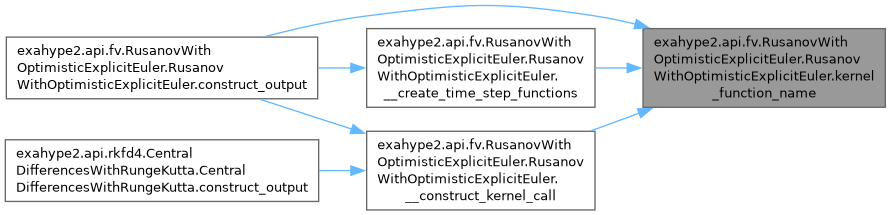
Referenced by __construct_kernel_call(), __create_time_step_functions(), and construct_output().
| str exahype2.api.fv.RusanovWithOptimisticExplicitEuler.RusanovWithOptimisticExplicitEuler.max_eigenvalue_kernel_function_name | ( | self | ) |
Name of the generated kernel which determines the maximum eigenvalue over the whole patch.
It is a kernel of its own, i.e. none of the time step kernels returns an eigenvalue (exahype2.api.fv.actionsets.ComputeMaxEigenvalue).
Definition at line 874 of file RusanovWithOptimisticExplicitEuler.py.
References exagrype.api.FD4WithKODissipation.FD4WithKODissipation._solver, exahype2.api.blockstructured.AdaptMeshAndBalanceLoad.AdaptMeshAndBalanceLoad._solver, exahype2.api.blockstructured.ConsumeRefinementRequests.ConsumeRefinementRequests._solver, exahype2.api.blockstructured.DynamicMeshRefinement.DynamicMeshRefinement._solver, exahype2.api.blockstructured.LoadCheckpoint._LoadPatchesFromCheckpoint._solver, exahype2.api.blockstructured.LoadCheckpoint.LoadCheckpoint._solver, exahype2.api.fv.actionsets.AbstractFVActionSet.AbstractFVActionSet._solver, exahype2.api.fv.actionsets.ApplyDirichletBoundaryConditions.ApplyDirichletBoundaryConditions._solver, exahype2.api.fv.actionsets.DiscardPatchInterior.DiscardPatchInterior._solver, exahype2.api.fv.AdaptMeshAndBalanceLoad.AdaptMeshAndBalanceLoad._solver, exahype2.api.fv.PlotAsVTKFile.PlotAsVTKFile._solver, exahype2.api.fv.RusanovWithExplicitEuler.RusanovWithExplicitEuler._solver, exahype2.api.fv.RusanovWithExplicitEuler.RusanovWithExplicitEulerGenerator._solver, and _solver.
Referenced by __create_time_step_functions(), and construct_output().

| exahype2.api.fv.RusanovWithOptimisticExplicitEuler.RusanovWithOptimisticExplicitEuler.cfl_constant = cfl_constant |
Both branches: derive the next time step size from the reduced eigenvalue.
This acts in unprepareTraversal() at the end of the time step only. The spawn has to see the solver's time stamp and time step size before the CFL condition advances them
The roll over of Sommerfeld boundary conditions is part of the projection and reads the current time step size, which the next task replaces. It therefore never runs before the roll over has terminated (see src/exahype2/api/fv/adrs/0002-time-step-size-after-roll-over.md)
Definition at line 859 of file RusanovWithOptimisticExplicitEuler.py.
Referenced by construct_output(), and exahype2.api.rkfd4.actionsets.ComputeTimeStepSize.ComputeTimeStepSize.is_adaptive().
| exahype2.api.fv.RusanovWithOptimisticExplicitEuler.RusanovWithOptimisticExplicitEuler.damp_time_step_size = damp_time_step_size |
Both branches: spawn the next time step's patch interior update.
Reads the patch and writes the patch interior plus the estimated time step size
Definition at line 860 of file RusanovWithOptimisticExplicitEuler.py.
Referenced by construct_output().
| exahype2.api.fv.RusanovWithOptimisticExplicitEuler.RusanovWithOptimisticExplicitEuler.halo_size = overlap |
Definition at line 853 of file RusanovWithOptimisticExplicitEuler.py.
| exahype2.api.fv.RusanovWithOptimisticExplicitEuler.RusanovWithOptimisticExplicitEuler.kernel_namespace = None |
Definition at line 857 of file RusanovWithOptimisticExplicitEuler.py.
Referenced by exahype2.api.rkfd4.CentralDifferencesWithRungeKutta.CentralDifferencesWithRungeKutta.__create_kernels(), __create_time_step_functions(), construct_output(), and exahype2.api.rkfd4.CentralDifferencesWithRungeKutta.CentralDifferencesWithRungeKutta.construct_output().
| exahype2.api.fv.RusanovWithOptimisticExplicitEuler.RusanovWithOptimisticExplicitEuler.max_eigenvalue_kernel_call = None |
Definition at line 858 of file RusanovWithOptimisticExplicitEuler.py.
Referenced by construct_output(), and exahype2.api.rkfd4.CentralDifferencesWithRungeKutta.CentralDifferencesWithRungeKutta.construct_output().
| exahype2.api.fv.RusanovWithOptimisticExplicitEuler.RusanovWithOptimisticExplicitEuler.max_volume_size = max_volume_size |
Definition at line 851 of file RusanovWithOptimisticExplicitEuler.py.
| exahype2.api.fv.RusanovWithOptimisticExplicitEuler.RusanovWithOptimisticExplicitEuler.min_volume_size = min_volume_size |
Definition at line 850 of file RusanovWithOptimisticExplicitEuler.py.
| exahype2.api.fv.RusanovWithOptimisticExplicitEuler.RusanovWithOptimisticExplicitEuler.overlap = overlap |
Optimistic branch: insert the patch interior once the shell is updated.
Definition at line 854 of file RusanovWithOptimisticExplicitEuler.py.
Referenced by __create_data_structures(), and construct_output().
| exahype2.api.fv.RusanovWithOptimisticExplicitEuler.RusanovWithOptimisticExplicitEuler.patch_size = patch_size |
Optimistic branch: insert the patch interior once the shell is updated.
Both branches: derive the next time step size from the reduced eigenvalue.
This acts in unprepareTraversal() at the end of the time step only. The spawn has to see the solver's time stamp and time step size before the CFL condition advances them
The roll over of Sommerfeld boundary conditions is part of the projection and reads the current time step size, which the next task replaces. It therefore never runs before the roll over has terminated (see src/exahype2/api/fv/adrs/0002-time-step-size-after-roll-over.md)
Definition at line 852 of file RusanovWithOptimisticExplicitEuler.py.
Referenced by exahype2.api.rkfd4.CentralDifferencesWithRungeKutta.CentralDifferencesWithRungeKutta.__add_data_to_repository(), __create_data_structures(), exahype2.api.rkfd4.CentralDifferencesWithRungeKutta.CentralDifferencesWithRungeKutta.__create_data_structures(), and construct_output().
| exahype2.api.fv.RusanovWithOptimisticExplicitEuler.RusanovWithOptimisticExplicitEuler.spawn_optimistic_calculations_as_task = spawn_optimistic_calculations_as_task |
Definition at line 861 of file RusanovWithOptimisticExplicitEuler.py.
 1.15.0