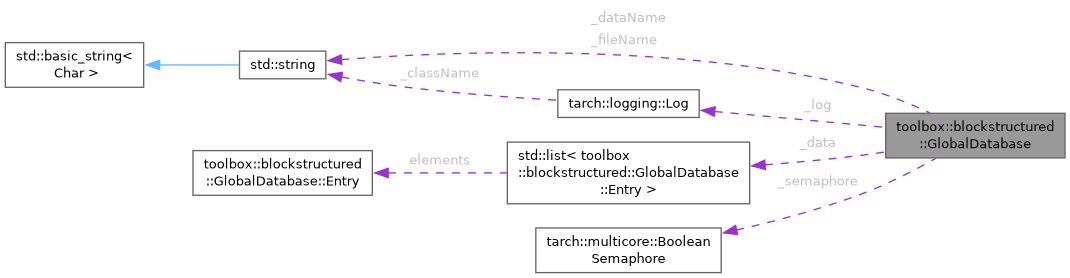
A simple global database.
The database can be configured with various thresholds such that we write out snapshots whenever a certain maximum size is reached.
The database is thread-safe. It was built after the model of the particle Database.
Definition at line 29 of file GlobalDatabase.h.
| toolbox::blockstructured::GlobalDatabase::GlobalDatabase |
( |
int | growthBetweenTwoDatabaseFlushes = 0, |
|
|
double | dataDelta = 1e-8, |
|
|
double | timeDelta = 0.0, |
|
|
bool | clearDatabaseAfterFlush = true, |
|
|
bool | deltasAreRelative = false ) |
Global database.
The database dumps/stores data if the data is either for a new timestamp which is a sufficient delta after the latest one. If the new data has the same timestamp as a previous one, it will replace it if the data is different by a sufficiently large margin. We always work with the max norm.
Flushing the database
Please read the documentation of clearDatabaseAfterFlush and growthBetweenTwoDatabaseFlushes below first.
- Parameters
-
| clearDatabaseAfterFlush | If this flag is set, each flush of the database will go into a separate file, and the code will clear the database after the flush. As a consequence, the database will never exceed the memory. However, you'll get a lot of files that you have to merge afterwards. |
| growthBetweenTwoDatabaseFlushes | Number of entries that we dump into the database before it is flushed the next time. Set it to max of an integer or zero to disable on-the-fly dumps. In this case, the database is only flushed when the simulation terminates. So, the thresholds for the data and position deltas determine how often entries and up in the database, and growthBetweenTwoDatabaseFlushes determines how often this database is written into a file. |
| dataDelta | If two pieces of data are defined for the same timestamp, this parameter is used to determine whether this is re-defining the data or whether it is just a duplicate. If the former is true, the existing data will be replaced with the new definition. In the later case, the data is not added to the database and is simply discarded. toolbox::blockstructured::GlobalDatabase::getAction() for a description how the C++ code interprets this threshold, but it is usually the max norm that is used here. |
This flag has no impact whatsoever how often the data is dumped into a file. The frequency of datafile writes is solely controlled via growthBetweenTwoDatabaseFlushes.
- Parameters
-
| timeDelta | this parameter ask the code to dump particle into database after certain time interval of time_delta_between_two_snapsots, even data and position do not change during this time interval. You can set the two parameter above to be extremely big to enforce code dump particle with (roughly) regular time interval. |
This flag has no impact whatsoever how often the data is dumped into a file. The frequency of datafile writes is solely controlled via growthBetweenTwoDatabaseFlushes.
- Parameters
-
| deltasAreRelative | By default (flag is false), we take the absolute deltas of the data to decide whether to replace data with duplicates or simply assume these to be identical. If this flag is set however, we track the maximum of the deltas, and we dump data if and only if it exceeds dataDelta times this maximum. So we use a relative quantity. This might make sense if one value in your database hovers around a size of 10^-3 and another is in the range of 10^10, in which case using the same absolute delta for both is not the ideal choice. |
References clearDatabaseAfterFlush().
Referenced by toolbox::blockstructured::GlobalDatabase::Entry::Entry().
| void toolbox::blockstructured::GlobalDatabase::addGlobalSnapshot |
( |
double | timestamp | ) |
|
Add snapshot.
The data is assumed to be global, and therefore uniquely identified by its timestamp. We can track any amount of data, such as none at all (like in this function) or an arbitrary number. Hence the overload. It is the user's responsibility to use the addGlobalSnapshot() routines in a consistent way. If you've added six pieces of data once and you try adding eight pieces in a next call, the code will do what we in the business like to call an "oopsie-woopsie", by which we mean an assertion will fail and your program will crash.
Thread-safety
The routine is thread-safe. It actually locks the database before it invokes getAction() and thus will not mess up either the database analysis or any writes.
If the database is configured to write snapshots, the routine will also invoke the dump. However, it is important that we free the lock before, as I do not use recursive locks and as the dumping itself is thread-safe.
| AddSnapshotAction toolbox::blockstructured::GlobalDatabase::getAction |
( |
double | timestamp, |
|
|
int | numberOfDataEntries, |
|
|
double * | data ) |
|
private |
Determine what to do with new entry.
First of all, invoke other getAction() routine. This one will determine if the entry is the first entry, if it's timestamp is such that it should be added to the database or discarded, and if it is at the same timestamp as the last one (in which case it might need to replace it.) In the latest case, we only replace it if the data actually differs from the existing data.
| bool toolbox::blockstructured::GlobalDatabase::_clearDatabaseAfterFlush |
|
private |
Flag that indicates if we erase the database after a flush.
If not set, each dump consists of all data ever recorded. If set, you will potentially get a huge set of data files, and you will have to concatenate them before you interpret the data.
- See also
- GlobalDatabase()
-
clearDatabaseAfterFlush()
Definition at line 56 of file GlobalDatabase.h.
| int toolbox::blockstructured::GlobalDatabase::_rank |
|
private |
This is a hack: Usually, I'd just ask the rank what its number is.
However, the database dump often is called in the very end, after the MPI rank is already down. So it will return -1. So what I do is that I store this piece of data whenever I insert a new entry.
Definition at line 67 of file GlobalDatabase.h.



 1.15.0
