 |
Peano
|
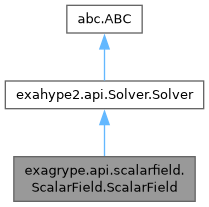
Four scalar fields which a spacetime advects. More...
Public Member Functions | |
| __init__ (self, str name, exahype2.api.AuxiliaryVariables ccz4_fields) | |
| Public Member Functions inherited from exahype2.api.Solver.Solver | |
| __init__ (self, str name, VariableSpecification unknowns) | |
| Create solver. | |
| str | __str__ (self) |
| str | name (self) |
| Unique solver name. | |
| "Solver.NumericalScheme" | numerical_scheme (self) |
| numerical_scheme (self, "Solver.NumericalScheme" value) | |
| List["Solver.Plotter"] | plotters (self) |
| All plotters of the solver, in the order they have been added. | |
| add_plotter (self, "Solver.Plotter" plotter) | |
| Add a plotter to the solver. | |
| "Solver.Plotter" | plotter (self) |
| Shorthand for solvers with at most one plotter. | |
| plotter (self, "Solver.Plotter" value) | |
| int | unknowns (self) |
| List["AuxiliaryVariables"] | auxiliary_variables (self) |
| All sets of auxiliary variables in the order they have been attached. | |
| int | number_of_auxiliary_variables (self) |
| Total number of entries of all sets of auxiliary variables. | |
| int | auxiliary_variable_offset (self, "AuxiliaryVariables" auxiliary) |
| Offset of the first entry of a set within the buffer the compute kernels work on, i.e. | |
| add_auxiliary_variables (self, "AuxiliaryVariables" auxiliary) | |
| Attach a set of auxiliary variables to the solver. | |
| str | signature_of (self, PDETerm term) |
| The signature of a PDE term including the pointers to the auxiliary variables. | |
| str | user_solver_includes (self) |
| Add further includes to this property, if your solver requires some additional routines from other header files. | |
| add_user_solver_includes (self, str value) | |
| Add further includes to this property, if your solver requires some additional routines from other header files. | |
| set_solver_constants (self, str datastring) | |
| add_solver_constants (self, str datastring) | |
| List[str] | variable_names_per_entry (self) |
| One name per entry of Q, i.e. | |
| str | get_name_of_global_instance (self) |
| List[PDETerm] | pde_terms (self) |
| All PDE terms (flux, eigenvalues, ...) registered with this solver, in registration order. | |
| bool | requires_user_class (self) |
| True iff at least one PDE term has no implementation. | |
| str | get_name_of_solver_class (self) |
| Name of the C++ class the solver repository instantiates: <SolverName> if requires_user_class, Abstract<SolverName> otherwise. | |
| add_pde_term (self, PDETerm term) | |
| Register a PDE term with this solver, or replace the one already registered under the same name and statelessness. | |
| remove_pde_term (self, str name, bool stateless=False) | |
| Remove a previously registered PDE term by name and statelessness. | |
| PDETerm | get_pde_term (self, str name, bool stateless=False) |
| Look up a previously registered PDE term by name and statelessness. | |
| add_abstract_solver_attribute (self, str declaration) | |
| Add a raw C++ member attribute declaration to the generated Abstract<SolverName> class (. | |
| add_abstract_solver_method (self, str declaration, Callable[[str], str] definition_generator) | |
| Add a raw C++ method to the generated Abstract<SolverName> class: declaration goes into the class body (public section), verbatim. | |
| str | create_readme_descriptor (self, domain_offset, domain_size) |
| Return a human-readable description of this solver instance, to be embedded into the generated project's README. | |
| generate_solver_realisation (self, exahype2_project, peano_project, setup_simulation, time_step, plot, mesh_adaptation, add_global_tasks=True) | |
| Turn this solver specification into a task graph and create the required C++ kernels/stubs. | |
Static Public Attributes | |
| dict | Unknowns = {"phi": 4} |
| Static Public Attributes inherited from exahype2.api.Solver.Solver | |
| str | SolutionUpdateTaskTag = "exahype2.api.Solver.SolutionUpdateTaskTag" |
| Tag of all tasks which write a new solution. | |
| str | IntermediateSolutionUpdateTag = "exahype2.api.Solver.IntermediateSolutionUpdateTag" |
| Tag of all tasks which write an intermediate solution. | |
Additional Inherited Members | |
| Data Fields inherited from exahype2.api.Solver.Solver | |
| solver_generator = SolverToCPPFiles(self) | |
| grid_construction = None | |
| tuple | mesh_adaptation = None |
| Turn this solver specification into a task graph and create the required C++ kernels/stubs. | |
| tuple | grid_selector |
| str | compute_kernel_call = None |
| pde_terms | |
| True iff at least one PDE term has no implementation. | |
| Protected Member Functions inherited from exahype2.api.Solver.Solver | |
| int | _register_variables (self, VariableSpecification variables, int offset) |
| Translate a plain int or a name-to-multiplicity dict into a total variable count, and - for the dict case - add each name's position within Q to _variable_positions. | |
| str | _get_default_includes (self) |
| Includes every generated action set can rely on being available, regardless of which action sets a concrete discretisation (e.g. | |
| str | _unknown_identifier (self) |
| _add_wants_to_plot_to_solver (self) | |
| Add wantsToPlot() to the solver's C++ class: It holds if any of the solver's plotters is active (exahype2.api.Solver.Solver.Plotter). | |
| _add_checkpoint_meta_data_to_solver (self) | |
| Override exahype2.Solver.toCheckpointMetaData() in the solver's C++ class such that it also writes the attributes added through add_abstract_solver_attribute(), e.g. | |
| Protected Attributes inherited from exahype2.api.Solver.Solver | |
| str | _name = name |
| Create solver. | |
| dict | _variable_positions = {} |
| Translate a plain int or a name-to-multiplicity dict into a total variable count, and - for the dict case - add each name's position within Q to _variable_positions. | |
| int | _unknowns = self._register_variables(unknowns, 0) |
| list | _auxiliary_variables = [] |
| All sets of auxiliary variables in the order they have been attached. | |
| str | _user_solver_includes = "" |
| str | _solver_constants = "" |
| dict | _pde_terms = {} |
| list | _abstract_solver_attributes = [] |
| list | _abstract_solver_methods = [] |
| _numerical_scheme = None | |
| list | _plotters = [] |
| Turn this solver specification into a task graph and create the required C++ kernels/stubs. | |
Four scalar fields which a spacetime advects.
The solver has four unknowns phi_0, ..., phi_3. They obey the advection equation
\( \\partial_t \\phi + v \\partial_x \\phi = 0, \\qquad v = \\alpha^2, \)
along the x-axis, where \( \\alpha \) is the lapse of first-order CCZ4. The lapse enters through a set of auxiliary variables, which holds the 58 entries of CCZ4 (exagrype.api.FOCCZ4Solver). A coupling creates the set, fills it, and hands it over to the constructor. The coupling is a fake coupling: the spacetime advects the field, but the field does not feed back into the spacetime. The velocity is the metric component g_xx of the gauge wave, i.e. the equation has a closed-form solution on the gauge wave (benchmarks/exagrype/gauge-wave-with-scalar-field).
The PDE terms are a non-conservative product, a maximum eigenvalue and an initial condition (four sine waves along the x-axis with phase shifts). All of them are stateless and call exagrype.scalarfield.nonconservativeProduct() and friends. The solver has no flux: the advective form is what the exact solution refers to.
The solver is deliberately plain. Its numerical scheme is assigned like for any other solver (outer coupling), or by the coupling (inner coupling).
Definition at line 10 of file ScalarField.py.
| exagrype.api.scalarfield.ScalarField.ScalarField.__init__ | ( | self, | |
| str | name, | ||
| exahype2.api.AuxiliaryVariables | ccz4_fields ) |
| name | str Name of the solver, exahype2.api.Solver. |
| ccz4_fields | exahype2.api.AuxiliaryVariables The set which holds the 58 entries of first-order CCZ4. The solver attaches it. The coupling fills it. |
Definition at line 42 of file ScalarField.py.
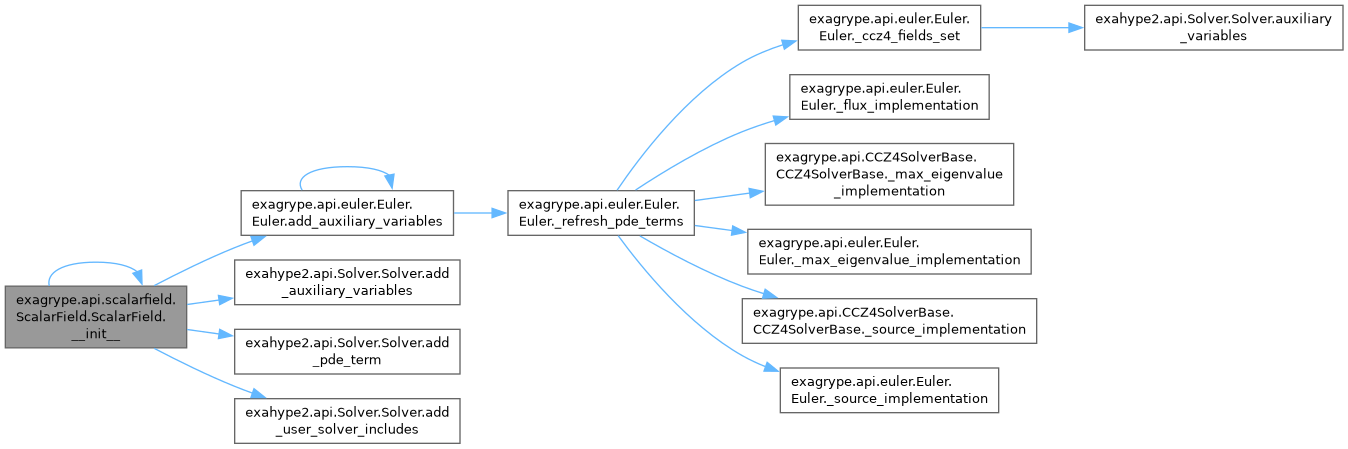
References __init__(), exagrype.api.euler.Euler.Euler.add_auxiliary_variables(), exahype2.api.Solver.Solver.add_auxiliary_variables(), exahype2.api.Solver.Solver.add_pde_term(), exahype2.api.Solver.Solver.add_user_solver_includes(), exagrype.api.euler.Euler.Euler.Unknowns, exagrype.api.FOCCZ4Solver.FOCCZ4Solver.Unknowns, exagrype.api.FOSOCCZ4Solver.FOSOCCZ4Solver.Unknowns, and Unknowns.
Referenced by __init__().
|
static |
Definition at line 39 of file ScalarField.py.
Referenced by __init__(), and exagrype.api.CCZ4SolverBase.CCZ4SolverBase.advected_quantities().
 1.15.0