 |
Peano
|
Runge-Kutta Finite Differences which insert the density floor after each stage. More...


Public Member Functions | |
| construct_output (self, exahype2_project, peano_project, time_step, add_global_tasks=True) | |
| Add the data to the Peano 4 project, generate the kernels and add the tasks of one Runge-Kutta step to time_step. | |
| Public Member Functions inherited from exahype2.api.rkfd4.CentralDifferencesWithRungeKutta.CentralDifferencesWithRungeKutta | |
| int | halo_size (self) |
| Width of the halo. | |
| __init__ (self, Solver solver, int patch_size, int rk_order, float time_step_size=None, float cfl_constant=0.5, "CentralDifferencesWithRungeKutta.RightHandSideKernel" right_hand_side_kernel=RightHandSideKernel.CentralDifferences, advection_velocity=None, advected_quantities=None, float min_volume_size=None, float max_volume_size=None, "toolbox.blockstructured.api.InterpolateHangingFaces.Scheme" interpolation=toolbox.blockstructured.api.InterpolateHangingFaces.Scheme.Linear, "toolbox.blockstructured.api.RestrictHangingFaces.Scheme" restriction=toolbox.blockstructured.api.RestrictHangingFaces.Scheme.Averaging) | |
| The constructor memorises the attributes and creates the data structures. | |
| int | overlap (self) |
| Width of the halo, i.e. | |
| int | rk_order (self) |
| bool | has_adaptive_time_step_size (self) |
| str | right_hand_side_kernel_name (self) |
| Name of the generated right-hand side kernel. | |
| str | max_eigenvalue_kernel_name (self) |
| Solver.MeshAdaptation | create_default_mesh_adaptation (self) |
| The finite differences adapt the mesh and balance the load through exahype2.api.rkfd4.AdaptMeshAndBalanceLoad by default. | |
| "toolbox.blockstructured.api.RestrictHangingFaces" | create_restriction_of_hanging_faces (self) |
| Action set which restricts the projected fine data from the hanging faces onto the coarse faces. | |
| Public Member Functions inherited from exahype2.api.Solver.Solver.NumericalScheme | |
| __init__ (self, "Solver" solver) | |
| wrap_task_graph_in_load_balancing_and_amr_tasks (self, time_step) | |
| Embed the time step's task graph into the global load balancing and AMR tasks. | |
Additional Inherited Members | |
| Data Fields inherited from exahype2.api.rkfd4.CentralDifferencesWithRungeKutta.CentralDifferencesWithRungeKutta | |
| interpolation = interpolation | |
| restriction = restriction | |
| right_hand_side_kernel = right_hand_side_kernel | |
| advection_velocity = resolve_quantities(solver, advection_velocity) | |
| advected_quantities = resolve_quantities(solver, advected_quantities) | |
| patch_size = patch_size | |
| The task must not run before the final roll over of the time step: Roll overs such as the Sommerfeld boundary treatment need the valid current time step size, which this task replaces (see adrs/0001-time-step-size-after-roll-over.md). | |
| min_volume_size = min_volume_size | |
| max_volume_size = max_volume_size | |
| butcher_tableau = ButcherTableau(rk_order) | |
| time_step_size = time_step_size | |
| cfl_constant = cfl_constant | |
| kernel_namespace = None | |
| max_eigenvalue_kernel_call = None | |
| has_adaptive_time_step_size | |
| The task must not run before the final roll over of the time step: Roll overs such as the Sommerfeld boundary treatment need the valid current time step size, which this task replaces (see adrs/0001-time-step-size-after-roll-over.md). | |
| rk_order | |
| Static Public Attributes inherited from exahype2.api.rkfd4.CentralDifferencesWithRungeKutta.CentralDifferencesWithRungeKutta | |
| int | HALO_SIZE = 2 |
| Width of the halo. | |
| Static Public Attributes inherited from exahype2.api.Solver.Solver.NumericalScheme | |
| str | DYNAMIC_MESH_REFINEMENT_TASK_NAME = "Dynamic mesh refinement and load balancing" |
| Name of the last task of each time step without the solver's name as prefix, i.e. | |
| Protected Member Functions inherited from exahype2.api.rkfd4.CentralDifferencesWithRungeKutta.CentralDifferencesWithRungeKutta | |
| _right_hand_side_action_sets (self, stage, cell_guard) | |
| Action sets of the task which evaluates the right-hand side of one stage. | |
| _patches (self) | |
| All patches of this numerical scheme, i.e. | |
| Protected Attributes inherited from exahype2.api.Solver.Solver.NumericalScheme | |
| _solver = solver | |
| Solver.NumericalScheme.NumericalSchemeGenerator | _generator = None |
Runge-Kutta Finite Differences which insert the density floor after each stage.
Definition at line 148 of file 20_additional-solver-steps.py.
| 20_additional-solver-steps.RungeKuttaWithDensityFloor.construct_output | ( | self, | |
| exahype2_project, | |||
| peano_project, | |||
| time_step, | |||
| add_global_tasks = True ) |
Add the data to the Peano 4 project, generate the kernels and add the tasks of one Runge-Kutta step to time_step.
| add_global_tasks | bool If False, the scheme adds neither the task that switches the load balancing off nor the last task that evaluates the adaptivity criterion and switches the load balancing on again, |
Per stage k, the time step holds the following tasks (see the class documentation for the data flow). Every task holds exactly one action set, with the exception of the reconstruction of the unknowns, which also holds the interpolation onto the hanging faces, and the reconstruction of several sets of auxiliary variables. This is deliberate: the task graph compiler runs the action sets of independent tasks in parallel only if each task holds one action set (peano4.api.taskgraph.compiler.FuseSteps). Where the scheme needs several action sets in a row, it hence creates a chain of tasks. If several solvers share a task graph, their chains overlap.
After the last stage, {SolverName}_Compute time step size determines the time step size of the next time step and advances the solver's time stamp. {SolverName}_Dynamic mesh refinement and load balancing finally evaluates the adaptivity criterion if the solver has one (exahype2.api.blockstructured.create_dynamic_mesh_refinement_action_set.create_dynamic_mesh_refinement_action_set()), switches the load balancing on again and informs it that the time step has finished.
Reimplemented from exahype2.api.rkfd4.CentralDifferencesWithRungeKutta.CentralDifferencesWithRungeKutta.
Definition at line 151 of file 20_additional-solver-steps.py.
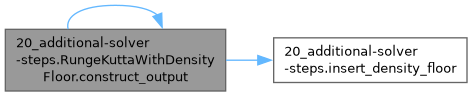
References construct_output(), and 20_additional-solver-steps.insert_density_floor().
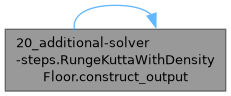
Referenced by construct_output().
 1.15.0