 |
Peano
|
Fourth-order central Finite Differences with explicit Runge-Kutta time stepping, realised over a block-structured mesh. More...

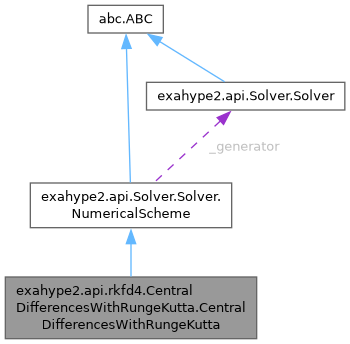
Data Structures | |
| class | RightHandSideKernel |
| The kernels which evaluate the right-hand side,. More... | |
Public Member Functions | |
| int | halo_size (self) |
| Width of the halo. | |
| __init__ (self, Solver solver, int patch_size, int rk_order, float time_step_size=None, float cfl_constant=0.5, "CentralDifferencesWithRungeKutta.RightHandSideKernel" right_hand_side_kernel=RightHandSideKernel.CentralDifferences, advection_velocity=None, advected_quantities=None, float min_volume_size=None, float max_volume_size=None, "toolbox.blockstructured.api.InterpolateHangingFaces.Scheme" interpolation=toolbox.blockstructured.api.InterpolateHangingFaces.Scheme.Linear, "toolbox.blockstructured.api.RestrictHangingFaces.Scheme" restriction=toolbox.blockstructured.api.RestrictHangingFaces.Scheme.Averaging) | |
| The constructor memorises the attributes and creates the data structures. | |
| int | overlap (self) |
| Width of the halo, i.e. | |
| int | rk_order (self) |
| bool | has_adaptive_time_step_size (self) |
| str | right_hand_side_kernel_name (self) |
| Name of the generated right-hand side kernel. | |
| str | max_eigenvalue_kernel_name (self) |
| Solver.MeshAdaptation | create_default_mesh_adaptation (self) |
| The finite differences adapt the mesh and balance the load through exahype2.api.rkfd4.AdaptMeshAndBalanceLoad by default. | |
| "toolbox.blockstructured.api.RestrictHangingFaces" | create_restriction_of_hanging_faces (self) |
| Action set which restricts the projected fine data from the hanging faces onto the coarse faces. | |
| construct_output (self, exahype2_project, peano_project, time_step, add_global_tasks=True) | |
| Add the data to the Peano 4 project, generate the kernels and add the tasks of one Runge-Kutta step to time_step. | |
| Public Member Functions inherited from exahype2.api.Solver.Solver.NumericalScheme | |
| __init__ (self, "Solver" solver) | |
| wrap_task_graph_in_load_balancing_and_amr_tasks (self, time_step) | |
| Embed the time step's task graph into the global load balancing and AMR tasks. | |
Data Fields | |
| interpolation = interpolation | |
| restriction = restriction | |
| right_hand_side_kernel = right_hand_side_kernel | |
| advection_velocity = resolve_quantities(solver, advection_velocity) | |
| advected_quantities = resolve_quantities(solver, advected_quantities) | |
| patch_size = patch_size | |
| The task must not run before the final roll over of the time step: Roll overs such as the Sommerfeld boundary treatment need the valid current time step size, which this task replaces (see adrs/0001-time-step-size-after-roll-over.md). | |
| min_volume_size = min_volume_size | |
| max_volume_size = max_volume_size | |
| butcher_tableau = ButcherTableau(rk_order) | |
| time_step_size = time_step_size | |
| cfl_constant = cfl_constant | |
| kernel_namespace = None | |
| max_eigenvalue_kernel_call = None | |
| has_adaptive_time_step_size | |
| The task must not run before the final roll over of the time step: Roll overs such as the Sommerfeld boundary treatment need the valid current time step size, which this task replaces (see adrs/0001-time-step-size-after-roll-over.md). | |
| rk_order | |
Static Public Attributes | |
| int | HALO_SIZE = 2 |
| Width of the halo. | |
| Static Public Attributes inherited from exahype2.api.Solver.Solver.NumericalScheme | |
| str | DYNAMIC_MESH_REFINEMENT_TASK_NAME = "Dynamic mesh refinement and load balancing" |
| Name of the last task of each time step without the solver's name as prefix, i.e. | |
Protected Member Functions | |
| _right_hand_side_action_sets (self, stage, cell_guard) | |
| Action sets of the task which evaluates the right-hand side of one stage. | |
| _patches (self) | |
| All patches of this numerical scheme, i.e. | |
Private Member Functions | |
| __create_data_structures (self) | |
| Create the mesh data structures this numerical scheme requires. | |
| __add_max_eigenvalue_reduction (self) | |
| Let the generated abstract solver class host the maximum eigenvalue of a time step. | |
| __add_data_to_repository (self, peano_project) | |
| Add the data from __create_data_structures() to the Peano 4 project and configure their generators. | |
| __create_kernels (self, peano4_project) | |
| Translate the DSLHyPE kernels into C++. | |
| __construct_kernel_call (self, function_name, additional_arguments) | |
| Construct the call of a generated kernel. | |
Additional Inherited Members | |
| Protected Attributes inherited from exahype2.api.Solver.Solver.NumericalScheme | |
| _solver = solver | |
| Solver.NumericalScheme.NumericalSchemeGenerator | _generator = None |
Fourth-order central Finite Differences with explicit Runge-Kutta time stepping, realised over a block-structured mesh.
Each mesh cell hosts a patch of patch_size^d grid cells. The unknowns sit in the grid cells' centres. The scheme evaluates the right-hand side of
\( \\partial _t Q = F(Q) \)
through fourth-order central differences (exahype2.api.rkfd4.FD4Kernels), and integrates in time with the explicit Runge-Kutta scheme from exahype2.api.rungekutta.ButcherTableau. The stencils reach two grid cells into the neighbouring patches, i.e. the halo is HALO_SIZE=2 grid cells wide:
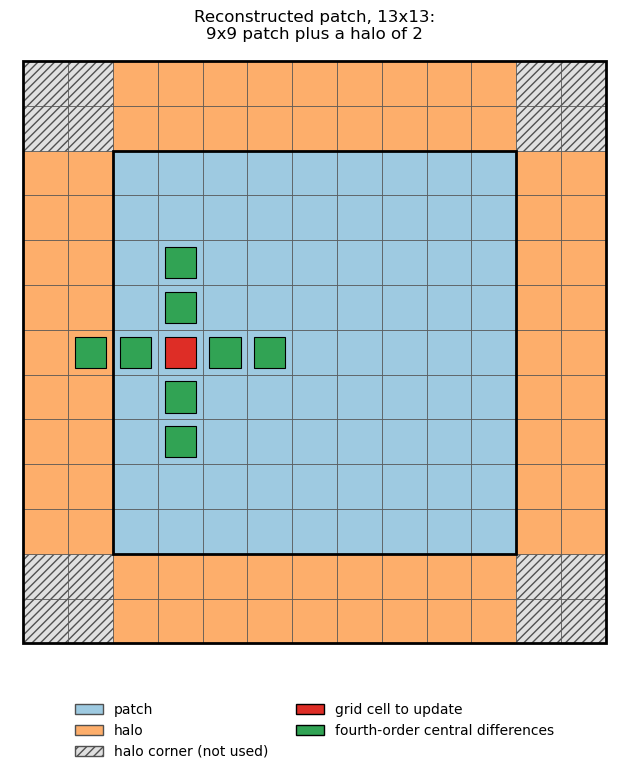
The script central-differences-with-runge-kutta-illustrations.py next to this file generates the illustrations of this page.
The scheme plugs into an exahype2.api.Solver like the Finite Volumes of exahype2.api.fv, but with the grid construction and the plotter of exahype2.api.rkfd4:
The solver can have a Flux, a NonconservativeProduct and a VolumetricSource. It needs an InitPointWisely term, a MaxEigenvalue term unless the time step size is fixed, and either a DirichletBoundaryConditions or a SommerfeldBoundaryConditions term unless all axes are periodic (exahype2.api.blockstructured.BoundaryConditions.get_boundary_conditions()). Sommerfeld conditions also require a MaxEigenvalue term, and a Butcher tableau whose stage time stamps do not decrease. Convergence Tests (Euler Equations) demonstrates fourth-order convergence for the Euler equations.
The scheme has no artificial dissipation. Subclasses can add further terms to the right-hand side:
exagrype.api.FD4WithKODissipation adds the Kreiss-Oliger dissipation this way.
The constructor's argument right_hand_side_kernel selects how the scheme evaluates the right-hand side (CentralDifferencesWithRungeKutta.RightHandSideKernel):
__create_data_structures() documents the data per mesh cell and face. Per time step, the scheme runs through the Runge-Kutta stages k=0,...,s-1. Stage k
The last stage computes \( Q^{n+1} = Q^n + \\Delta t \\sum _k b_k K_k \) instead, i.e. it overwrites solver._patch, and projects the new solution onto the faces, where the first stage of the next time step picks it up.
As the reconstruction of a stage reads the face data the previous stage has written, the task graph compiler maps each stage onto a mesh traversal of its own (peano4.api.taskgraph.compiler.FuseSteps). For a second-order Runge-Kutta scheme with Dirichlet boundary conditions, the time step's task graph reads:
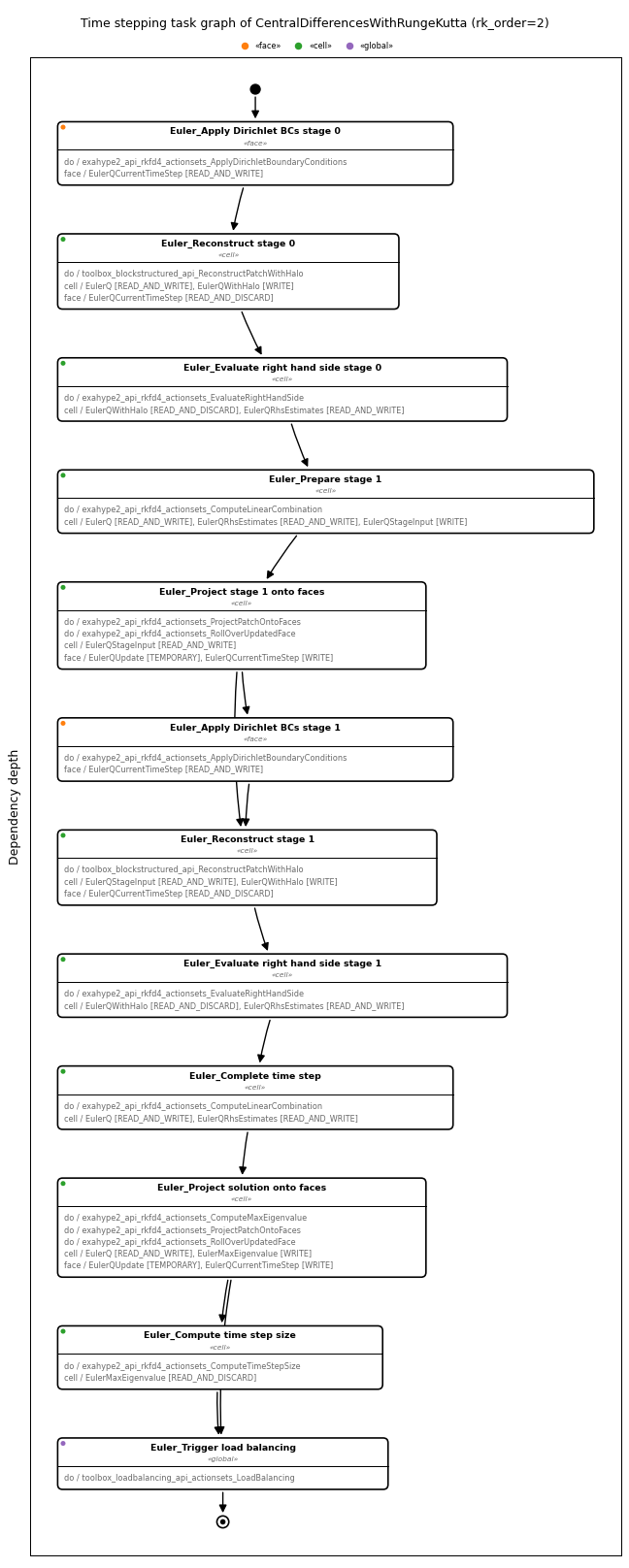
The boundary values are evaluated at the time stamp of the respective stage, i.e. at \( t^n + c_k \\Delta t \). Otherwise, the scheme would drop to first order along the boundary.
If you pass a time_step_size, the scheme uses this fixed time step size. Otherwise, it derives the time step size from the maximum eigenvalue of the solution after each time step through the CFL condition with cfl_constant (exahype2.api.rkfd4.actionsets.ComputeTimeStepSize). This requires a MaxEigenvalue PDE term, with or without state.
Definition at line 94 of file CentralDifferencesWithRungeKutta.py.
| exahype2.api.rkfd4.CentralDifferencesWithRungeKutta.CentralDifferencesWithRungeKutta.__init__ | ( | self, | |
| Solver | solver, | ||
| int | patch_size, | ||
| int | rk_order, | ||
| float | time_step_size = None, | ||
| float | cfl_constant = 0.5, | ||
| "CentralDifferencesWithRungeKutta.RightHandSideKernel" | right_hand_side_kernel = RightHandSideKernel.CentralDifferences, | ||
| advection_velocity = None, | |||
| advected_quantities = None, | |||
| float | min_volume_size = None, | ||
| float | max_volume_size = None, | ||
| "toolbox.blockstructured.api.InterpolateHangingFaces.Scheme" | interpolation = toolbox.blockstructured.api.InterpolateHangingFaces.Scheme.Linear, | ||
| "toolbox.blockstructured.api.RestrictHangingFaces.Scheme" | restriction = toolbox.blockstructured.api.RestrictHangingFaces.Scheme.Averaging ) |
The constructor memorises the attributes and creates the data structures.
It does not add the data to the solver's Peano 4 project yet, but it assigns them to the solver, so anybody else working against this solver, such as the grid construction or the plotter, finds them there.
| solver | exahype2.api.Solver The solver this numerical scheme realises. |
| patch_size | int Number of grid cells per axis within one patch, i.e. within one mesh cell. Has to be at least HALO_SIZE, as the projection onto the faces takes the HALO_SIZE outermost layers of the patch. |
| rk_order | int Order of the Runge-Kutta scheme, i.e. its number of stages. Has to be between one and four, exahype2.api.rungekutta.ButcherTableau. |
| time_step_size | float or None Fixed time step size. If None, the time step size is adaptive. |
| cfl_constant | float CFL constant for adaptive time step sizes. It scales the time step size h / (d lambda_max), with h the grid cell size, d the dimension and lambda_max the maximum eigenvalue. Ignored if time_step_size is set. Fourth-order central differences with the classic fourth-order Runge-Kutta scheme are stable up to roughly two for linear advection without dissipation, so 0.5 is a conservative default. |
| right_hand_side_kernel | CentralDifferencesWithRungeKutta.RightHandSideKernel The kernel which evaluates the right-hand side, |
| advection_velocity | str or List[str or int] or None Only for CentralDifferencesWithLopsidedAdvection: the entries of Q which hold the advection velocity, one per dimension. Pass the name of a variable with one entry per dimension (e.g. "shift" for exagrype.api.FOCCZ4Solver), or a list of names or indices. The velocity may be an auxiliary variable. |
| advected_quantities | List[str or int] or None Only for CentralDifferencesWithLopsidedAdvection: the unknowns which are advected, as names of variables or indices of entries, |
| min_volume_size | float The time step asks for a refinement of a cell only if its grid cells are at least of this size (exahype2.api.blockstructured.DynamicMeshRefinement). None (the default) does not bound the refinement. |
| max_volume_size | float The time step asks for an erase, i.e. coarsening, of a cell only if the grid cells of the coarser cell would be strictly smaller than this size. None (the default) does not bound the coarsening. |
| interpolation | toolbox.blockstructured.api.InterpolateHangingFaces.Scheme How the scheme initialises the halo of a fine patch next to a coarser patch on an adaptive mesh. Whenever a Runge-Kutta stage reconstructs the halo of a fine cell, it interpolates the data of the adjacent coarse face onto the fine cell's hanging face (toolbox.blockstructured.api.InterpolateHangingFaces). The default is linear interpolation. |
| restriction | toolbox.blockstructured.api.RestrictHangingFaces.Scheme How the scheme hands the data of fine patches over to an adjacent coarser patch. Whenever the fine cells project their data onto their faces, the scheme restricts the data of the hanging faces onto the coarse face (toolbox.blockstructured.api.RestrictHangingFaces). The default is averaging. |
On a regular mesh, there are no hanging faces, and the two schemes are never used. At resolution transitions, the halo of a fine patch is only as accurate as the interpolation, i.e. the scheme drops to low order there.
Definition at line 234 of file CentralDifferencesWithRungeKutta.py.
References __init__().
Referenced by __init__().
|
private |
Add the data from __create_data_structures() to the Peano 4 project and configure their generators.
Only _patch_overlap_current_time_step is exchanged between ranks, and only on the faces the solver's grid selector holds for. The task graph compiler uses, loads and stores data only where the solver's grid selector holds, too (peano4.api.datamodel.DoF).
Definition at line 631 of file CentralDifferencesWithRungeKutta.py.
References _patches(), exagrype.api.FD4WithKODissipation.FD4WithKODissipation._solver, exahype2.api.blockstructured.AdaptMeshAndBalanceLoad.AdaptMeshAndBalanceLoad._solver, exahype2.api.blockstructured.ConsumeRefinementRequests.ConsumeRefinementRequests._solver, exahype2.api.blockstructured.DynamicMeshRefinement.DynamicMeshRefinement._solver, exahype2.api.blockstructured.LoadCheckpoint._LoadPatchesFromCheckpoint._solver, exahype2.api.blockstructured.LoadCheckpoint.LoadCheckpoint._solver, exahype2.api.fv.actionsets.AbstractFVActionSet.AbstractFVActionSet._solver, exahype2.api.fv.actionsets.ApplyDirichletBoundaryConditions.ApplyDirichletBoundaryConditions._solver, exahype2.api.fv.actionsets.DiscardPatchInterior.DiscardPatchInterior._solver, exahype2.api.fv.AdaptMeshAndBalanceLoad.AdaptMeshAndBalanceLoad._solver, exahype2.api.fv.PlotAsVTKFile.PlotAsVTKFile._solver, exahype2.api.fv.RusanovWithExplicitEuler.RusanovWithExplicitEuler._solver, exahype2.api.fv.RusanovWithExplicitEuler.RusanovWithExplicitEulerGenerator._solver, exahype2.api.fv.RusanovWithOptimisticExplicitEuler.RusanovWithOptimisticExplicitEuler._solver, exahype2.api.fv.SetupSimulationOverRegularGrid.SetupSimulationOverRegularGrid._solver, exahype2.api.fv.SetupSimulationWithUserCodedRefinementCriterion.SetupSimulationWithUserCodedRefinementCriterion._solver, exahype2.api.fv.WriteCheckpoint.WriteCheckpoint._solver, exahype2.api.rkfd4.actionsets.AbstractRKFD4ActionSet.AbstractRKFD4ActionSet._solver, exahype2.api.rkfd4.actionsets.ApplyDirichletBoundaryConditions.ApplyDirichletBoundaryConditions._solver, exahype2.api.rkfd4.AdaptMeshAndBalanceLoad.AdaptMeshAndBalanceLoad._solver, _solver, exagrype.api.FD4WithKODissipation.FD4WithKODissipation.HALO_SIZE, HALO_SIZE, has_adaptive_time_step_size, exagrype.api.scalarfield.FiniteVolumesInnerCoupling._FiniteVolumes.patch_size, exagrype.api.scalarfield.InnerCouplingGenerator.InnerCouplingGenerator.patch_size, exagrype.api.scalarfield.RungeKuttaFD4InnerCoupling._RungeKuttaFD4.patch_size, exahype2.api.blockstructured.DynamicMeshRefinement.DynamicMeshRefinement.patch_size, exahype2.api.fv.actionsets.ComputeGlobalCFLCondition.ComputeGlobalCFLCondition.patch_size, exahype2.api.fv.actionsets.InsertPatchInterior.InsertPatchInterior.patch_size, exahype2.api.fv.RusanovWithExplicitEuler.RusanovWithExplicitEuler.patch_size, exahype2.api.fv.RusanovWithOptimisticExplicitEuler.RusanovWithOptimisticExplicitEuler.patch_size, exahype2.api.rkfd4.actionsets.ComputeTimeStepSize.ComputeTimeStepSize.patch_size, and patch_size.
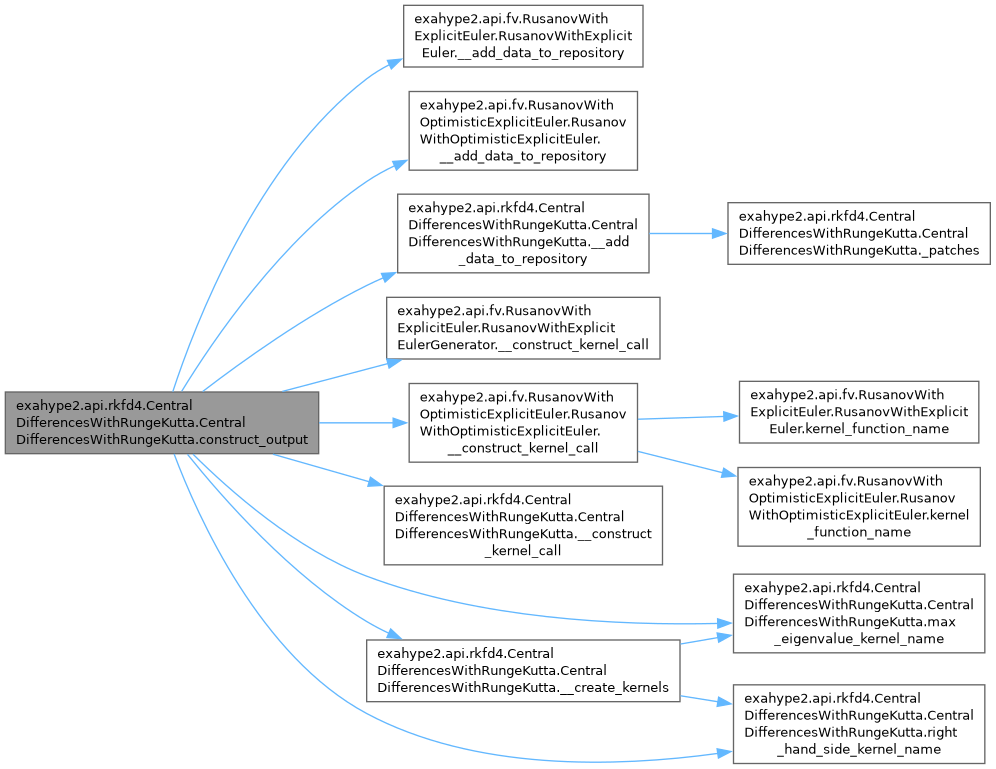
Referenced by construct_output().


|
private |
Let the generated abstract solver class host the maximum eigenvalue of a time step.
The class collects the maximum over all patches and threads. This is a reduction over the whole mesh, hence it belongs to the solver and not to a cell. Reading and resetting it is one operation, as the patches contribute in a different traversal than the one that derives the time step size from it.
Definition at line 573 of file CentralDifferencesWithRungeKutta.py.
References exagrype.api.FD4WithKODissipation.FD4WithKODissipation._solver, exahype2.api.blockstructured.AdaptMeshAndBalanceLoad.AdaptMeshAndBalanceLoad._solver, exahype2.api.blockstructured.ConsumeRefinementRequests.ConsumeRefinementRequests._solver, exahype2.api.blockstructured.DynamicMeshRefinement.DynamicMeshRefinement._solver, exahype2.api.blockstructured.LoadCheckpoint._LoadPatchesFromCheckpoint._solver, exahype2.api.blockstructured.LoadCheckpoint.LoadCheckpoint._solver, exahype2.api.fv.actionsets.AbstractFVActionSet.AbstractFVActionSet._solver, exahype2.api.fv.actionsets.ApplyDirichletBoundaryConditions.ApplyDirichletBoundaryConditions._solver, exahype2.api.fv.actionsets.DiscardPatchInterior.DiscardPatchInterior._solver, exahype2.api.fv.AdaptMeshAndBalanceLoad.AdaptMeshAndBalanceLoad._solver, exahype2.api.fv.PlotAsVTKFile.PlotAsVTKFile._solver, exahype2.api.fv.RusanovWithExplicitEuler.RusanovWithExplicitEuler._solver, exahype2.api.fv.RusanovWithExplicitEuler.RusanovWithExplicitEulerGenerator._solver, exahype2.api.fv.RusanovWithOptimisticExplicitEuler.RusanovWithOptimisticExplicitEuler._solver, exahype2.api.fv.SetupSimulationOverRegularGrid.SetupSimulationOverRegularGrid._solver, exahype2.api.fv.SetupSimulationWithUserCodedRefinementCriterion.SetupSimulationWithUserCodedRefinementCriterion._solver, exahype2.api.fv.WriteCheckpoint.WriteCheckpoint._solver, exahype2.api.rkfd4.actionsets.AbstractRKFD4ActionSet.AbstractRKFD4ActionSet._solver, exahype2.api.rkfd4.actionsets.ApplyDirichletBoundaryConditions.ApplyDirichletBoundaryConditions._solver, exahype2.api.rkfd4.AdaptMeshAndBalanceLoad.AdaptMeshAndBalanceLoad._solver, and _solver.
|
private |
Construct the call of a generated kernel.
The kernel takes a exahype2.CellData called patchData, the additional arguments and one functor per PDE term the solver has, in the order flux, nonconservativeProduct, volumetricSource, maxEigenvalue (see __create_kernels()). Each functor forwards to the solver instance.
If PDE terms are registered both with and without state, the generated code asks cellCanUseStatelessPDETerms() before it invokes the kernel, and hands over the stateless variants if it returns true. This logic is a copy of the one of exahype2.api.fv, as rkfd4 does not depend on the Finite Volume package.
| function_name | str Unqualified name of the kernel. |
| additional_arguments | [str] C++ expressions passed after patchData. |
Definition at line 841 of file CentralDifferencesWithRungeKutta.py.
References exagrype.api.FD4WithKODissipation.FD4WithKODissipation._solver, exahype2.api.blockstructured.AdaptMeshAndBalanceLoad.AdaptMeshAndBalanceLoad._solver, exahype2.api.blockstructured.ConsumeRefinementRequests.ConsumeRefinementRequests._solver, exahype2.api.blockstructured.DynamicMeshRefinement.DynamicMeshRefinement._solver, exahype2.api.blockstructured.LoadCheckpoint._LoadPatchesFromCheckpoint._solver, exahype2.api.blockstructured.LoadCheckpoint.LoadCheckpoint._solver, exahype2.api.fv.actionsets.AbstractFVActionSet.AbstractFVActionSet._solver, exahype2.api.fv.actionsets.ApplyDirichletBoundaryConditions.ApplyDirichletBoundaryConditions._solver, exahype2.api.fv.actionsets.DiscardPatchInterior.DiscardPatchInterior._solver, exahype2.api.fv.AdaptMeshAndBalanceLoad.AdaptMeshAndBalanceLoad._solver, exahype2.api.fv.PlotAsVTKFile.PlotAsVTKFile._solver, exahype2.api.fv.RusanovWithExplicitEuler.RusanovWithExplicitEuler._solver, exahype2.api.fv.RusanovWithExplicitEuler.RusanovWithExplicitEulerGenerator._solver, exahype2.api.fv.RusanovWithOptimisticExplicitEuler.RusanovWithOptimisticExplicitEuler._solver, exahype2.api.fv.SetupSimulationOverRegularGrid.SetupSimulationOverRegularGrid._solver, exahype2.api.fv.SetupSimulationWithUserCodedRefinementCriterion.SetupSimulationWithUserCodedRefinementCriterion._solver, exahype2.api.fv.WriteCheckpoint.WriteCheckpoint._solver, exahype2.api.rkfd4.actionsets.AbstractRKFD4ActionSet.AbstractRKFD4ActionSet._solver, exahype2.api.rkfd4.actionsets.ApplyDirichletBoundaryConditions.ApplyDirichletBoundaryConditions._solver, exahype2.api.rkfd4.AdaptMeshAndBalanceLoad.AdaptMeshAndBalanceLoad._solver, and _solver.
Referenced by construct_output().

|
private |
Create the mesh data structures this numerical scheme requires.
All of them are assigned to self._solver rather than self, so the solver's grid construction and plotter, as well as the action sets, find them there:
All patches use smart pointers (peano4.api.datamodel.PatchToDoubleArrayWithSmartPointer), like the Finite Volumes of exahype2.api.fv. The legacy exahype2.solvers.rkfd.CellCenteredFiniteDifferences held a third face overlap with the data of the previous time step. It is required for AMR and local time stepping only, so we do not create it.
Definition at line 472 of file CentralDifferencesWithRungeKutta.py.
References exagrype.api.FD4WithKODissipation.FD4WithKODissipation._solver, exahype2.api.blockstructured.AdaptMeshAndBalanceLoad.AdaptMeshAndBalanceLoad._solver, exahype2.api.blockstructured.ConsumeRefinementRequests.ConsumeRefinementRequests._solver, exahype2.api.blockstructured.DynamicMeshRefinement.DynamicMeshRefinement._solver, exahype2.api.blockstructured.LoadCheckpoint._LoadPatchesFromCheckpoint._solver, exahype2.api.blockstructured.LoadCheckpoint.LoadCheckpoint._solver, exahype2.api.fv.actionsets.AbstractFVActionSet.AbstractFVActionSet._solver, exahype2.api.fv.actionsets.ApplyDirichletBoundaryConditions.ApplyDirichletBoundaryConditions._solver, exahype2.api.fv.actionsets.DiscardPatchInterior.DiscardPatchInterior._solver, exahype2.api.fv.AdaptMeshAndBalanceLoad.AdaptMeshAndBalanceLoad._solver, exahype2.api.fv.PlotAsVTKFile.PlotAsVTKFile._solver, exahype2.api.fv.RusanovWithExplicitEuler.RusanovWithExplicitEuler._solver, exahype2.api.fv.RusanovWithExplicitEuler.RusanovWithExplicitEulerGenerator._solver, exahype2.api.fv.RusanovWithOptimisticExplicitEuler.RusanovWithOptimisticExplicitEuler._solver, exahype2.api.fv.SetupSimulationOverRegularGrid.SetupSimulationOverRegularGrid._solver, exahype2.api.fv.SetupSimulationWithUserCodedRefinementCriterion.SetupSimulationWithUserCodedRefinementCriterion._solver, exahype2.api.fv.WriteCheckpoint.WriteCheckpoint._solver, exahype2.api.rkfd4.actionsets.AbstractRKFD4ActionSet.AbstractRKFD4ActionSet._solver, exahype2.api.rkfd4.actionsets.ApplyDirichletBoundaryConditions.ApplyDirichletBoundaryConditions._solver, exahype2.api.rkfd4.AdaptMeshAndBalanceLoad.AdaptMeshAndBalanceLoad._solver, _solver, exagrype.api.FD4WithKODissipation.FD4WithKODissipation.HALO_SIZE, HALO_SIZE, exagrype.api.scalarfield.FiniteVolumesInnerCoupling._FiniteVolumes.patch_size, exagrype.api.scalarfield.InnerCouplingGenerator.InnerCouplingGenerator.patch_size, exagrype.api.scalarfield.RungeKuttaFD4InnerCoupling._RungeKuttaFD4.patch_size, exahype2.api.blockstructured.DynamicMeshRefinement.DynamicMeshRefinement.patch_size, exahype2.api.fv.actionsets.ComputeGlobalCFLCondition.ComputeGlobalCFLCondition.patch_size, exahype2.api.fv.actionsets.InsertPatchInterior.InsertPatchInterior.patch_size, exahype2.api.fv.RusanovWithExplicitEuler.RusanovWithExplicitEuler.patch_size, exahype2.api.fv.RusanovWithOptimisticExplicitEuler.RusanovWithOptimisticExplicitEuler.patch_size, exahype2.api.rkfd4.actionsets.ComputeTimeStepSize.ComputeTimeStepSize.patch_size, patch_size, exagrype.api.scalarfield.RungeKuttaFD4InnerCoupling._RungeKuttaFD4.rk_order, and rk_order.
|
private |
Translate the DSLHyPE kernels into C++.
The kernels end up in the kernels/ subdirectory of output_directory:
Calling this function is delayed until all PDE term information is provided, as the kernels contain only the PDE terms the solver has.
Definition at line 703 of file CentralDifferencesWithRungeKutta.py.
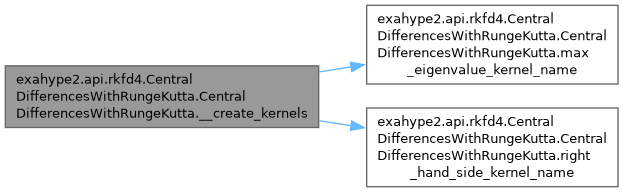
References exagrype.api.FD4WithKODissipation.FD4WithKODissipation._solver, exahype2.api.blockstructured.AdaptMeshAndBalanceLoad.AdaptMeshAndBalanceLoad._solver, exahype2.api.blockstructured.ConsumeRefinementRequests.ConsumeRefinementRequests._solver, exahype2.api.blockstructured.DynamicMeshRefinement.DynamicMeshRefinement._solver, exahype2.api.blockstructured.LoadCheckpoint._LoadPatchesFromCheckpoint._solver, exahype2.api.blockstructured.LoadCheckpoint.LoadCheckpoint._solver, exahype2.api.fv.actionsets.AbstractFVActionSet.AbstractFVActionSet._solver, exahype2.api.fv.actionsets.ApplyDirichletBoundaryConditions.ApplyDirichletBoundaryConditions._solver, exahype2.api.fv.actionsets.DiscardPatchInterior.DiscardPatchInterior._solver, exahype2.api.fv.AdaptMeshAndBalanceLoad.AdaptMeshAndBalanceLoad._solver, exahype2.api.fv.PlotAsVTKFile.PlotAsVTKFile._solver, exahype2.api.fv.RusanovWithExplicitEuler.RusanovWithExplicitEuler._solver, exahype2.api.fv.RusanovWithExplicitEuler.RusanovWithExplicitEulerGenerator._solver, exahype2.api.fv.RusanovWithOptimisticExplicitEuler.RusanovWithOptimisticExplicitEuler._solver, exahype2.api.fv.SetupSimulationOverRegularGrid.SetupSimulationOverRegularGrid._solver, exahype2.api.fv.SetupSimulationWithUserCodedRefinementCriterion.SetupSimulationWithUserCodedRefinementCriterion._solver, exahype2.api.fv.WriteCheckpoint.WriteCheckpoint._solver, exahype2.api.rkfd4.actionsets.AbstractRKFD4ActionSet.AbstractRKFD4ActionSet._solver, exahype2.api.rkfd4.actionsets.ApplyDirichletBoundaryConditions.ApplyDirichletBoundaryConditions._solver, exahype2.api.rkfd4.AdaptMeshAndBalanceLoad.AdaptMeshAndBalanceLoad._solver, _solver, has_adaptive_time_step_size, exahype2.api.fv.RusanovWithExplicitEuler.RusanovWithExplicitEuler.kernel_namespace, exahype2.api.fv.RusanovWithOptimisticExplicitEuler.RusanovWithOptimisticExplicitEuler.kernel_namespace, kernel_namespace, max_eigenvalue_kernel_name(), and right_hand_side_kernel_name().
Referenced by construct_output().

|
protected |
All patches of this numerical scheme, i.e.
all data besides the maximum eigenvalue.
Definition at line 617 of file CentralDifferencesWithRungeKutta.py.
References exagrype.api.FD4WithKODissipation.FD4WithKODissipation._solver, exahype2.api.blockstructured.AdaptMeshAndBalanceLoad.AdaptMeshAndBalanceLoad._solver, exahype2.api.blockstructured.ConsumeRefinementRequests.ConsumeRefinementRequests._solver, exahype2.api.blockstructured.DynamicMeshRefinement.DynamicMeshRefinement._solver, exahype2.api.blockstructured.LoadCheckpoint._LoadPatchesFromCheckpoint._solver, exahype2.api.blockstructured.LoadCheckpoint.LoadCheckpoint._solver, exahype2.api.fv.actionsets.AbstractFVActionSet.AbstractFVActionSet._solver, exahype2.api.fv.actionsets.ApplyDirichletBoundaryConditions.ApplyDirichletBoundaryConditions._solver, exahype2.api.fv.actionsets.DiscardPatchInterior.DiscardPatchInterior._solver, exahype2.api.fv.AdaptMeshAndBalanceLoad.AdaptMeshAndBalanceLoad._solver, exahype2.api.fv.PlotAsVTKFile.PlotAsVTKFile._solver, exahype2.api.fv.RusanovWithExplicitEuler.RusanovWithExplicitEuler._solver, exahype2.api.fv.RusanovWithExplicitEuler.RusanovWithExplicitEulerGenerator._solver, exahype2.api.fv.RusanovWithOptimisticExplicitEuler.RusanovWithOptimisticExplicitEuler._solver, exahype2.api.fv.SetupSimulationOverRegularGrid.SetupSimulationOverRegularGrid._solver, exahype2.api.fv.SetupSimulationWithUserCodedRefinementCriterion.SetupSimulationWithUserCodedRefinementCriterion._solver, exahype2.api.fv.WriteCheckpoint.WriteCheckpoint._solver, exahype2.api.rkfd4.actionsets.AbstractRKFD4ActionSet.AbstractRKFD4ActionSet._solver, exahype2.api.rkfd4.actionsets.ApplyDirichletBoundaryConditions.ApplyDirichletBoundaryConditions._solver, exahype2.api.rkfd4.AdaptMeshAndBalanceLoad.AdaptMeshAndBalanceLoad._solver, and _solver.
Referenced by __add_data_to_repository().

|
protected |
Action sets of the task which evaluates the right-hand side of one stage.
The task reads solver._patch_with_halo, i.e. the stage's input with its halo, and writes the stage's slot of solver._rhs_estimates. By default, it holds one action set, which invokes the fourth-order Finite Differences kernel. Subclasses can append action sets which add further terms to the estimate. The action sets of one task run one after the other, in the order of the list. For the kernel CentralDifferencesWithLopsidedAdvection, the list holds the lopsided advection as second action set.
| stage | int Number of the Runge-Kutta stage, starting with zero. |
| cell_guard | str C++ boolean expression, evaluated per cell. |
Reimplemented in exagrype.api.FD4WithKODissipation.FD4WithKODissipation.
Definition at line 431 of file CentralDifferencesWithRungeKutta.py.
References exagrype.api.FD4WithKODissipation.FD4WithKODissipation._solver, exahype2.api.blockstructured.AdaptMeshAndBalanceLoad.AdaptMeshAndBalanceLoad._solver, exahype2.api.blockstructured.ConsumeRefinementRequests.ConsumeRefinementRequests._solver, exahype2.api.blockstructured.DynamicMeshRefinement.DynamicMeshRefinement._solver, exahype2.api.blockstructured.LoadCheckpoint._LoadPatchesFromCheckpoint._solver, exahype2.api.blockstructured.LoadCheckpoint.LoadCheckpoint._solver, exahype2.api.fv.actionsets.AbstractFVActionSet.AbstractFVActionSet._solver, exahype2.api.fv.actionsets.ApplyDirichletBoundaryConditions.ApplyDirichletBoundaryConditions._solver, exahype2.api.fv.actionsets.DiscardPatchInterior.DiscardPatchInterior._solver, exahype2.api.fv.AdaptMeshAndBalanceLoad.AdaptMeshAndBalanceLoad._solver, exahype2.api.fv.PlotAsVTKFile.PlotAsVTKFile._solver, exahype2.api.fv.RusanovWithExplicitEuler.RusanovWithExplicitEuler._solver, exahype2.api.fv.RusanovWithExplicitEuler.RusanovWithExplicitEulerGenerator._solver, exahype2.api.fv.RusanovWithOptimisticExplicitEuler.RusanovWithOptimisticExplicitEuler._solver, exahype2.api.fv.SetupSimulationOverRegularGrid.SetupSimulationOverRegularGrid._solver, exahype2.api.fv.SetupSimulationWithUserCodedRefinementCriterion.SetupSimulationWithUserCodedRefinementCriterion._solver, exahype2.api.fv.WriteCheckpoint.WriteCheckpoint._solver, exahype2.api.rkfd4.actionsets.AbstractRKFD4ActionSet.AbstractRKFD4ActionSet._solver, exahype2.api.rkfd4.actionsets.ApplyDirichletBoundaryConditions.ApplyDirichletBoundaryConditions._solver, exahype2.api.rkfd4.AdaptMeshAndBalanceLoad.AdaptMeshAndBalanceLoad._solver, _solver, and right_hand_side_kernel.
| exahype2.api.rkfd4.CentralDifferencesWithRungeKutta.CentralDifferencesWithRungeKutta.construct_output | ( | self, | |
| exahype2_project, | |||
| peano_project, | |||
| time_step, | |||
| add_global_tasks = True ) |
Add the data to the Peano 4 project, generate the kernels and add the tasks of one Runge-Kutta step to time_step.
| add_global_tasks | bool If False, the scheme adds neither the task that switches the load balancing off nor the last task that evaluates the adaptivity criterion and switches the load balancing on again, |
Per stage k, the time step holds the following tasks (see the class documentation for the data flow). Every task holds exactly one action set, with the exception of the reconstruction of the unknowns, which also holds the interpolation onto the hanging faces, and the reconstruction of several sets of auxiliary variables. This is deliberate: the task graph compiler runs the action sets of independent tasks in parallel only if each task holds one action set (peano4.api.taskgraph.compiler.FuseSteps). Where the scheme needs several action sets in a row, it hence creates a chain of tasks. If several solvers share a task graph, their chains overlap.
After the last stage, {SolverName}_Compute time step size determines the time step size of the next time step and advances the solver's time stamp. {SolverName}_Dynamic mesh refinement and load balancing finally evaluates the adaptivity criterion if the solver has one (exahype2.api.blockstructured.create_dynamic_mesh_refinement_action_set.create_dynamic_mesh_refinement_action_set()), switches the load balancing on again and informs it that the time step has finished.
Reimplemented from exahype2.api.Solver.Solver.NumericalScheme.
Reimplemented in 20_additional-solver-steps.RungeKuttaWithDensityFloor.
Definition at line 979 of file CentralDifferencesWithRungeKutta.py.
References exahype2.api.fv.RusanovWithExplicitEuler.RusanovWithExplicitEuler.__add_data_to_repository(), exahype2.api.fv.RusanovWithOptimisticExplicitEuler.RusanovWithOptimisticExplicitEuler.__add_data_to_repository(), __add_data_to_repository(), exahype2.api.fv.RusanovWithExplicitEuler.RusanovWithExplicitEulerGenerator.__construct_kernel_call(), exahype2.api.fv.RusanovWithOptimisticExplicitEuler.RusanovWithOptimisticExplicitEuler.__construct_kernel_call(), __construct_kernel_call(), __create_kernels(), exagrype.api.FD4WithKODissipation.FD4WithKODissipation._solver, exahype2.api.blockstructured.AdaptMeshAndBalanceLoad.AdaptMeshAndBalanceLoad._solver, exahype2.api.blockstructured.ConsumeRefinementRequests.ConsumeRefinementRequests._solver, exahype2.api.blockstructured.DynamicMeshRefinement.DynamicMeshRefinement._solver, exahype2.api.blockstructured.LoadCheckpoint._LoadPatchesFromCheckpoint._solver, exahype2.api.blockstructured.LoadCheckpoint.LoadCheckpoint._solver, exahype2.api.fv.actionsets.AbstractFVActionSet.AbstractFVActionSet._solver, exahype2.api.fv.actionsets.ApplyDirichletBoundaryConditions.ApplyDirichletBoundaryConditions._solver, exahype2.api.fv.actionsets.DiscardPatchInterior.DiscardPatchInterior._solver, exahype2.api.fv.AdaptMeshAndBalanceLoad.AdaptMeshAndBalanceLoad._solver, exahype2.api.fv.PlotAsVTKFile.PlotAsVTKFile._solver, exahype2.api.fv.RusanovWithExplicitEuler.RusanovWithExplicitEuler._solver, exahype2.api.fv.RusanovWithExplicitEuler.RusanovWithExplicitEulerGenerator._solver, exahype2.api.fv.RusanovWithOptimisticExplicitEuler.RusanovWithOptimisticExplicitEuler._solver, exahype2.api.fv.SetupSimulationOverRegularGrid.SetupSimulationOverRegularGrid._solver, exahype2.api.fv.SetupSimulationWithUserCodedRefinementCriterion.SetupSimulationWithUserCodedRefinementCriterion._solver, exahype2.api.fv.WriteCheckpoint.WriteCheckpoint._solver, exahype2.api.rkfd4.actionsets.AbstractRKFD4ActionSet.AbstractRKFD4ActionSet._solver, exahype2.api.rkfd4.actionsets.ApplyDirichletBoundaryConditions.ApplyDirichletBoundaryConditions._solver, exahype2.api.rkfd4.AdaptMeshAndBalanceLoad.AdaptMeshAndBalanceLoad._solver, _solver, advection_velocity, butcher_tableau, has_adaptive_time_step_size, exahype2.api.fv.RusanovWithExplicitEuler.RusanovWithExplicitEuler.kernel_namespace, exahype2.api.fv.RusanovWithOptimisticExplicitEuler.RusanovWithOptimisticExplicitEuler.kernel_namespace, kernel_namespace, exahype2.api.fv.RusanovWithExplicitEuler.RusanovWithExplicitEuler.max_eigenvalue_kernel_call, exahype2.api.fv.RusanovWithOptimisticExplicitEuler.RusanovWithOptimisticExplicitEuler.max_eigenvalue_kernel_call, max_eigenvalue_kernel_call, max_eigenvalue_kernel_name(), and right_hand_side_kernel_name().
| Solver.MeshAdaptation exahype2.api.rkfd4.CentralDifferencesWithRungeKutta.CentralDifferencesWithRungeKutta.create_default_mesh_adaptation | ( | self | ) |
The finite differences adapt the mesh and balance the load through exahype2.api.rkfd4.AdaptMeshAndBalanceLoad by default.
Reimplemented from exahype2.api.Solver.Solver.NumericalScheme.
Definition at line 946 of file CentralDifferencesWithRungeKutta.py.
References exagrype.api.FD4WithKODissipation.FD4WithKODissipation._solver, exahype2.api.blockstructured.AdaptMeshAndBalanceLoad.AdaptMeshAndBalanceLoad._solver, exahype2.api.blockstructured.ConsumeRefinementRequests.ConsumeRefinementRequests._solver, exahype2.api.blockstructured.DynamicMeshRefinement.DynamicMeshRefinement._solver, exahype2.api.blockstructured.LoadCheckpoint._LoadPatchesFromCheckpoint._solver, exahype2.api.blockstructured.LoadCheckpoint.LoadCheckpoint._solver, exahype2.api.fv.actionsets.AbstractFVActionSet.AbstractFVActionSet._solver, exahype2.api.fv.actionsets.ApplyDirichletBoundaryConditions.ApplyDirichletBoundaryConditions._solver, exahype2.api.fv.actionsets.DiscardPatchInterior.DiscardPatchInterior._solver, exahype2.api.fv.AdaptMeshAndBalanceLoad.AdaptMeshAndBalanceLoad._solver, exahype2.api.fv.PlotAsVTKFile.PlotAsVTKFile._solver, exahype2.api.fv.RusanovWithExplicitEuler.RusanovWithExplicitEuler._solver, exahype2.api.fv.RusanovWithExplicitEuler.RusanovWithExplicitEulerGenerator._solver, exahype2.api.fv.RusanovWithOptimisticExplicitEuler.RusanovWithOptimisticExplicitEuler._solver, exahype2.api.fv.SetupSimulationOverRegularGrid.SetupSimulationOverRegularGrid._solver, exahype2.api.fv.SetupSimulationWithUserCodedRefinementCriterion.SetupSimulationWithUserCodedRefinementCriterion._solver, exahype2.api.fv.WriteCheckpoint.WriteCheckpoint._solver, exahype2.api.rkfd4.actionsets.AbstractRKFD4ActionSet.AbstractRKFD4ActionSet._solver, exahype2.api.rkfd4.actionsets.ApplyDirichletBoundaryConditions.ApplyDirichletBoundaryConditions._solver, exahype2.api.rkfd4.AdaptMeshAndBalanceLoad.AdaptMeshAndBalanceLoad._solver, and _solver.
| "toolbox.blockstructured.api.RestrictHangingFaces" exahype2.api.rkfd4.CentralDifferencesWithRungeKutta.CentralDifferencesWithRungeKutta.create_restriction_of_hanging_faces | ( | self | ) |
Action set which restricts the projected fine data from the hanging faces onto the coarse faces.
Every task which projects the solution onto the faces has to host this action set, so the faces between coarse and fine patches hold consistent data afterwards. The task has to write all of _patch_overlap_update, as averaging clears it first.
Definition at line 957 of file CentralDifferencesWithRungeKutta.py.
References exagrype.api.FD4WithKODissipation.FD4WithKODissipation._solver, exahype2.api.blockstructured.AdaptMeshAndBalanceLoad.AdaptMeshAndBalanceLoad._solver, exahype2.api.blockstructured.ConsumeRefinementRequests.ConsumeRefinementRequests._solver, exahype2.api.blockstructured.DynamicMeshRefinement.DynamicMeshRefinement._solver, exahype2.api.blockstructured.LoadCheckpoint._LoadPatchesFromCheckpoint._solver, exahype2.api.blockstructured.LoadCheckpoint.LoadCheckpoint._solver, exahype2.api.fv.actionsets.AbstractFVActionSet.AbstractFVActionSet._solver, exahype2.api.fv.actionsets.ApplyDirichletBoundaryConditions.ApplyDirichletBoundaryConditions._solver, exahype2.api.fv.actionsets.DiscardPatchInterior.DiscardPatchInterior._solver, exahype2.api.fv.AdaptMeshAndBalanceLoad.AdaptMeshAndBalanceLoad._solver, exahype2.api.fv.PlotAsVTKFile.PlotAsVTKFile._solver, exahype2.api.fv.RusanovWithExplicitEuler.RusanovWithExplicitEuler._solver, exahype2.api.fv.RusanovWithExplicitEuler.RusanovWithExplicitEulerGenerator._solver, exahype2.api.fv.RusanovWithOptimisticExplicitEuler.RusanovWithOptimisticExplicitEuler._solver, exahype2.api.fv.SetupSimulationOverRegularGrid.SetupSimulationOverRegularGrid._solver, exahype2.api.fv.SetupSimulationWithUserCodedRefinementCriterion.SetupSimulationWithUserCodedRefinementCriterion._solver, exahype2.api.fv.WriteCheckpoint.WriteCheckpoint._solver, exahype2.api.rkfd4.actionsets.AbstractRKFD4ActionSet.AbstractRKFD4ActionSet._solver, exahype2.api.rkfd4.actionsets.ApplyDirichletBoundaryConditions.ApplyDirichletBoundaryConditions._solver, exahype2.api.rkfd4.AdaptMeshAndBalanceLoad.AdaptMeshAndBalanceLoad._solver, _solver, exahype2.api.blockstructured.AdaptMeshAndBalanceLoad.AdaptMeshAndBalanceLoad.restriction, exahype2.api.fv.RusanovWithExplicitEuler.RusanovWithExplicitEuler.restriction, and restriction.
| int exahype2.api.rkfd4.CentralDifferencesWithRungeKutta.CentralDifferencesWithRungeKutta.halo_size | ( | self | ) |
Width of the halo.
Alias of HALO_SIZE, as the generic parts of exahype2.api expect this name.
Definition at line 222 of file CentralDifferencesWithRungeKutta.py.
References exagrype.api.FD4WithKODissipation.FD4WithKODissipation.HALO_SIZE, and HALO_SIZE.
| bool exahype2.api.rkfd4.CentralDifferencesWithRungeKutta.CentralDifferencesWithRungeKutta.has_adaptive_time_step_size | ( | self | ) |
| str exahype2.api.rkfd4.CentralDifferencesWithRungeKutta.CentralDifferencesWithRungeKutta.max_eigenvalue_kernel_name | ( | self | ) |
Definition at line 428 of file CentralDifferencesWithRungeKutta.py.
References exagrype.api.FD4WithKODissipation.FD4WithKODissipation._solver, exahype2.api.blockstructured.AdaptMeshAndBalanceLoad.AdaptMeshAndBalanceLoad._solver, exahype2.api.blockstructured.ConsumeRefinementRequests.ConsumeRefinementRequests._solver, exahype2.api.blockstructured.DynamicMeshRefinement.DynamicMeshRefinement._solver, exahype2.api.blockstructured.LoadCheckpoint._LoadPatchesFromCheckpoint._solver, exahype2.api.blockstructured.LoadCheckpoint.LoadCheckpoint._solver, exahype2.api.fv.actionsets.AbstractFVActionSet.AbstractFVActionSet._solver, exahype2.api.fv.actionsets.ApplyDirichletBoundaryConditions.ApplyDirichletBoundaryConditions._solver, exahype2.api.fv.actionsets.DiscardPatchInterior.DiscardPatchInterior._solver, exahype2.api.fv.AdaptMeshAndBalanceLoad.AdaptMeshAndBalanceLoad._solver, exahype2.api.fv.PlotAsVTKFile.PlotAsVTKFile._solver, exahype2.api.fv.RusanovWithExplicitEuler.RusanovWithExplicitEuler._solver, exahype2.api.fv.RusanovWithExplicitEuler.RusanovWithExplicitEulerGenerator._solver, exahype2.api.fv.RusanovWithOptimisticExplicitEuler.RusanovWithOptimisticExplicitEuler._solver, exahype2.api.fv.SetupSimulationOverRegularGrid.SetupSimulationOverRegularGrid._solver, exahype2.api.fv.SetupSimulationWithUserCodedRefinementCriterion.SetupSimulationWithUserCodedRefinementCriterion._solver, exahype2.api.fv.WriteCheckpoint.WriteCheckpoint._solver, exahype2.api.rkfd4.actionsets.AbstractRKFD4ActionSet.AbstractRKFD4ActionSet._solver, exahype2.api.rkfd4.actionsets.ApplyDirichletBoundaryConditions.ApplyDirichletBoundaryConditions._solver, exahype2.api.rkfd4.AdaptMeshAndBalanceLoad.AdaptMeshAndBalanceLoad._solver, and _solver.
Referenced by __create_kernels(), and construct_output().

| int exahype2.api.rkfd4.CentralDifferencesWithRungeKutta.CentralDifferencesWithRungeKutta.overlap | ( | self | ) |
Width of the halo, i.e.
number of grid cells each face holds per adjacent patch. Always HALO_SIZE.
Definition at line 403 of file CentralDifferencesWithRungeKutta.py.
References exagrype.api.FD4WithKODissipation.FD4WithKODissipation.HALO_SIZE, and HALO_SIZE.
| str exahype2.api.rkfd4.CentralDifferencesWithRungeKutta.CentralDifferencesWithRungeKutta.right_hand_side_kernel_name | ( | self | ) |
Name of the generated right-hand side kernel.
It carries the solver name, as do the kernels/{SolverName}_fd4*.h files holding it, so two solvers' kernels do not clash.
Definition at line 419 of file CentralDifferencesWithRungeKutta.py.
References exagrype.api.FD4WithKODissipation.FD4WithKODissipation._solver, exahype2.api.blockstructured.AdaptMeshAndBalanceLoad.AdaptMeshAndBalanceLoad._solver, exahype2.api.blockstructured.ConsumeRefinementRequests.ConsumeRefinementRequests._solver, exahype2.api.blockstructured.DynamicMeshRefinement.DynamicMeshRefinement._solver, exahype2.api.blockstructured.LoadCheckpoint._LoadPatchesFromCheckpoint._solver, exahype2.api.blockstructured.LoadCheckpoint.LoadCheckpoint._solver, exahype2.api.fv.actionsets.AbstractFVActionSet.AbstractFVActionSet._solver, exahype2.api.fv.actionsets.ApplyDirichletBoundaryConditions.ApplyDirichletBoundaryConditions._solver, exahype2.api.fv.actionsets.DiscardPatchInterior.DiscardPatchInterior._solver, exahype2.api.fv.AdaptMeshAndBalanceLoad.AdaptMeshAndBalanceLoad._solver, exahype2.api.fv.PlotAsVTKFile.PlotAsVTKFile._solver, exahype2.api.fv.RusanovWithExplicitEuler.RusanovWithExplicitEuler._solver, exahype2.api.fv.RusanovWithExplicitEuler.RusanovWithExplicitEulerGenerator._solver, exahype2.api.fv.RusanovWithOptimisticExplicitEuler.RusanovWithOptimisticExplicitEuler._solver, exahype2.api.fv.SetupSimulationOverRegularGrid.SetupSimulationOverRegularGrid._solver, exahype2.api.fv.SetupSimulationWithUserCodedRefinementCriterion.SetupSimulationWithUserCodedRefinementCriterion._solver, exahype2.api.fv.WriteCheckpoint.WriteCheckpoint._solver, exahype2.api.rkfd4.actionsets.AbstractRKFD4ActionSet.AbstractRKFD4ActionSet._solver, exahype2.api.rkfd4.actionsets.ApplyDirichletBoundaryConditions.ApplyDirichletBoundaryConditions._solver, exahype2.api.rkfd4.AdaptMeshAndBalanceLoad.AdaptMeshAndBalanceLoad._solver, and _solver.
Referenced by __create_kernels(), and construct_output().

| int exahype2.api.rkfd4.CentralDifferencesWithRungeKutta.CentralDifferencesWithRungeKutta.rk_order | ( | self | ) |
Definition at line 411 of file CentralDifferencesWithRungeKutta.py.
References butcher_tableau.
| exahype2.api.rkfd4.CentralDifferencesWithRungeKutta.CentralDifferencesWithRungeKutta.advected_quantities = resolve_quantities(solver, advected_quantities) |
Definition at line 368 of file CentralDifferencesWithRungeKutta.py.
Referenced by exagrype.api.CCZ4SolverBase.CCZ4SolverBase._advection_indices().
| exahype2.api.rkfd4.CentralDifferencesWithRungeKutta.CentralDifferencesWithRungeKutta.advection_velocity = resolve_quantities(solver, advection_velocity) |
Definition at line 367 of file CentralDifferencesWithRungeKutta.py.
Referenced by construct_output().
| exahype2.api.rkfd4.CentralDifferencesWithRungeKutta.CentralDifferencesWithRungeKutta.butcher_tableau = ButcherTableau(rk_order) |
Definition at line 393 of file CentralDifferencesWithRungeKutta.py.
Referenced by construct_output(), and rk_order().
| exahype2.api.rkfd4.CentralDifferencesWithRungeKutta.CentralDifferencesWithRungeKutta.cfl_constant = cfl_constant |
Definition at line 395 of file CentralDifferencesWithRungeKutta.py.
|
static |
Width of the halo.
Subclasses with wider stencils override it.
Definition at line 219 of file CentralDifferencesWithRungeKutta.py.
Referenced by __add_data_to_repository(), __create_data_structures(), halo_size(), and overlap().
| exahype2.api.rkfd4.CentralDifferencesWithRungeKutta.CentralDifferencesWithRungeKutta.has_adaptive_time_step_size |
The task must not run before the final roll over of the time step: Roll overs such as the Sommerfeld boundary treatment need the valid current time step size, which this task replaces (see adrs/0001-time-step-size-after-roll-over.md).
Definition at line 562 of file CentralDifferencesWithRungeKutta.py.
Referenced by __add_data_to_repository(), __create_kernels(), and construct_output().
| exahype2.api.rkfd4.CentralDifferencesWithRungeKutta.CentralDifferencesWithRungeKutta.interpolation = interpolation |
Definition at line 330 of file CentralDifferencesWithRungeKutta.py.
| exahype2.api.rkfd4.CentralDifferencesWithRungeKutta.CentralDifferencesWithRungeKutta.kernel_namespace = None |
Definition at line 398 of file CentralDifferencesWithRungeKutta.py.
Referenced by __create_kernels(), and construct_output().
| exahype2.api.rkfd4.CentralDifferencesWithRungeKutta.CentralDifferencesWithRungeKutta.max_eigenvalue_kernel_call = None |
Definition at line 399 of file CentralDifferencesWithRungeKutta.py.
Referenced by construct_output().
| exahype2.api.rkfd4.CentralDifferencesWithRungeKutta.CentralDifferencesWithRungeKutta.max_volume_size = max_volume_size |
Definition at line 392 of file CentralDifferencesWithRungeKutta.py.
| exahype2.api.rkfd4.CentralDifferencesWithRungeKutta.CentralDifferencesWithRungeKutta.min_volume_size = min_volume_size |
Definition at line 391 of file CentralDifferencesWithRungeKutta.py.
| exahype2.api.rkfd4.CentralDifferencesWithRungeKutta.CentralDifferencesWithRungeKutta.patch_size = patch_size |
The task must not run before the final roll over of the time step: Roll overs such as the Sommerfeld boundary treatment need the valid current time step size, which this task replaces (see adrs/0001-time-step-size-after-roll-over.md).
Definition at line 385 of file CentralDifferencesWithRungeKutta.py.
Referenced by __add_data_to_repository(), and __create_data_structures().
| exahype2.api.rkfd4.CentralDifferencesWithRungeKutta.CentralDifferencesWithRungeKutta.restriction = restriction |
Definition at line 331 of file CentralDifferencesWithRungeKutta.py.
Referenced by create_restriction_of_hanging_faces().
| exahype2.api.rkfd4.CentralDifferencesWithRungeKutta.CentralDifferencesWithRungeKutta.right_hand_side_kernel = right_hand_side_kernel |
Definition at line 356 of file CentralDifferencesWithRungeKutta.py.
Referenced by _right_hand_side_action_sets().
| exahype2.api.rkfd4.CentralDifferencesWithRungeKutta.CentralDifferencesWithRungeKutta.rk_order |
Definition at line 1132 of file CentralDifferencesWithRungeKutta.py.
Referenced by __create_data_structures().
| exahype2.api.rkfd4.CentralDifferencesWithRungeKutta.CentralDifferencesWithRungeKutta.time_step_size = time_step_size |
Definition at line 394 of file CentralDifferencesWithRungeKutta.py.
Referenced by has_adaptive_time_step_size().
 1.15.0