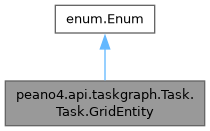
Which kind of mesh entity a Task works on.
GLOBAL tasks do not work on any mesh entity at all. They only plug into prepareTraversal()/unprepareTraversal(), i.e. they realise global (per rank) activities such as triggering the load balancing. They therefore may not declare any cell, face or vertex data, may not repeat. Task graph compilers which fuse tasks append a GLOBAL task to the traversal holding its last dependency (peano4.api.taskgraph.compiler.FuseSteps.translate()). Other tasks may depend on a GLOBAL task. The compiler then does not fuse them into the traversal of the GLOBAL task, as the latter acts in the prepare and unprepare events of this traversal: they run in a later mesh sweep.
GLOBAL_START_OF_STEP and GLOBAL_END_OF_STEP are GLOBAL tasks that are tied to the beginning and the end of the whole task graph rather than to the traversal of their dependencies. Both do not require a mesh traversal of their own:
- A GLOBAL_START_OF_STEP task runs first, i.e. its action sets are the first ones of the first traversal. It may not depend on any task. Other tasks may depend on it, but this is trivial.
- A GLOBAL_END_OF_STEP task runs last, i.e. its action sets are the last ones of the last traversal, after all other tasks including the other GLOBAL tasks. Other GLOBAL_END_OF_STEP tasks may depend on it, which orders them among each other. A typical example is the global CFL condition, which reduces data in unprepareTraversal() only. If a task that is not an end-of-step task depends on it, it cannot run at the very end of the step. It then ends the traversal of its last dependency, as a GLOBAL task does, and the dependent task runs in a later traversal (peano4.api.taskgraph.Graph.Graph.anchored_end_of_step_tasks()).
Task graph compilers that do not fuse tasks guarantee the same order (peano4.api.taskgraph.Graph.Graph.ordered_tasks()).
Definition at line 114 of file Task.py.


 1.15.0