 |
Peano
|
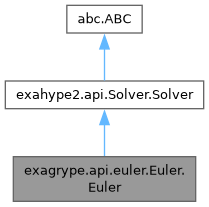
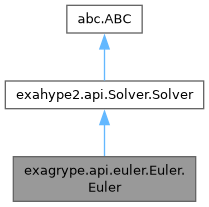
Compressible Euler equations of an ideal gas. More...
Public Member Functions | |
| __init__ (self, str name, float gamma=1.4, exahype2.api.InitPointWisely initial_condition=None) | |
| Create an Euler solver. | |
| add_auxiliary_variables (self, exahype2.api.AuxiliaryVariables auxiliary) | |
| Attach a set of auxiliary variables and hand it to flux, source and eigenvalue. | |
| generate_solver_realisation (self, *args, **kwargs) | |
| Reject solvers that do not see the CCZ4 fields. | |
| float | gamma (self) |
| Adiabatic index of the gas. | |
| Public Member Functions inherited from exahype2.api.Solver.Solver | |
| __init__ (self, str name, VariableSpecification unknowns) | |
| Create solver. | |
| str | __str__ (self) |
| str | name (self) |
| Unique solver name. | |
| "Solver.NumericalScheme" | numerical_scheme (self) |
| numerical_scheme (self, "Solver.NumericalScheme" value) | |
| List["Solver.Plotter"] | plotters (self) |
| All plotters of the solver, in the order they have been added. | |
| add_plotter (self, "Solver.Plotter" plotter) | |
| Add a plotter to the solver. | |
| "Solver.Plotter" | plotter (self) |
| Shorthand for solvers with at most one plotter. | |
| plotter (self, "Solver.Plotter" value) | |
| int | unknowns (self) |
| List["AuxiliaryVariables"] | auxiliary_variables (self) |
| All sets of auxiliary variables in the order they have been attached. | |
| int | number_of_auxiliary_variables (self) |
| Total number of entries of all sets of auxiliary variables. | |
| int | auxiliary_variable_offset (self, "AuxiliaryVariables" auxiliary) |
| Offset of the first entry of a set within the buffer the compute kernels work on, i.e. | |
| str | signature_of (self, PDETerm term) |
| The signature of a PDE term including the pointers to the auxiliary variables. | |
| str | user_solver_includes (self) |
| Add further includes to this property, if your solver requires some additional routines from other header files. | |
| add_user_solver_includes (self, str value) | |
| Add further includes to this property, if your solver requires some additional routines from other header files. | |
| set_solver_constants (self, str datastring) | |
| add_solver_constants (self, str datastring) | |
| List[str] | variable_names_per_entry (self) |
| One name per entry of Q, i.e. | |
| str | get_name_of_global_instance (self) |
| List[PDETerm] | pde_terms (self) |
| All PDE terms (flux, eigenvalues, ...) registered with this solver, in registration order. | |
| bool | requires_user_class (self) |
| True iff at least one PDE term has no implementation. | |
| str | get_name_of_solver_class (self) |
| Name of the C++ class the solver repository instantiates: <SolverName> if requires_user_class, Abstract<SolverName> otherwise. | |
| add_pde_term (self, PDETerm term) | |
| Register a PDE term with this solver, or replace the one already registered under the same name and statelessness. | |
| remove_pde_term (self, str name, bool stateless=False) | |
| Remove a previously registered PDE term by name and statelessness. | |
| PDETerm | get_pde_term (self, str name, bool stateless=False) |
| Look up a previously registered PDE term by name and statelessness. | |
| add_abstract_solver_attribute (self, str declaration) | |
| Add a raw C++ member attribute declaration to the generated Abstract<SolverName> class (. | |
| add_abstract_solver_method (self, str declaration, Callable[[str], str] definition_generator) | |
| Add a raw C++ method to the generated Abstract<SolverName> class: declaration goes into the class body (public section), verbatim. | |
| str | create_readme_descriptor (self, domain_offset, domain_size) |
| Return a human-readable description of this solver instance, to be embedded into the generated project's README. | |
Static Public Attributes | |
| dict | Unknowns |
| Static Public Attributes inherited from exahype2.api.Solver.Solver | |
| str | SolutionUpdateTaskTag = "exahype2.api.Solver.SolutionUpdateTaskTag" |
| Tag of all tasks which write a new solution. | |
| str | IntermediateSolutionUpdateTag = "exahype2.api.Solver.IntermediateSolutionUpdateTag" |
| Tag of all tasks which write an intermediate solution. | |
Protected Member Functions | |
| _refresh_pde_terms (self) | |
| Rebuild the implementations of flux, source and eigenvalue from the hooks. | |
| _ccz4_fields_set (self) | |
| The set of auxiliary variables which holds the CCZ4 fields. | |
| str | _ccz4_fields (self) |
| C++ expression of the pointer to the CCZ4 fields in a PDE term. | |
| str | _flux_implementation (self) |
| C++ of the flux along normal. | |
| str | _source_implementation (self) |
| C++ of the volumetric source. | |
| str | _max_eigenvalue_implementation (self) |
| Protected Member Functions inherited from exahype2.api.Solver.Solver | |
| int | _register_variables (self, VariableSpecification variables, int offset) |
| Translate a plain int or a name-to-multiplicity dict into a total variable count, and - for the dict case - add each name's position within Q to _variable_positions. | |
| str | _get_default_includes (self) |
| Includes every generated action set can rely on being available, regardless of which action sets a concrete discretisation (e.g. | |
| str | _unknown_identifier (self) |
| _add_wants_to_plot_to_solver (self) | |
| Add wantsToPlot() to the solver's C++ class: It holds if any of the solver's plotters is active (exahype2.api.Solver.Solver.Plotter). | |
| _add_checkpoint_meta_data_to_solver (self) | |
| Override exahype2.Solver.toCheckpointMetaData() in the solver's C++ class such that it also writes the attributes added through add_abstract_solver_attribute(), e.g. | |
Protected Attributes | |
| float | _gamma = gamma |
| _flux = exahype2.api.Flux(implementation="", stateless=True) | |
| _source = exahype2.api.VolumetricSource(implementation="", stateless=True) | |
| _max_eigenvalue | |
| Protected Attributes inherited from exahype2.api.Solver.Solver | |
| str | _name = name |
| Create solver. | |
| dict | _variable_positions = {} |
| Translate a plain int or a name-to-multiplicity dict into a total variable count, and - for the dict case - add each name's position within Q to _variable_positions. | |
| int | _unknowns = self._register_variables(unknowns, 0) |
| list | _auxiliary_variables = [] |
| All sets of auxiliary variables in the order they have been attached. | |
| str | _user_solver_includes = "" |
| str | _solver_constants = "" |
| dict | _pde_terms = {} |
| list | _abstract_solver_attributes = [] |
| list | _abstract_solver_methods = [] |
| _numerical_scheme = None | |
| list | _plotters = [] |
| Turn this solver specification into a task graph and create the required C++ kernels/stubs. | |
Additional Inherited Members | |
| Data Fields inherited from exahype2.api.Solver.Solver | |
| solver_generator = SolverToCPPFiles(self) | |
| grid_construction = None | |
| tuple | mesh_adaptation = None |
| Turn this solver specification into a task graph and create the required C++ kernels/stubs. | |
| tuple | grid_selector |
| str | compute_kernel_call = None |
| pde_terms | |
| True iff at least one PDE term has no implementation. | |
Compressible Euler equations of an ideal gas.
The solver evolves the five conserved quantities density, momentum and total energy,
\( \\partial_t \\begin{pmatrix} \\rho \\\\ j \\\\ E \\end{pmatrix} + \\nabla \\cdot \\begin{pmatrix} j \\\\ j \\otimes j / \\rho + p I \\\\ (E+p) j / \\rho \\end{pmatrix} = 0, \\qquad p = (\\gamma-1) \\left(E - \\frac{|j|^2}{2\\rho}\\right), \)
in three dimensions. It has a flux, a maximum eigenvalue, a source term and an initial condition, all of them stateless. The source term is zero. Flux, source and eigenvalue see the CCZ4 fields, even though they ignore them at the moment. The solver always holds a set of auxiliary variables with the 58 entries of first-order CCZ4, which the user attaches (add_auxiliary_variables()); generating the solver without it fails. By default, the initial condition is a density wave which the fluid advects with constant velocity (initialvalues.smooth_wave()).
The solver is deliberately plain. Its purpose within ExaGRyPE is to be the matter ingredient which one couples to exagrype.api.FOCCZ4Solver. The assembly of such a coupled system is not part of this class, but done by the user (see benchmarks/exagrype/gauge-wave-with-Euler), who typically attaches auxiliary variables (exahype2.api.AuxiliaryVariables) with the spacetime to the solver, and replaces the flux and the source term through the hooks _flux_implementation() and _source_implementation().
| exagrype.api.euler.Euler.Euler.__init__ | ( | self, | |
| str | name, | ||
| float | gamma = 1.4, | ||
| exahype2.api.InitPointWisely | initial_condition = None ) |
Create an Euler solver.
| name | str Name of the solver, exahype2.api.Solver. |
| gamma | float Adiabatic index of the ideal gas. Has to be greater than one. |
| initial_condition | exahype2.api.InitPointWisely Initial condition. Defaults to exagrype.api.euler.initialvalues.smooth_wave(). |
Definition at line 58 of file Euler.py.
References __init__(), and Unknowns.
Referenced by __init__().
|
protected |
C++ expression of the pointer to the CCZ4 fields in a PDE term.
The kernels of exagrype.euler take it as ccz4Fields.
Definition at line 180 of file Euler.py.
References _ccz4_fields_set().

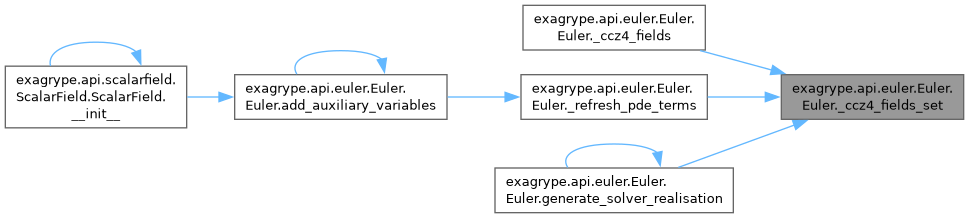
|
protected |
The set of auxiliary variables which holds the CCZ4 fields.
It is the set with as many entries as FOCCZ4Solver has unknowns. Other sets (such as the lapse of a toy coupling) are not handed to the kernels.
Definition at line 159 of file Euler.py.
References exahype2.api.Solver.Solver.auxiliary_variables().
Referenced by _ccz4_fields(), _refresh_pde_terms(), and generate_solver_realisation().

|
protected |
C++ of the flux along normal.
Hook for subclasses, which can scale or modify the flux, e.g. by the lapse of a spacetime they hold as auxiliary variables. The code has the variables Q, x, normal and F at hand, plus one pointer per set of auxiliary variables (the CCZ4 fields: _ccz4_fields()). The default calls exagrype.euler.flux().
Definition at line 195 of file Euler.py.
Referenced by solvers.fv.FV.FV.__str__(), and _refresh_pde_terms().

|
protected |
Definition at line 225 of file Euler.py.
Referenced by _refresh_pde_terms().

|
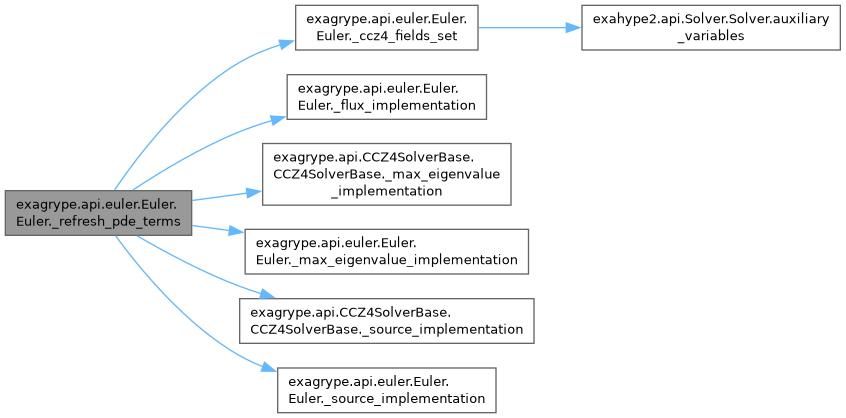
protected |
Rebuild the implementations of flux, source and eigenvalue from the hooks.
Nothing happens before the set with the CCZ4 fields has been attached, as the kernels need it.
Definition at line 144 of file Euler.py.
References _ccz4_fields_set(), _flux, _flux_implementation(), solvers.aderdg.AbstractSolverDeclarations.AbstractSolverDeclarations._flux_implementation, solvers.aderdg.AbstractSolverDefinitions.AbstractSolverDefinitions._flux_implementation, solvers.aderdg.ADERDG.ADERDG._flux_implementation, solvers.aderdg.SolverDeclarations.SolverDeclarations._flux_implementation, solvers.aderdg.SolverDefinitions.SolverDefinitions._flux_implementation, solvers.fv.musclhancock.GlobalAdaptiveTimeStep.GlobalAdaptiveTimeStep._flux_implementation, solvers.fv.musclhancock.GlobalFixedTimeStep.GlobalFixedTimeStep._flux_implementation, solvers.fv.riemann.GlobalAdaptiveTimeStep.GlobalAdaptiveTimeStep._flux_implementation, solvers.fv.riemann.GlobalAdaptiveTimeStepWithEnclaveTasking.GlobalAdaptiveTimeStepWithEnclaveTasking._flux_implementation, solvers.fv.riemann.GlobalFixedTimeStep.GlobalFixedTimeStep._flux_implementation, solvers.fv.riemann.GlobalFixedTimeStepWithEnclaveTasking.GlobalFixedTimeStepWithEnclaveTasking._flux_implementation, solvers.fv.rusanov.GlobalAdaptiveTimeStep.GlobalAdaptiveTimeStep._flux_implementation, solvers.fv.rusanov.GlobalAdaptiveTimeStepWithEnclaveTasking.GlobalAdaptiveTimeStepWithEnclaveTasking._flux_implementation, solvers.fv.rusanov.GlobalFixedTimeStep.GlobalFixedTimeStep._flux_implementation, solvers.fv.rusanov.GlobalFixedTimeStepWithEnclaveTasking.GlobalFixedTimeStepWithEnclaveTasking._flux_implementation, solvers.fv.rusanov.LocalTimeStepWithEnclaveTasking.LocalTimeStepWithEnclaveTasking._flux_implementation, solvers.fv.rusanov.SubcyclingAdaptiveTimeStepWithEnclaveTasking.SubcyclingAdaptiveTimeStepWithEnclaveTasking._flux_implementation, solvers.fv.rusanov.SubcyclingFixedTimeStep.SubcyclingFixedTimeStep._flux_implementation, solvers.fv.rusanov.SubcyclingFixedTimeStepWithEnclaveTasking.SubcyclingFixedTimeStepWithEnclaveTasking._flux_implementation, solvers.rkdg.RungeKuttaDG.RungeKuttaDG._flux_implementation, _max_eigenvalue, exagrype.api.CCZ4SolverBase.CCZ4SolverBase._max_eigenvalue_implementation(), _max_eigenvalue_implementation(), exagrype.api.actionsets.CopyPatchWithLinearInterpolation.CopyPatchWithLinearInterpolation._source, _source, exagrype.api.CCZ4SolverBase.CCZ4SolverBase._source_implementation(), and _source_implementation().
Referenced by add_auxiliary_variables().

|
protected |
C++ of the volumetric source.
Hook for subclasses. The code has Q, x, t and S at hand, plus the arguments of _flux_implementation(). The default calls exagrype.euler.source(), which yields zero.
Definition at line 211 of file Euler.py.
Referenced by _refresh_pde_terms().

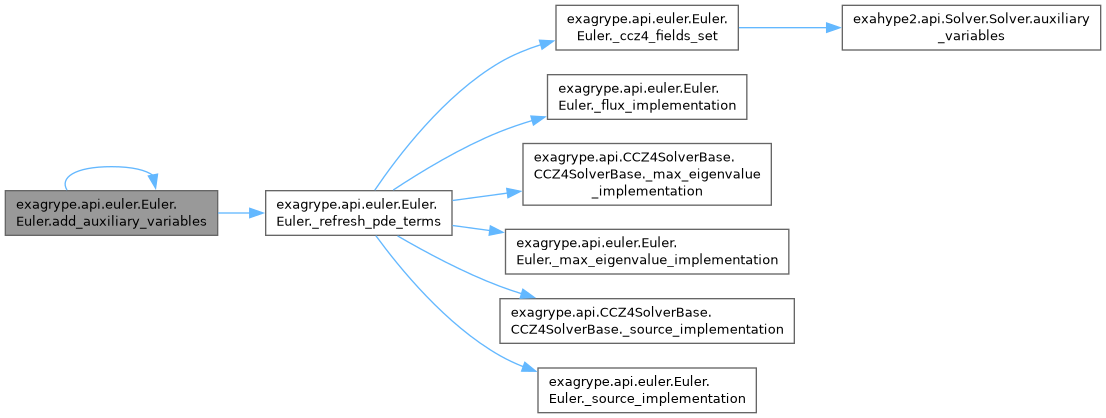
| exagrype.api.euler.Euler.Euler.add_auxiliary_variables | ( | self, | |
| exahype2.api.AuxiliaryVariables | auxiliary ) |
Attach a set of auxiliary variables and hand it to flux, source and eigenvalue.
The sets are not known when the constructor creates the PDE terms, so the terms are (re)built from the hooks whenever a set arrives. They stay empty until the first set has been attached.
| auxiliary | exahype2.api.AuxiliaryVariables The set, exahype2.api.Solver.add_auxiliary_variables(). |
Reimplemented from exahype2.api.Solver.Solver.
Definition at line 106 of file Euler.py.
References _refresh_pde_terms(), and add_auxiliary_variables().
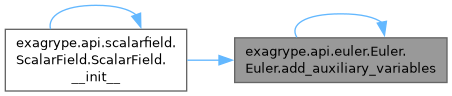
Referenced by exagrype.api.scalarfield.ScalarField.ScalarField.__init__(), and add_auxiliary_variables().
| float exagrype.api.euler.Euler.Euler.gamma | ( | self | ) |
| exagrype.api.euler.Euler.Euler.generate_solver_realisation | ( | self, | |
| * | args, | ||
| ** | kwargs ) |
Reject solvers that do not see the CCZ4 fields.
The Euler solver is the matter part of a coupled system with first-order CCZ4. Hence, it always holds a set of auxiliary variables with as many entries as FOCCZ4Solver has unknowns. Flux, source and eigenvalue rely on this and do not handle solvers without auxiliary variables. The check runs at generation time, as the sets are attached after the constructor.
Reimplemented from exahype2.api.Solver.Solver.
Definition at line 122 of file Euler.py.
References _ccz4_fields_set(), and generate_solver_realisation().
Referenced by generate_solver_realisation().

|
protected |
Definition at line 94 of file Euler.py.
Referenced by _refresh_pde_terms().
|
protected |
Definition at line 81 of file Euler.py.
Referenced by gamma(), and exaparty.api.sphtools.riemann.RiemannSolver.get_soundspeed().
|
protected |
Definition at line 96 of file Euler.py.
Referenced by _refresh_pde_terms().
|
protected |
Definition at line 95 of file Euler.py.
Referenced by _refresh_pde_terms().
|
static |
Definition at line 51 of file Euler.py.
Referenced by __init__(), exagrype.api.FOCCZ4Solver.FOCCZ4Solver.__init__(), exagrype.api.FOSOCCZ4Solver.FOSOCCZ4Solver.__init__(), exagrype.api.scalarfield.ScalarField.ScalarField.__init__(), exagrype.api.FOSOCCZ4Solver.FOSOCCZ4Solver._number_of_evolved_entries(), exagrype.api.CCZ4SolverBase.CCZ4SolverBase.advected_quantities(), and exagrype.api.FOSOCCZ4Solver.FOSOCCZ4Solver.advected_quantities().
 1.15.0