 |
Peano
|
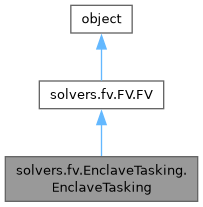
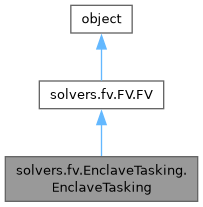
Enclave tasking variant of the Finite Volume scheme. More...
Public Member Functions | |
| __init__ (self, name, patch_size, overlap, unknowns, auxiliary_variables, min_volume_h, max_volume_h, plot_grid_properties, bool pde_terms_without_state, kernel_namespace) | |
| Not so nice. | |
| create_data_structures (self) | |
| This routine does not really add new data, but it heavily tailors when data are stored, exchanged, ... Each generator has some guard attributes, i.e., some guards, which control when data is stored, sent, received. | |
| create_action_sets (self) | |
| Adaptive mesh handing. | |
| set_implementation (self, boundary_conditions, refinement_criterion, initial_conditions, memory_location, use_split_loop, additional_action_set_includes, additional_user_includes) | |
| If you pass in User_Defined, then the generator will create C++ stubs that you have to befill manually. | |
| add_entries_to_text_replacement_dictionary (self, d) | |
| d: Dictionary of string to string in/out argument | |
| add_actions_to_create_grid (self, step, evaluate_refinement_criterion) | |
| The boundary information is set only once. | |
| add_actions_to_init_grid (self, step) | |
| Add all the action sets to init grid. | |
| add_actions_to_perform_time_step (self, step) | |
| Add enclave aspect to time stepping. | |
| add_implementation_files_to_project (self, namespace, output, dimensions, subdirectory="") | |
| The ExaHyPE project will call this operation when it sets up the overall environment. | |
| switch_storage_scheme (self, Storage cell_data_storage, Storage face_data_storage) | |
| By default, we hold all data on the heap using smart pointers. | |
| Public Member Functions inherited from solvers.fv.FV.FV | |
| __init__ (self, name, patch_size, overlap, unknowns, auxiliary_variables, min_volume_h, max_volume_h, plot_grid_properties, bool pde_terms_without_state, kernel_namespace, baseline_action_set_descend_invocation_order=0) | |
| Create solver. | |
| __str__ (self) | |
| get_min_number_of_spacetree_levels (self, domain_size) | |
| get_max_number_of_spacetree_levels (self, domain_size) | |
| get_coarsest_number_of_patches (self, domain_size) | |
| get_finest_number_of_patches (self, domain_size) | |
| get_coarsest_number_of_finite_volumes (self, domain_size) | |
| get_finest_number_of_finite_volumes (self, domain_size) | |
| get_coarsest_volume_size (self, domain_size) | |
| get_finest_volume_size (self, domain_size) | |
| create_readme_descriptor (self, domain_offset, domain_size) | |
| user_action_set_includes (self) | |
| Add further includes to this property, if your action sets require some additional routines from other header files. | |
| user_solver_includes (self) | |
| Add further includes to this property, if your solver requires some additional routines from other header files. | |
| add_user_action_set_includes (self, value) | |
| Add further includes to this property, if your action sets require some additional routines from other header files. | |
| add_user_solver_includes (self, value) | |
| Add further includes to this property, if your solver requires some additional routines from other header files. | |
| get_name_of_global_instance (self) | |
| add_to_Peano4_datamodel (self, datamodel, verbose) | |
| Add all required data to the Peano project's datamodel so it is properly built up. | |
| add_use_data_statements_to_Peano4_solver_step (self, step) | |
| Tell Peano what data to move around. | |
| plot_description (self) | |
| plot_description (self, description) | |
| Add a proper description to the plots. | |
| add_actions_to_plot_solution (self, step, output_path, restart_from_checkpoint=False) | |
| Add action sets to plot solution step. | |
| add_actions_to_checkpoint_solution (self, step, output_path, restart_from_checkpoint=False) | |
| Add action sets to plot solution step. | |
| set_solver_constants (self, datastring) | |
| add_solver_constants (self, datastring) | |
| unknowns (self) | |
| patch_size (self) | |
| auxiliary_variables (self) | |
| patch_size (self, value) | |
| unknowns (self, value) | |
| auxiliary_variables (self, value) | |
| preprocess_reconstructed_patch (self) | |
| preprocess_reconstructed_patch (self, kernel) | |
| Set a new processing kernel. | |
| name (self) | |
| postprocess_updated_patch (self) | |
| postprocess_updated_patch (self, kernel) | |
| Define a postprocessing routine over the data. | |
| overlap (self) | |
| overlap (self, value) | |
| interpolation (self) | |
| interpolation (self, value) | |
| restriction (self) | |
| restriction (self, value) | |
Data Fields | |
| str | enclave_task_priority = "tarch::multicore::Task::DefaultPriority-1" |
| bool | make_copy_of_enclave_task_data = False |
| Data Fields inherited from solvers.fv.FV.FV | |
| select_dofs_to_print = None | |
Protected Member Functions | |
| _create_guards (self) | |
| All the internal logic depends on guards, i.e., boolean predicates. | |
| _optimise_patch_storage_for_global_time_stepping (self) | |
| Make storage and loading more restrictive such that enclave data are not held in-between primary and secondary sweep. | |
| _enclave_task_name (self) | |
| Protected Member Functions inherited from solvers.fv.FV.FV | |
| _provide_cell_data_to_compute_kernels_default_guard (self) | |
| Default logic when to create cell data or not. | |
| _provide_face_data_to_compute_kernels_default_guard (self) | |
| _store_cell_data_default_guard (self) | |
| Extend the guard via ands only. | |
| _load_cell_data_default_guard (self) | |
| Extend the guard via ands only. | |
| _store_face_data_default_guard (self) | |
| Extend the guard via ands only. | |
| _load_face_data_default_guard (self) | |
| Extend the guard via ands only. | |
| _unknown_identifier (self) | |
| _get_default_includes (self) | |
| _init_dictionary_with_default_parameters (self, d) | |
| This one is called by all algorithmic steps before I invoke add_entries_to_text_replacement_dictionary(). | |
Enclave tasking variant of the Finite Volume scheme.
The concept of (enclave) tasking within ExaHyPE solvers is described in detail in the generic enclave discussion of ExaHyPE. This class is a prototype realisation of this concept which other solvers then specialise for particular numerical schemes.
The class basically replaces the standard "update a cell" action set with an action set that might or might not spawn a task. In return, it adds a further action set which merges the arising task outcomes into the actual mesh structure. By default, we use peano4.datamanagement.CellMarker.willBeEnclaveCell() and peano4.datamanagement.CellMarker.hasBeenEnclaveCell() to guide the decision whether to spawn a task or not. You can overwrite this decision by redefining the corresponding entry in the dictionary befilled by add_entries_to_text_replacement_dictionary().
Use the attributes self.enclave_task_priority to change the priority of the task. This value can either be a string that C++ can evaluate into a priority or a plain numerical value. I set it to
self.enclave_task_priority = "tarch::multicore::Task::DefaultPriority-1"
by default.
Definition at line 300 of file EnclaveTasking.py.
| solvers.fv.EnclaveTasking.EnclaveTasking.__init__ | ( | self, | |
| name, | |||
| patch_size, | |||
| overlap, | |||
| unknowns, | |||
| auxiliary_variables, | |||
| min_volume_h, | |||
| max_volume_h, | |||
| plot_grid_properties, | |||
| bool | pde_terms_without_state, | ||
| kernel_namespace ) |
Not so nice.
I have to store this field as I later rely on get_name_of_global_instance() which uses this field.
Definition at line 330 of file EnclaveTasking.py.
|
protected |
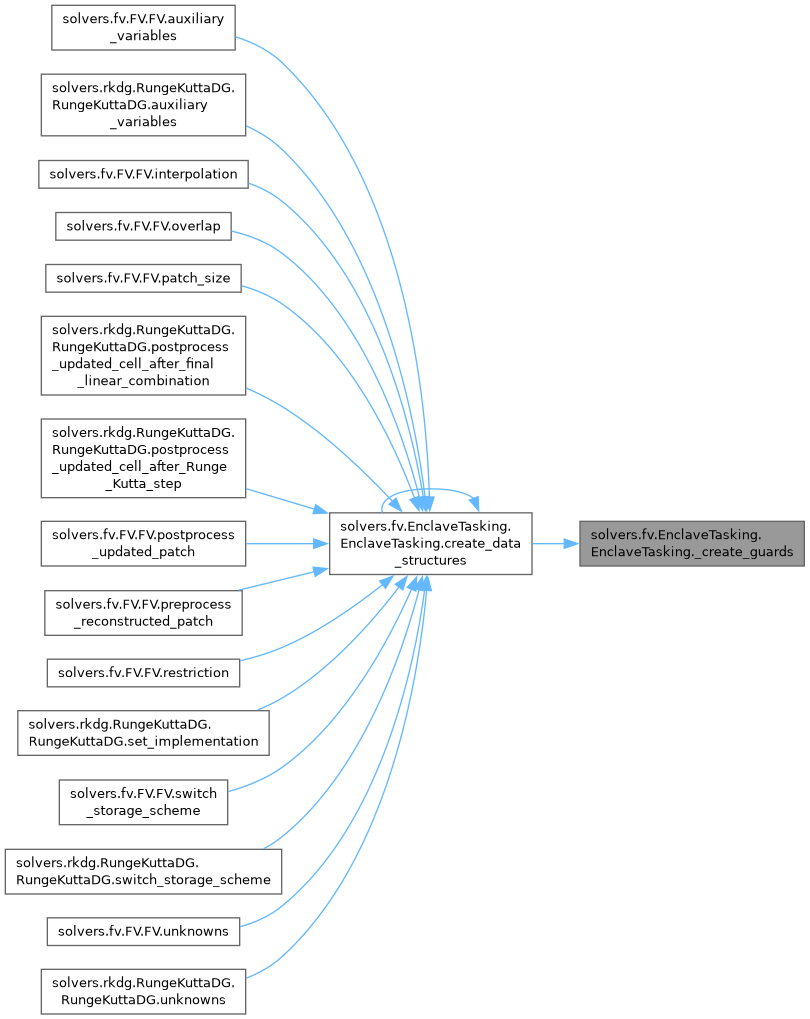
All the internal logic depends on guards, i.e., boolean predicates.
We want to be able to alter them in subclasses, but we need a certain baseline. It is defined in this routine.
Definition at line 375 of file EnclaveTasking.py.
Referenced by create_data_structures().
|
protected |
Definition at line 833 of file EnclaveTasking.py.
References api.solvers.Solver.Solver._name, api.Tree.Tree._name, dastgen2.attributes.Attribute.Attribute._name, dastgen2.attributes.BooleanArray.BooleanArray._name, dastgen2.attributes.Enumeration.Enumeration._name, exagrype.api.euler.CCZ4WithEuler_OuterAdditiveCoupling.CCZ4WithEuler_OuterAdditiveCoupling._name, exagrype.api.euler.CCZ4WithEuler_OuterMultiplicativeCoupling.CCZ4WithEuler_OuterMultiplicativeCoupling._name, exagrype.api.FOSOSolver.FOSOSolver._name, exagrype.api.scalarfield.CCZ4WithScalarField_InnerCoupling.CCZ4WithScalarField_InnerCoupling._name, exagrype.api.scalarfield.CCZ4WithScalarField_OuterMultiplicativeCoupling.CCZ4WithScalarField_OuterMultiplicativeCoupling._name, exahype2.api.AuxiliaryVariables.AuxiliaryVariables._name, exahype2.api.dslhype.SyntaxTree.Construction._name, exahype2.api.dslhype.SyntaxTree.DataBlockConstructionFromDotProduct._name, exahype2.api.dslhype.SyntaxTree.DataBlockConstructionFromExisting._name, exahype2.api.dslhype.SyntaxTree.DataBlockConstructionFromFunction._name, exahype2.api.dslhype.SyntaxTree.DataBlockConstructionFromMatrixVectorProduct._name, exahype2.api.dslhype.SyntaxTree.DataBlockConstructionFromOperation._name, exahype2.api.dslhype.SyntaxTree.MemoryAllocation._name, exahype2.api.dslhype.SyntaxTree.MemoryDeallocation._name, exahype2.api.Solver.Solver._name, mghype::matrixfree::solvers::Solver._name, peano4.api.dastgen2.Peano4DoubleArray.Peano4DoubleArray._name, peano4.api.dastgen2.Peano4IntegerArray.Peano4IntegerArray._name, peano4.api.dastgen2.Peano4SmartPointerDoubleArray.Peano4SmartPointerDoubleArray._name, peano4::RunMultipleSteps._name, solvers.aderdg.ADERDG.ADERDG._name, solvers.api.Solver.Solver._name, solvers.elliptic.AMRMarker.AMRMarker._name, solvers.elliptic.ConstrainedPoissonEquationForMarkerOnCells.ConstrainedPoissonEquationForMarkerOnCells._name, _name, and tarch::services::ServiceRepository::ServiceEntry._name.
Referenced by add_implementation_files_to_project().

|
protected |
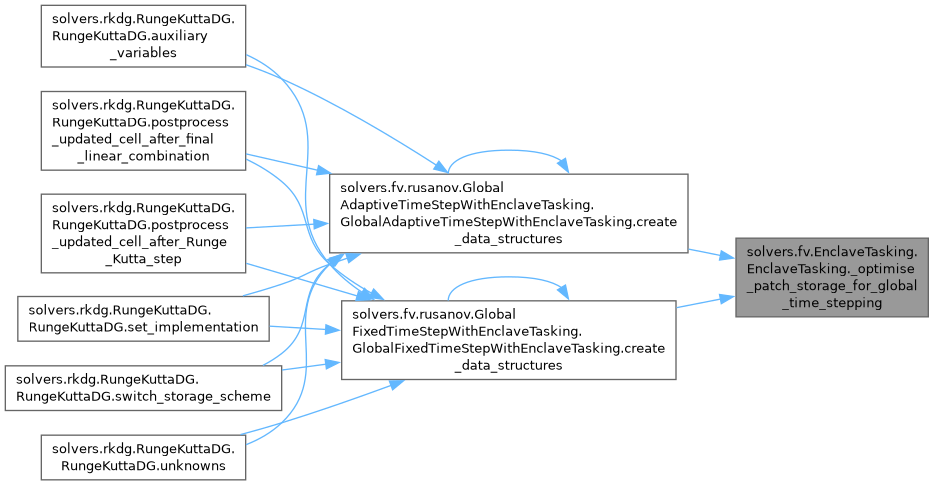
Make storage and loading more restrictive such that enclave data are not held in-between primary and secondary sweep.
If you work with global time stepping, you know that each enclave cell will be updated per grid traversal duo. Consequently, every enclave cell's data doesn't have to be stored in-between two grid traversals - we know that it is currently outsourced to a task.
Things are different if we use local time stepping, as there will always be cells that are currently processed, and then there are cells which are not updated and which we consequently should keep.
If you want to have this optimisation, you have to call this routine explicitly in create_data_structures(). By default, we always store the patches all the time.
If we work with smart pointers, it is a bad idea to call this routine, as the enclave framework does not(!) use smart pointers. So we rely on the fact that someone holds the raw pointers alive. If we don't store data here, we run risk that the smart pointer becomes zero and the underlying memory is freed while the enclave task still works against it.
As I don't know what storage scheme we employ, I decided to disable this routine. Notably as I don't think storing makes much of a difference if data are held on the heap anyway.
Definition at line 539 of file EnclaveTasking.py.
Referenced by solvers.fv.rusanov.GlobalAdaptiveTimeStepWithEnclaveTasking.GlobalAdaptiveTimeStepWithEnclaveTasking.create_data_structures(), and solvers.fv.rusanov.GlobalFixedTimeStepWithEnclaveTasking.GlobalFixedTimeStepWithEnclaveTasking.create_data_structures().
| solvers.fv.EnclaveTasking.EnclaveTasking.add_actions_to_create_grid | ( | self, | |
| step, | |||
| evaluate_refinement_criterion ) |
The boundary information is set only once.
It is therefore important that we ues the face label and initialise it properly.
Reimplemented from solvers.fv.FV.FV.
Definition at line 760 of file EnclaveTasking.py.
References api.solvers.Solver.Solver._name, api.Tree.Tree._name, dastgen2.attributes.Attribute.Attribute._name, dastgen2.attributes.BooleanArray.BooleanArray._name, dastgen2.attributes.Enumeration.Enumeration._name, exagrype.api.euler.CCZ4WithEuler_OuterAdditiveCoupling.CCZ4WithEuler_OuterAdditiveCoupling._name, exagrype.api.euler.CCZ4WithEuler_OuterMultiplicativeCoupling.CCZ4WithEuler_OuterMultiplicativeCoupling._name, exagrype.api.FOSOSolver.FOSOSolver._name, exagrype.api.scalarfield.CCZ4WithScalarField_InnerCoupling.CCZ4WithScalarField_InnerCoupling._name, exagrype.api.scalarfield.CCZ4WithScalarField_OuterMultiplicativeCoupling.CCZ4WithScalarField_OuterMultiplicativeCoupling._name, exahype2.api.AuxiliaryVariables.AuxiliaryVariables._name, exahype2.api.dslhype.SyntaxTree.Construction._name, exahype2.api.dslhype.SyntaxTree.DataBlockConstructionFromDotProduct._name, exahype2.api.dslhype.SyntaxTree.DataBlockConstructionFromExisting._name, exahype2.api.dslhype.SyntaxTree.DataBlockConstructionFromFunction._name, exahype2.api.dslhype.SyntaxTree.DataBlockConstructionFromMatrixVectorProduct._name, exahype2.api.dslhype.SyntaxTree.DataBlockConstructionFromOperation._name, exahype2.api.dslhype.SyntaxTree.MemoryAllocation._name, exahype2.api.dslhype.SyntaxTree.MemoryDeallocation._name, exahype2.api.Solver.Solver._name, mghype::matrixfree::solvers::Solver._name, peano4.api.dastgen2.Peano4DoubleArray.Peano4DoubleArray._name, peano4.api.dastgen2.Peano4IntegerArray.Peano4IntegerArray._name, peano4.api.dastgen2.Peano4SmartPointerDoubleArray.Peano4SmartPointerDoubleArray._name, peano4::RunMultipleSteps._name, solvers.aderdg.ADERDG.ADERDG._name, solvers.api.Solver.Solver._name, solvers.elliptic.AMRMarker.AMRMarker._name, solvers.elliptic.ConstrainedPoissonEquationForMarkerOnCells.ConstrainedPoissonEquationForMarkerOnCells._name, _name, tarch::services::ServiceRepository::ServiceEntry._name, and add_actions_to_create_grid().
Referenced by add_actions_to_create_grid().
| solvers.fv.EnclaveTasking.EnclaveTasking.add_actions_to_init_grid | ( | self, | |
| step ) |
Add all the action sets to init grid.
The AMR stuff has to be the very first thing. Actually, the AMR routines' interpolation doesn't play any role here. But the restriction indeed is very important, as we have to get the face data for BCs et al. The action set order is inverted while we ascend within the tree again. Therefore, we add the AMR action set first which means it will be called last when we go from fine to coarse levels within the tree.
The order of the action sets is preserved throughout the steps down within the tree hierarchy. It is inverted throughout the backrolling.
This is what we want to achieve:
Reimplemented from solvers.fv.FV.FV.
Definition at line 767 of file EnclaveTasking.py.
References api.solvers.Solver.Solver._name, api.Tree.Tree._name, dastgen2.attributes.Attribute.Attribute._name, dastgen2.attributes.BooleanArray.BooleanArray._name, dastgen2.attributes.Enumeration.Enumeration._name, exagrype.api.euler.CCZ4WithEuler_OuterAdditiveCoupling.CCZ4WithEuler_OuterAdditiveCoupling._name, exagrype.api.euler.CCZ4WithEuler_OuterMultiplicativeCoupling.CCZ4WithEuler_OuterMultiplicativeCoupling._name, exagrype.api.FOSOSolver.FOSOSolver._name, exagrype.api.scalarfield.CCZ4WithScalarField_InnerCoupling.CCZ4WithScalarField_InnerCoupling._name, exagrype.api.scalarfield.CCZ4WithScalarField_OuterMultiplicativeCoupling.CCZ4WithScalarField_OuterMultiplicativeCoupling._name, exahype2.api.AuxiliaryVariables.AuxiliaryVariables._name, exahype2.api.dslhype.SyntaxTree.Construction._name, exahype2.api.dslhype.SyntaxTree.DataBlockConstructionFromDotProduct._name, exahype2.api.dslhype.SyntaxTree.DataBlockConstructionFromExisting._name, exahype2.api.dslhype.SyntaxTree.DataBlockConstructionFromFunction._name, exahype2.api.dslhype.SyntaxTree.DataBlockConstructionFromMatrixVectorProduct._name, exahype2.api.dslhype.SyntaxTree.DataBlockConstructionFromOperation._name, exahype2.api.dslhype.SyntaxTree.MemoryAllocation._name, exahype2.api.dslhype.SyntaxTree.MemoryDeallocation._name, exahype2.api.Solver.Solver._name, mghype::matrixfree::solvers::Solver._name, peano4.api.dastgen2.Peano4DoubleArray.Peano4DoubleArray._name, peano4.api.dastgen2.Peano4IntegerArray.Peano4IntegerArray._name, peano4.api.dastgen2.Peano4SmartPointerDoubleArray.Peano4SmartPointerDoubleArray._name, peano4::RunMultipleSteps._name, solvers.aderdg.ADERDG.ADERDG._name, solvers.api.Solver.Solver._name, solvers.elliptic.AMRMarker.AMRMarker._name, solvers.elliptic.ConstrainedPoissonEquationForMarkerOnCells.ConstrainedPoissonEquationForMarkerOnCells._name, _name, tarch::services::ServiceRepository::ServiceEntry._name, and add_actions_to_init_grid().
Referenced by add_actions_to_init_grid().
| solvers.fv.EnclaveTasking.EnclaveTasking.add_actions_to_perform_time_step | ( | self, | |
| step ) |
Add enclave aspect to time stepping.
There's a bunch of different things to do to extend my standard solver into an enclave solver. In this operation, we add the runtime logic, i.e., what happens at which point.
We need additional action sets that are triggered throughout the traversal in every second time step. I call this one task_based_implementation_primary_iteration or secondary, respectively. One wraps the implementation of _HandleCellTemplate into a task, the other communicates with the task bookkeeping only. Both rely on additional labels within the cell. We therefore end up with three new action sets: reconstruct_patch_and_apply_FV_kernel, exahype2.grid.UpdateCellLabel and roll_over_enclave_task_results.
Reimplemented from solvers.fv.FV.FV.
Definition at line 772 of file EnclaveTasking.py.
References _action_set_merge_enclave_task_outcome, and add_actions_to_perform_time_step().
Referenced by add_actions_to_perform_time_step().
| solvers.fv.EnclaveTasking.EnclaveTasking.add_entries_to_text_replacement_dictionary | ( | self, | |
| d ) |
d: Dictionary of string to string in/out argument
Reimplemented from solvers.fv.FV.FV.
Definition at line 717 of file EnclaveTasking.py.
References _fused_compute_kernel_call_stateless_cpu, _fused_compute_kernel_call_stateless_gpu, api.solvers.Solver.Solver._name, api.Tree.Tree._name, dastgen2.attributes.Attribute.Attribute._name, dastgen2.attributes.BooleanArray.BooleanArray._name, dastgen2.attributes.Enumeration.Enumeration._name, exagrype.api.euler.CCZ4WithEuler_OuterAdditiveCoupling.CCZ4WithEuler_OuterAdditiveCoupling._name, exagrype.api.euler.CCZ4WithEuler_OuterMultiplicativeCoupling.CCZ4WithEuler_OuterMultiplicativeCoupling._name, exagrype.api.FOSOSolver.FOSOSolver._name, exagrype.api.scalarfield.CCZ4WithScalarField_InnerCoupling.CCZ4WithScalarField_InnerCoupling._name, exagrype.api.scalarfield.CCZ4WithScalarField_OuterMultiplicativeCoupling.CCZ4WithScalarField_OuterMultiplicativeCoupling._name, exahype2.api.AuxiliaryVariables.AuxiliaryVariables._name, exahype2.api.dslhype.SyntaxTree.Construction._name, exahype2.api.dslhype.SyntaxTree.DataBlockConstructionFromDotProduct._name, exahype2.api.dslhype.SyntaxTree.DataBlockConstructionFromExisting._name, exahype2.api.dslhype.SyntaxTree.DataBlockConstructionFromFunction._name, exahype2.api.dslhype.SyntaxTree.DataBlockConstructionFromMatrixVectorProduct._name, exahype2.api.dslhype.SyntaxTree.DataBlockConstructionFromOperation._name, exahype2.api.dslhype.SyntaxTree.MemoryAllocation._name, exahype2.api.dslhype.SyntaxTree.MemoryDeallocation._name, exahype2.api.Solver.Solver._name, mghype::matrixfree::solvers::Solver._name, peano4.api.dastgen2.Peano4DoubleArray.Peano4DoubleArray._name, peano4.api.dastgen2.Peano4IntegerArray.Peano4IntegerArray._name, peano4.api.dastgen2.Peano4SmartPointerDoubleArray.Peano4SmartPointerDoubleArray._name, peano4::RunMultipleSteps._name, solvers.aderdg.ADERDG.ADERDG._name, solvers.api.Solver.Solver._name, solvers.elliptic.AMRMarker.AMRMarker._name, solvers.elliptic.ConstrainedPoissonEquationForMarkerOnCells.ConstrainedPoissonEquationForMarkerOnCells._name, _name, tarch::services::ServiceRepository::ServiceEntry._name, enclave_task_priority, and make_copy_of_enclave_task_data.
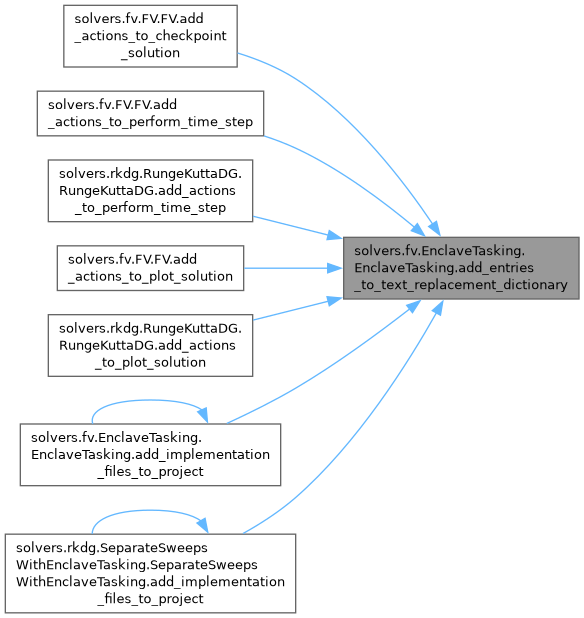
Referenced by solvers.fv.FV.FV.add_actions_to_checkpoint_solution(), solvers.fv.FV.FV.add_actions_to_perform_time_step(), solvers.rkdg.RungeKuttaDG.RungeKuttaDG.add_actions_to_perform_time_step(), solvers.fv.FV.FV.add_actions_to_plot_solution(), solvers.rkdg.RungeKuttaDG.RungeKuttaDG.add_actions_to_plot_solution(), add_implementation_files_to_project(), and solvers.rkdg.SeparateSweepsWithEnclaveTasking.SeparateSweepsWithEnclaveTasking.add_implementation_files_to_project().
| solvers.fv.EnclaveTasking.EnclaveTasking.add_implementation_files_to_project | ( | self, | |
| namespace, | |||
| output, | |||
| dimensions, | |||
| subdirectory = "" ) |
The ExaHyPE project will call this operation when it sets up the overall environment.
This routine is typically not invoked by a user.
output: peano4.api.output.Output
Reimplemented from solvers.fv.FV.FV.
Definition at line 793 of file EnclaveTasking.py.
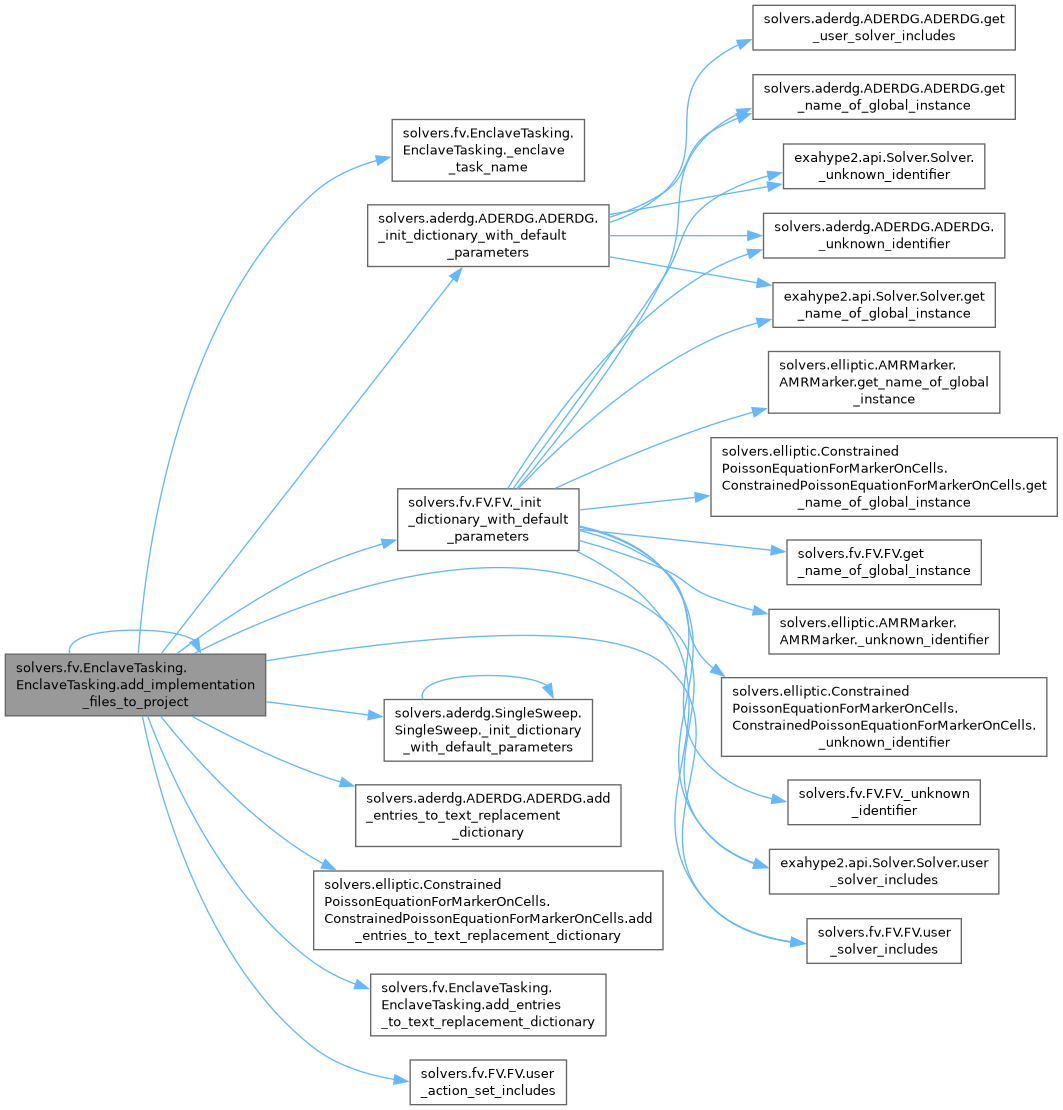
References _enclave_task_name(), solvers.aderdg.ADERDG.ADERDG._init_dictionary_with_default_parameters(), solvers.aderdg.SingleSweep.SingleSweep._init_dictionary_with_default_parameters(), solvers.fv.FV.FV._init_dictionary_with_default_parameters(), solvers.aderdg.ADERDG.ADERDG.add_entries_to_text_replacement_dictionary(), solvers.elliptic.ConstrainedPoissonEquationForMarkerOnCells.ConstrainedPoissonEquationForMarkerOnCells.add_entries_to_text_replacement_dictionary(), add_entries_to_text_replacement_dictionary(), add_implementation_files_to_project(), solvers.aderdg.ADERDG.ADERDG.user_action_set_includes, solvers.fv.FV.FV.user_action_set_includes(), solvers.limiting.PosterioriLimiting.PosterioriLimiting.user_action_set_includes, solvers.limiting.StaticLimiting.StaticLimiting.user_action_set_includes, exagrype.api.CCZ4SolverBase.CCZ4SolverBase.user_solver_includes, exahype2.api.Solver.Solver.user_solver_includes(), solvers.aderdg.ADERDG.ADERDG.user_solver_includes, solvers.fv.FV.FV.user_solver_includes(), solvers.limiting.PosterioriLimiting.PosterioriLimiting.user_solver_includes, and solvers.limiting.StaticLimiting.StaticLimiting.user_solver_includes.
Referenced by add_implementation_files_to_project().
| solvers.fv.EnclaveTasking.EnclaveTasking.create_action_sets | ( | self | ) |
Adaptive mesh handing.
Adaptive meshes require us to clear the patch overlaps and to restrict/interpolate. Obviously, there's no need to do this for a refined faces. So we can eliminate these cases a priori. Furthermore, we clear faces only in the primary sweep. We know that either the primary sweep (for skeleton) or the secondary sweep (for enclaves) will write in proper data into anything that's cleared, and we know that restriction only has to happen after the primary sweep, as all cells next to an adaptivity boundary are skeleton cells.
As pointed out, both interpolation and restriction are to be active for the first sweep only. We interpolate into hanging faces, and we have to restrict immediately again as they are non-persistent. The projection onto the (hanging) faces is also happening directly in the primary sweep, as the cells adjacent to the hanging face are skeleton cells.
AMR and adjust cell have to be there always, i.e., also throughout the grid construction. But the criterion is something that we only evaluate in the secondary sweep. That's when we have an updated/changed time step. If we identify coarsening and refinement instructions in the secondary sweep, the next primary one will actually see them and trigger the update. That is, the subsequent secondary switch will actually implement the grid changes, and we can evaluate the criteria again.
For dynamic AMR, this implies that we have to ensure that all changed grid parts are labelled as skeleton cells. This way, we can implement the AMR properly, we ensure that all the enclaves run in parallel, and we know that all data is held persistently on the stacks.
Reimplemented from solvers.fv.FV.FV.
Definition at line 580 of file EnclaveTasking.py.
References create_action_sets().
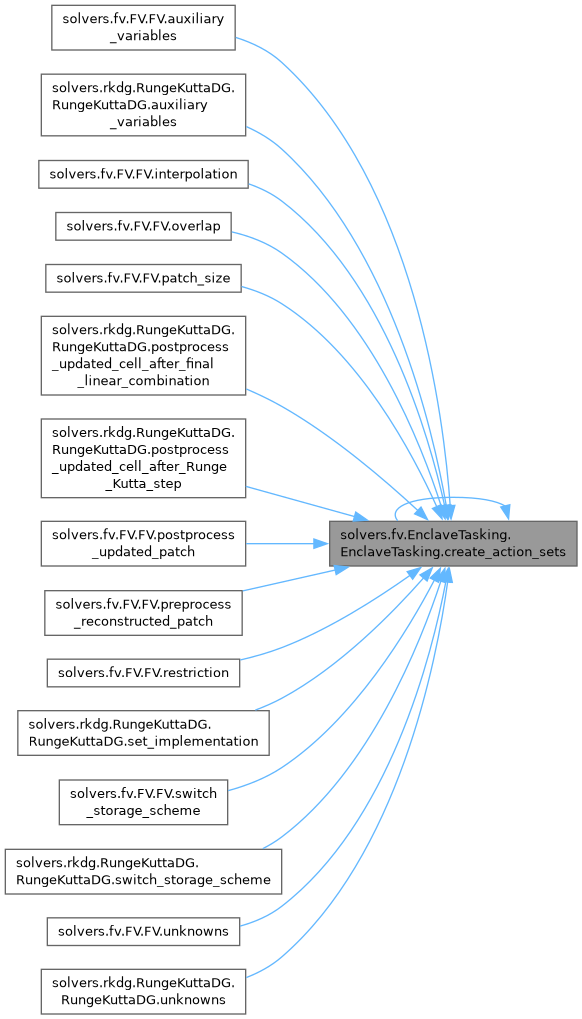
Referenced by solvers.fv.FV.FV.auxiliary_variables(), solvers.rkdg.RungeKuttaDG.RungeKuttaDG.auxiliary_variables(), create_action_sets(), solvers.fv.FV.FV.interpolation(), solvers.fv.FV.FV.overlap(), solvers.fv.FV.FV.patch_size(), solvers.rkdg.RungeKuttaDG.RungeKuttaDG.postprocess_updated_cell_after_final_linear_combination(), solvers.rkdg.RungeKuttaDG.RungeKuttaDG.postprocess_updated_cell_after_Runge_Kutta_step(), solvers.fv.FV.FV.postprocess_updated_patch(), solvers.fv.FV.FV.preprocess_reconstructed_patch(), solvers.fv.FV.FV.restriction(), solvers.rkdg.RungeKuttaDG.RungeKuttaDG.set_implementation(), solvers.fv.FV.FV.switch_storage_scheme(), solvers.rkdg.RungeKuttaDG.RungeKuttaDG.switch_storage_scheme(), solvers.fv.FV.FV.unknowns(), and solvers.rkdg.RungeKuttaDG.RungeKuttaDG.unknowns().
| solvers.fv.EnclaveTasking.EnclaveTasking.create_data_structures | ( | self | ) |
This routine does not really add new data, but it heavily tailors when data are stored, exchanged, ... Each generator has some guard attributes, i.e., some guards, which control when data is stored, sent, received.
The routine takes these guards and rewires them to the local guards of this object. If you alter these guards further, you have to alter them before you invoke this class' create_data_structures().
Reimplemented from solvers.fv.FV.FV.
Definition at line 512 of file EnclaveTasking.py.
References _create_guards(), _first_iteration_after_initialisation_guard, _initialisation_sweep_guard, solvers.fv.FV.FV._patch_overlap_new, solvers.fv.FV.FV._patch_overlap_old, _primary_sweep_or_plot_guard, _secondary_sweep_or_grid_initialisation_or_plot_guard, and create_data_structures().
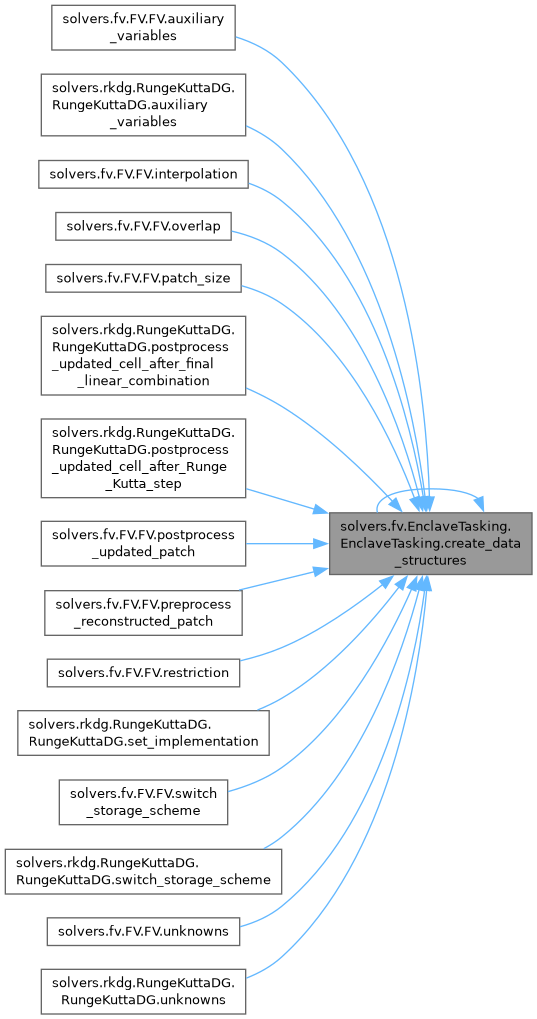
Referenced by solvers.fv.FV.FV.auxiliary_variables(), solvers.rkdg.RungeKuttaDG.RungeKuttaDG.auxiliary_variables(), create_data_structures(), solvers.fv.FV.FV.interpolation(), solvers.fv.FV.FV.overlap(), solvers.fv.FV.FV.patch_size(), solvers.rkdg.RungeKuttaDG.RungeKuttaDG.postprocess_updated_cell_after_final_linear_combination(), solvers.rkdg.RungeKuttaDG.RungeKuttaDG.postprocess_updated_cell_after_Runge_Kutta_step(), solvers.fv.FV.FV.postprocess_updated_patch(), solvers.fv.FV.FV.preprocess_reconstructed_patch(), solvers.fv.FV.FV.restriction(), solvers.rkdg.RungeKuttaDG.RungeKuttaDG.set_implementation(), solvers.fv.FV.FV.switch_storage_scheme(), solvers.rkdg.RungeKuttaDG.RungeKuttaDG.switch_storage_scheme(), solvers.fv.FV.FV.unknowns(), and solvers.rkdg.RungeKuttaDG.RungeKuttaDG.unknowns().

| solvers.fv.EnclaveTasking.EnclaveTasking.set_implementation | ( | self, | |
| boundary_conditions, | |||
| refinement_criterion, | |||
| initial_conditions, | |||
| memory_location, | |||
| use_split_loop, | |||
| additional_action_set_includes, | |||
| additional_user_includes ) |
If you pass in User_Defined, then the generator will create C++ stubs that you have to befill manually.
If you pass in None_Implementation, it will create nop, i.e., no implementation or defaults. Any other string is copied 1:1 into the implementation. If you pass in None, then the set value so far won't be overwritten.
Definition at line 671 of file EnclaveTasking.py.
| solvers.fv.EnclaveTasking.EnclaveTasking.switch_storage_scheme | ( | self, | |
| Storage | cell_data_storage, | ||
| Storage | face_data_storage ) |
By default, we hold all data on the heap using smart pointers.
You can explicitly switch to storage on the call stack or heap using raw pointers.
Reimplemented from solvers.fv.FV.FV.
Definition at line 837 of file EnclaveTasking.py.
|
protected |
Definition at line 614 of file EnclaveTasking.py.
Referenced by add_actions_to_perform_time_step(), solvers.rkdg.SeparateSweepsWithEnclaveTasking.SeparateSweepsWithEnclaveTasking.add_actions_to_perform_time_step(), and solvers.fv.rusanov.LocalTimeStepWithEnclaveTasking.LocalTimeStepWithEnclaveTasking.create_action_sets().
|
protected |
Definition at line 391 of file EnclaveTasking.py.
Referenced by create_data_structures().
|
protected |
Definition at line 349 of file EnclaveTasking.py.
Referenced by add_entries_to_text_replacement_dictionary().
|
protected |
Definition at line 350 of file EnclaveTasking.py.
Referenced by add_entries_to_text_replacement_dictionary().
|
protected |
Definition at line 381 of file EnclaveTasking.py.
Referenced by create_data_structures().
|
protected |
Definition at line 445 of file EnclaveTasking.py.
|
protected |
Definition at line 435 of file EnclaveTasking.py.
|
protected |
Definition at line 406 of file EnclaveTasking.py.
|
protected |
Definition at line 421 of file EnclaveTasking.py.
Referenced by create_data_structures().
|
protected |
Definition at line 457 of file EnclaveTasking.py.
|
protected |
Definition at line 467 of file EnclaveTasking.py.
|
protected |
Definition at line 482 of file EnclaveTasking.py.
|
protected |
Definition at line 497 of file EnclaveTasking.py.
Referenced by create_data_structures().
|
protected |
Definition at line 697 of file EnclaveTasking.py.
| str solvers.fv.EnclaveTasking.EnclaveTasking.enclave_task_priority = "tarch::multicore::Task::DefaultPriority-1" |
Definition at line 372 of file EnclaveTasking.py.
Referenced by add_entries_to_text_replacement_dictionary(), and solvers.rkdg.SeparateSweepsWithEnclaveTasking.SeparateSweepsWithEnclaveTasking.add_entries_to_text_replacement_dictionary().
| bool solvers.fv.EnclaveTasking.EnclaveTasking.make_copy_of_enclave_task_data = False |
Definition at line 843 of file EnclaveTasking.py.
Referenced by add_entries_to_text_replacement_dictionary(), and solvers.rkdg.SeparateSweepsWithEnclaveTasking.SeparateSweepsWithEnclaveTasking.add_entries_to_text_replacement_dictionary().
 1.15.0