 |
Peano
|
Abstract finite volume solver step sizes that works on patch-based AMR with a halo layer of one. More...
Public Member Functions | |
| __init__ (self, name, patch_size, overlap, unknowns, auxiliary_variables, min_volume_h, max_volume_h, plot_grid_properties, bool pde_terms_without_state, kernel_namespace, baseline_action_set_descend_invocation_order=0) | |
| Create solver. | |
| __str__ (self) | |
| get_min_number_of_spacetree_levels (self, domain_size) | |
| get_max_number_of_spacetree_levels (self, domain_size) | |
| get_coarsest_number_of_patches (self, domain_size) | |
| get_finest_number_of_patches (self, domain_size) | |
| get_coarsest_number_of_finite_volumes (self, domain_size) | |
| get_finest_number_of_finite_volumes (self, domain_size) | |
| get_coarsest_volume_size (self, domain_size) | |
| get_finest_volume_size (self, domain_size) | |
| create_readme_descriptor (self, domain_offset, domain_size) | |
| user_action_set_includes (self) | |
| Add further includes to this property, if your action sets require some additional routines from other header files. | |
| user_solver_includes (self) | |
| Add further includes to this property, if your solver requires some additional routines from other header files. | |
| add_user_action_set_includes (self, value) | |
| Add further includes to this property, if your action sets require some additional routines from other header files. | |
| add_user_solver_includes (self, value) | |
| Add further includes to this property, if your solver requires some additional routines from other header files. | |
| create_data_structures (self) | |
| Create data structures required by all Finite Volume solvers. | |
| create_action_sets (self) | |
| Create all the action sets. | |
| get_name_of_global_instance (self) | |
| add_to_Peano4_datamodel (self, datamodel, verbose) | |
| Add all required data to the Peano project's datamodel so it is properly built up. | |
| add_use_data_statements_to_Peano4_solver_step (self, step) | |
| Tell Peano what data to move around. | |
| add_actions_to_init_grid (self, step, restart_from_checkpoint=False) | |
| Add all the action sets to init grid. | |
| add_actions_to_create_grid (self, step, evaluate_refinement_criterion) | |
| The boundary information is set only once. | |
| plot_description (self) | |
| plot_description (self, description) | |
| Add a proper description to the plots. | |
| add_actions_to_plot_solution (self, step, output_path, restart_from_checkpoint=False) | |
| Add action sets to plot solution step. | |
| add_actions_to_checkpoint_solution (self, step, output_path, restart_from_checkpoint=False) | |
| Add action sets to plot solution step. | |
| add_actions_to_perform_time_step (self, step) | |
| Add action sets to time step. | |
| add_entries_to_text_replacement_dictionary (self, d) | |
| add_implementation_files_to_project (self, namespace, output, dimensions, subdirectory="", abstract_overwrite=True) | |
| The ExaHyPE project will call this operation when it sets up the overall environment. | |
| set_solver_constants (self, datastring) | |
| add_solver_constants (self, datastring) | |
| unknowns (self) | |
| patch_size (self) | |
| auxiliary_variables (self) | |
| patch_size (self, value) | |
| unknowns (self, value) | |
| auxiliary_variables (self, value) | |
| preprocess_reconstructed_patch (self) | |
| preprocess_reconstructed_patch (self, kernel) | |
| Set a new processing kernel. | |
| name (self) | |
| postprocess_updated_patch (self) | |
| postprocess_updated_patch (self, kernel) | |
| Define a postprocessing routine over the data. | |
| overlap (self) | |
| overlap (self, value) | |
| interpolation (self) | |
| interpolation (self, value) | |
| restriction (self) | |
| restriction (self, value) | |
| switch_storage_scheme (self, Storage cell_data_storage, Storage face_data_storage) | |
| By default, we hold all data on the heap using smart pointers. | |
Data Fields | |
| select_dofs_to_print = None | |
Protected Member Functions | |
| _provide_cell_data_to_compute_kernels_default_guard (self) | |
| Default logic when to create cell data or not. | |
| _provide_face_data_to_compute_kernels_default_guard (self) | |
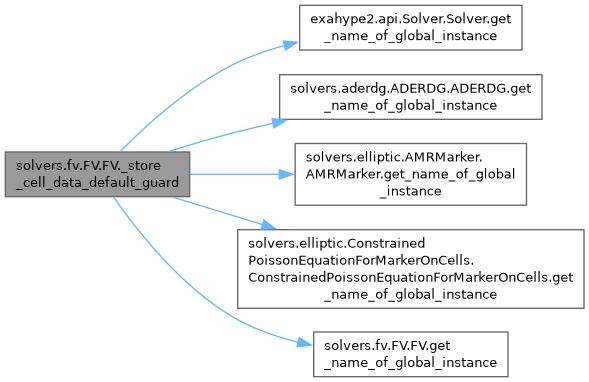
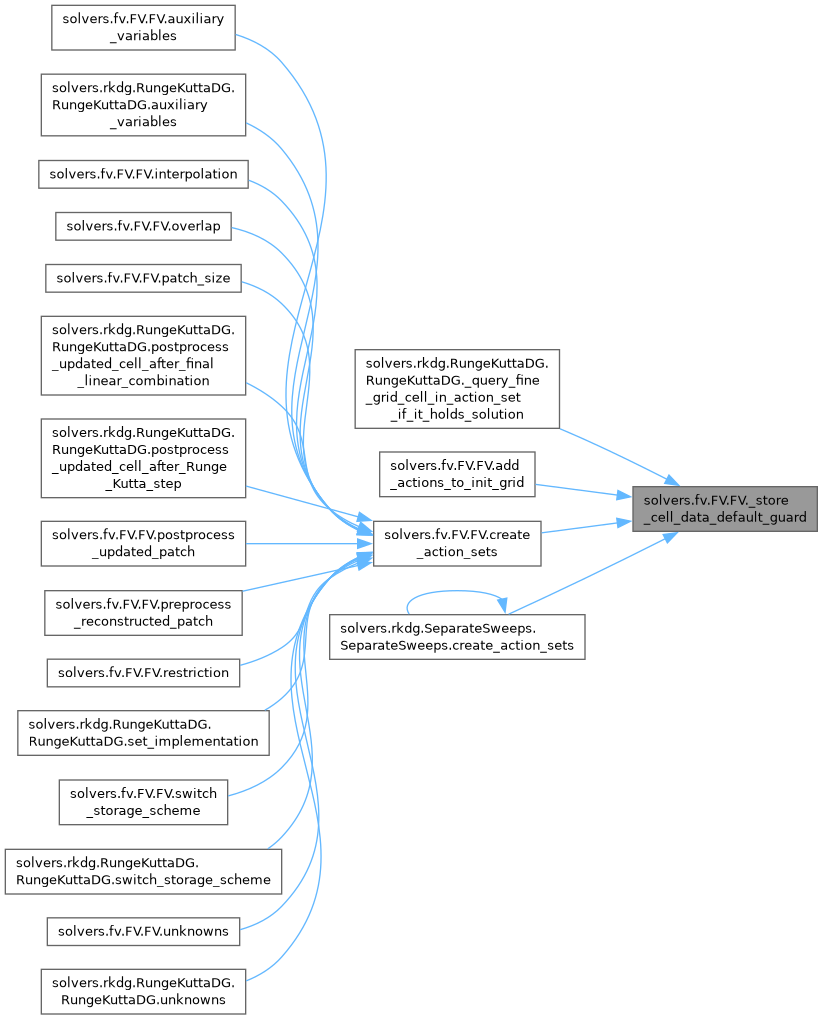
| _store_cell_data_default_guard (self) | |
| Extend the guard via ands only. | |
| _load_cell_data_default_guard (self) | |
| Extend the guard via ands only. | |
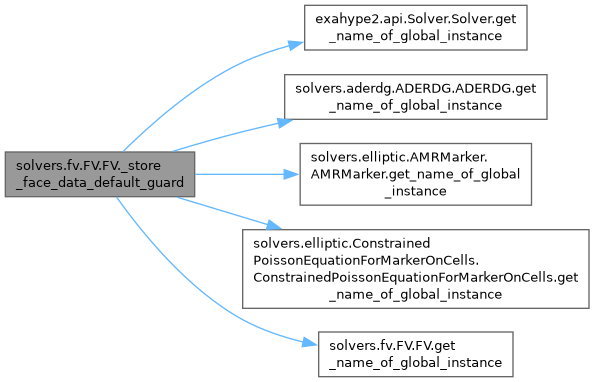
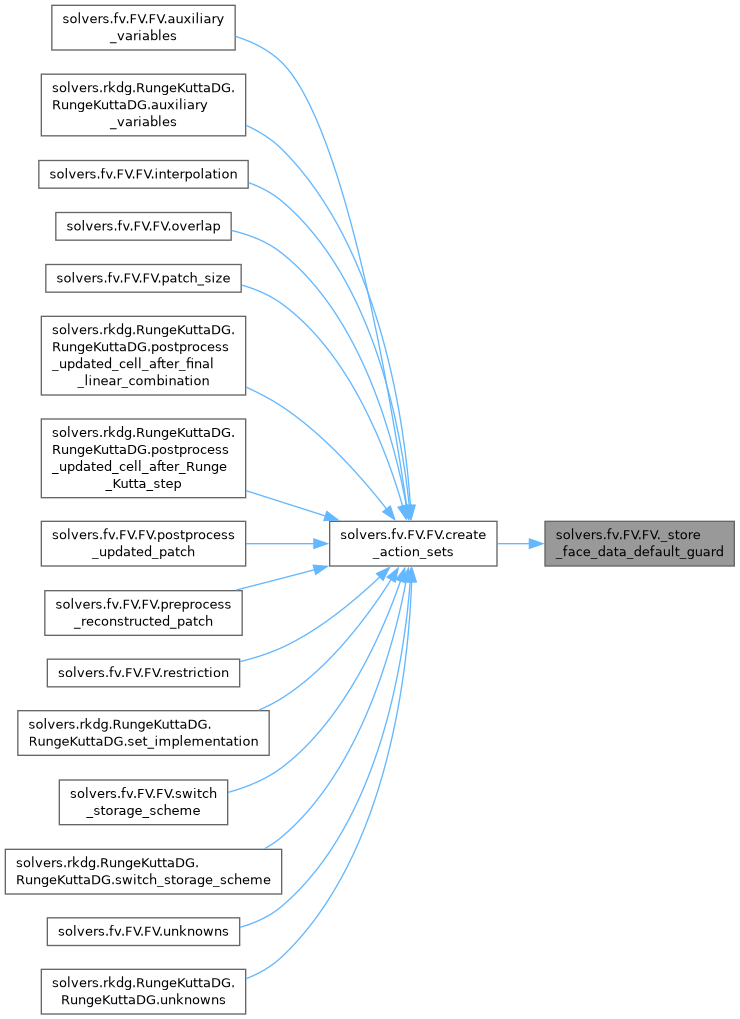
| _store_face_data_default_guard (self) | |
| Extend the guard via ands only. | |
| _load_face_data_default_guard (self) | |
| Extend the guard via ands only. | |
| _unknown_identifier (self) | |
| _get_default_includes (self) | |
| _init_dictionary_with_default_parameters (self, d) | |
| This one is called by all algorithmic steps before I invoke add_entries_to_text_replacement_dictionary(). | |
Static Private Attributes | |
| __repr__ = __str__ | |
Abstract finite volume solver step sizes that works on patch-based AMR with a halo layer of one.
FV is the base class of all FV solvers. It defines what kind of action sets do exist, i.e., what in principle can be done while we run through the grid. It also provides some kind of very basic infrastructure, i.e., what the name of a solver is, what data is to be held per face or cell, or where in the multiscale mesh we actually have to hold data.
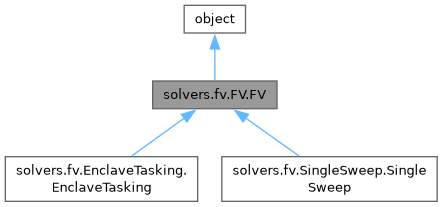
The FV class cannot/should not be instantiated. There are two direct children: SingleSweep and EnclaveTasking. The FV base class defines what data are available. The two subclasses define how we run through the mesh: once per time step or twice per time step with some tasking. So FV defines what can be done, the subclasses define how the steps are orchestrated. Again, they do not (yet) say what is computed. That's then the responsibility of classes that inherit from SingleSweep or EnclaveTasking, respectively.
A finite volume solver in ExaHyPE 2 (actually any solver) is first of all a static collection of data logically tied to grid entities and some operations over the mesh that are just there. All data and action sets however have guards, i.e., boolean guards that define
In the baseline FV class, these guards are usually set to default values. That is, all action sets per time step are invoked always (the guard is true) and all data are always stored on the finest mesh. If you want to alter this behaviour, i.e., store data not always or skip steps, you can overwrite the corresponding attributes of the attributes, i.e., the guards of the associated data.
See the discussion on "Control flow between this class and subclasses" below.
I do equip both Q and NewQ with proper merge routines. However, all merge guards set to "never" by default. If you need some data exchange, you have to activate them manually.
There are three key routines: the constructor, create_data_structures() and create_action_sets(). The constructor sets some global variables (such as the name) and then invokes the other two routines.
create_data_structures() establishes all the data structures tied to the grid entities. It also sets some properties of these data such as the patch size, e.g. If you want to add additional data (such as additional quantities per cell) or if you want to alter the configuration of data tied to grid entities, you should redefine create_data_structures(). However, any subclass still should call FV's create_data_structures() - or the create_data_structures() of the SingleSweep or EnclaveTasking, respectively. This will ensure that the baseline configuration of all data is in place. After that, you can modify the properties.
create_action_sets() establishes the action sets, i.e. activities that are to be triggered whenever you run a time step, you plot, you initialise the grid.
Both create_data_structures() and create_action_sets() add attributes to the FV class. See self._patch for example within create_action_sets(). These attributes have guards such as self._action_set_initial_conditions.guard. These guards are set to defaults in FV. It is basically the job of SingleSweep or EnclaveTasking - they determine when which data are used - to reset these guards from a default to something tailored to the particular data flow.
If you want to redefine when data is stored or operations are invoked, overwrite create_data_structures(), and call the superclass, i.e. either SingleSweep or EnclaveTasking. This is what happens:
We use by default a linear interpolation and averaging. For the linear interpolation, I do not compute the operators on demand. Instead, I use the optimised scheme which computes the operators once and then reuses them as static operation.
If you wanna alter the inter-resolution transfer operators, please use
    self._interpolation = "tensor_product< " + self._name + ">"
    self.add_solver_constants( "" "static constexpr double  NormalInterpolationMatrix1d[]     = {
      1.0, 0.0
    };
    "" " )
    self.add_solver_constants( "" "static constexpr double  TangentialInterpolationMatrix1d[] = {
    1.0,0.0,0.0,0.0,
    1.0,0.0,0.0,0.0,
    1.0,0.0,0.0,0.0,
    0.0,1.0,0.0,0.0,

    0.0,1.0,0.0,0.0,
    0.0,1.0,0.0,0.0,
    0.0,0.0,1.0,0.0,
    0.0,0.0,1.0,0.0,

    0.0,0.0,1.0,0.0,
    0.0,0.0,0.0,1.0,
    0.0,0.0,0.0,1.0,
    0.0,0.0,0.0,1.0
    };"" " )
The above snippet refers to a overlap of one and five unknowns. So the interpolation along a 1d tangential direction is three 5x5 matrices. Along the normal, we have to project onto one target element, so our projection matrix has one row. We have two values (inside and outside) along this normal, so two columns. In the standard enumeration scheme (refers to the face with normal 0), we have one real coarse grid value in this case. The other one would be the restricted value. We don't often use it (and therefore have a 0 here).
For data postprocessing, the introduction of fancy interior conditions or the coupling to other codes, each Finite Volume solver has an attribute
_action_set_postprocess_solution
You can use this attribute to add postprocessing routines to the code.
| solvers.fv.FV.FV.__init__ | ( | self, | |
| name, | |||
| patch_size, | |||
| overlap, | |||
| unknowns, | |||
| auxiliary_variables, | |||
| min_volume_h, | |||
| max_volume_h, | |||
| plot_grid_properties, | |||
| bool | pde_terms_without_state, | ||
| kernel_namespace, | |||
| baseline_action_set_descend_invocation_order = 0 ) |
Create solver.
name: string A unique name for the solver. This one will be used for all generated classes. Also the C++ object instance later on will incorporate this name.
patch_size: int Size of the patch in one dimension. All stuff here's dimension-generic.
overlap: int That's the size of the halo layer which is half of the overlap with a neighbour. A value of 1 means that a patch_size x patch_size patch in 2d is surrounded by one additional cell layer. The overlap has to be bigger or equal to one. It has to be smaller or equal to patch_size.
unknowns: int Number of unknowns per Finite Volume voxel.
auxiliary_variables: int Number of auxiliary variables per Finite Volume voxel. Eventually, both unknowns and auxiliary_variables are merged into one big vector if we work with AoS. But the solver has to be able to distinguish them, as only the unknowns are subject to a hyperbolic formulation.
min_volume_h: double This size refers to the individual Finite Volume.
max_volume_h: double This size refers to the individual Finite Volume.
plot_grid_properties: Boolean Clarifies whether a dump of the data should be enriched with grid info (such as enclave status flags), too.
| solvers.fv.FV.FV.__str__ | ( | self | ) |
Definition at line 322 of file FV.py.
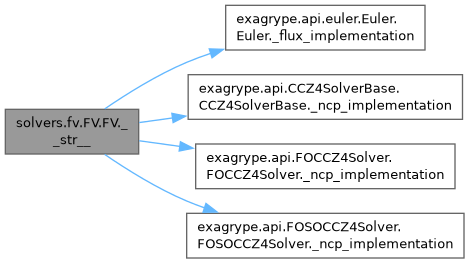
References peano4.api.output.ActionSet.ActionSet.__class__, peano4.api.output.Jinja2TemplatedHeaderImplementationFilePair.Jinja2TemplatedHeaderImplementationFilePair.__class__, peano4.api.output.TemplatedHeaderFile.TemplatedHeaderFile.__class__, exahype2.api.Solver.Solver._auxiliary_variables, solvers.aderdg.ADERDG.ADERDG._auxiliary_variables, _auxiliary_variables, solvers.aderdg.ADERDG.ADERDG._boundary_conditions_implementation, solvers.fv.EnclaveTasking.EnclaveTasking._boundary_conditions_implementation, _boundary_conditions_implementation, solvers.aderdg.ADERDG.ADERDG._cell_data_storage, _cell_data_storage, solvers.aderdg.AbstractSolverDeclarations.AbstractSolverDeclarations._eigenvalues_implementation, solvers.aderdg.AbstractSolverDefinitions.AbstractSolverDefinitions._eigenvalues_implementation, solvers.aderdg.ADERDG.ADERDG._eigenvalues_implementation, solvers.aderdg.SolverDeclarations.SolverDeclarations._eigenvalues_implementation, solvers.aderdg.SolverDefinitions.SolverDefinitions._eigenvalues_implementation, solvers.fv.musclhancock.GlobalAdaptiveTimeStep.GlobalAdaptiveTimeStep._eigenvalues_implementation, solvers.fv.musclhancock.GlobalFixedTimeStep.GlobalFixedTimeStep._eigenvalues_implementation, solvers.fv.riemann.GlobalAdaptiveTimeStep.GlobalAdaptiveTimeStep._eigenvalues_implementation, solvers.fv.riemann.GlobalAdaptiveTimeStepWithEnclaveTasking.GlobalAdaptiveTimeStepWithEnclaveTasking._eigenvalues_implementation, solvers.fv.riemann.GlobalFixedTimeStep.GlobalFixedTimeStep._eigenvalues_implementation, solvers.fv.riemann.GlobalFixedTimeStepWithEnclaveTasking.GlobalFixedTimeStepWithEnclaveTasking._eigenvalues_implementation, solvers.fv.rusanov.GlobalAdaptiveTimeStep.GlobalAdaptiveTimeStep._eigenvalues_implementation, solvers.fv.rusanov.GlobalAdaptiveTimeStepWithEnclaveTasking.GlobalAdaptiveTimeStepWithEnclaveTasking._eigenvalues_implementation, solvers.fv.rusanov.GlobalFixedTimeStep.GlobalFixedTimeStep._eigenvalues_implementation, solvers.fv.rusanov.GlobalFixedTimeStepWithEnclaveTasking.GlobalFixedTimeStepWithEnclaveTasking._eigenvalues_implementation, solvers.fv.rusanov.LocalTimeStepWithEnclaveTasking.LocalTimeStepWithEnclaveTasking._eigenvalues_implementation, solvers.fv.rusanov.SubcyclingAdaptiveTimeStepWithEnclaveTasking.SubcyclingAdaptiveTimeStepWithEnclaveTasking._eigenvalues_implementation, solvers.fv.rusanov.SubcyclingFixedTimeStep.SubcyclingFixedTimeStep._eigenvalues_implementation, solvers.fv.rusanov.SubcyclingFixedTimeStepWithEnclaveTasking.SubcyclingFixedTimeStepWithEnclaveTasking._eigenvalues_implementation, solvers.rkdg.RungeKuttaDG.RungeKuttaDG._eigenvalues_implementation, solvers.aderdg.ADERDG.ADERDG._face_data_storage, _face_data_storage, exagrype.api.euler.Euler.Euler._flux_implementation(), solvers.aderdg.AbstractSolverDeclarations.AbstractSolverDeclarations._flux_implementation, solvers.aderdg.AbstractSolverDefinitions.AbstractSolverDefinitions._flux_implementation, solvers.aderdg.ADERDG.ADERDG._flux_implementation, solvers.aderdg.SolverDeclarations.SolverDeclarations._flux_implementation, solvers.aderdg.SolverDefinitions.SolverDefinitions._flux_implementation, solvers.fv.musclhancock.GlobalAdaptiveTimeStep.GlobalAdaptiveTimeStep._flux_implementation, solvers.fv.musclhancock.GlobalFixedTimeStep.GlobalFixedTimeStep._flux_implementation, solvers.fv.riemann.GlobalAdaptiveTimeStep.GlobalAdaptiveTimeStep._flux_implementation, solvers.fv.riemann.GlobalAdaptiveTimeStepWithEnclaveTasking.GlobalAdaptiveTimeStepWithEnclaveTasking._flux_implementation, solvers.fv.riemann.GlobalFixedTimeStep.GlobalFixedTimeStep._flux_implementation, solvers.fv.riemann.GlobalFixedTimeStepWithEnclaveTasking.GlobalFixedTimeStepWithEnclaveTasking._flux_implementation, solvers.fv.rusanov.GlobalAdaptiveTimeStep.GlobalAdaptiveTimeStep._flux_implementation, solvers.fv.rusanov.GlobalAdaptiveTimeStepWithEnclaveTasking.GlobalAdaptiveTimeStepWithEnclaveTasking._flux_implementation, solvers.fv.rusanov.GlobalFixedTimeStep.GlobalFixedTimeStep._flux_implementation, solvers.fv.rusanov.GlobalFixedTimeStepWithEnclaveTasking.GlobalFixedTimeStepWithEnclaveTasking._flux_implementation, solvers.fv.rusanov.LocalTimeStepWithEnclaveTasking.LocalTimeStepWithEnclaveTasking._flux_implementation, solvers.fv.rusanov.SubcyclingAdaptiveTimeStepWithEnclaveTasking.SubcyclingAdaptiveTimeStepWithEnclaveTasking._flux_implementation, solvers.fv.rusanov.SubcyclingFixedTimeStep.SubcyclingFixedTimeStep._flux_implementation, solvers.fv.rusanov.SubcyclingFixedTimeStepWithEnclaveTasking.SubcyclingFixedTimeStepWithEnclaveTasking._flux_implementation, solvers.rkdg.RungeKuttaDG.RungeKuttaDG._flux_implementation, solvers.aderdg.ADERDG.ADERDG._initial_conditions_implementation, solvers.fv.EnclaveTasking.EnclaveTasking._initial_conditions_implementation, _initial_conditions_implementation, _max_volume_h, _min_volume_h, api.solvers.Solver.Solver._name, api.Tree.Tree._name, dastgen2.attributes.Attribute.Attribute._name, dastgen2.attributes.BooleanArray.BooleanArray._name, dastgen2.attributes.Enumeration.Enumeration._name, exagrype.api.euler.CCZ4WithEuler_OuterAdditiveCoupling.CCZ4WithEuler_OuterAdditiveCoupling._name, exagrype.api.euler.CCZ4WithEuler_OuterMultiplicativeCoupling.CCZ4WithEuler_OuterMultiplicativeCoupling._name, exagrype.api.FOSOSolver.FOSOSolver._name, exagrype.api.scalarfield.CCZ4WithScalarField_InnerCoupling.CCZ4WithScalarField_InnerCoupling._name, exagrype.api.scalarfield.CCZ4WithScalarField_OuterMultiplicativeCoupling.CCZ4WithScalarField_OuterMultiplicativeCoupling._name, exahype2.api.AuxiliaryVariables.AuxiliaryVariables._name, exahype2.api.dslhype.SyntaxTree.Construction._name, exahype2.api.dslhype.SyntaxTree.DataBlockConstructionFromDotProduct._name, exahype2.api.dslhype.SyntaxTree.DataBlockConstructionFromExisting._name, exahype2.api.dslhype.SyntaxTree.DataBlockConstructionFromFunction._name, exahype2.api.dslhype.SyntaxTree.DataBlockConstructionFromMatrixVectorProduct._name, exahype2.api.dslhype.SyntaxTree.DataBlockConstructionFromOperation._name, exahype2.api.dslhype.SyntaxTree.MemoryAllocation._name, exahype2.api.dslhype.SyntaxTree.MemoryDeallocation._name, exahype2.api.Solver.Solver._name, mghype::matrixfree::solvers::Solver._name, peano4.api.dastgen2.Peano4DoubleArray.Peano4DoubleArray._name, peano4.api.dastgen2.Peano4IntegerArray.Peano4IntegerArray._name, peano4.api.dastgen2.Peano4SmartPointerDoubleArray.Peano4SmartPointerDoubleArray._name, peano4::RunMultipleSteps._name, solvers.aderdg.ADERDG.ADERDG._name, solvers.api.Solver.Solver._name, solvers.elliptic.AMRMarker.AMRMarker._name, solvers.elliptic.ConstrainedPoissonEquationForMarkerOnCells.ConstrainedPoissonEquationForMarkerOnCells._name, solvers.fv.EnclaveTasking.EnclaveTasking._name, _name, tarch::services::ServiceRepository::ServiceEntry._name, exagrype.api.CCZ4SolverBase.CCZ4SolverBase._ncp_implementation(), exagrype.api.FOCCZ4Solver.FOCCZ4Solver._ncp_implementation(), exagrype.api.FOSOCCZ4Solver.FOSOCCZ4Solver._ncp_implementation(), solvers.aderdg.AbstractSolverDeclarations.AbstractSolverDeclarations._ncp_implementation, solvers.aderdg.AbstractSolverDefinitions.AbstractSolverDefinitions._ncp_implementation, solvers.aderdg.ADERDG.ADERDG._ncp_implementation, solvers.aderdg.SolverDeclarations.SolverDeclarations._ncp_implementation, solvers.aderdg.SolverDefinitions.SolverDefinitions._ncp_implementation, solvers.fv.musclhancock.GlobalAdaptiveTimeStep.GlobalAdaptiveTimeStep._ncp_implementation, solvers.fv.musclhancock.GlobalFixedTimeStep.GlobalFixedTimeStep._ncp_implementation, solvers.fv.riemann.GlobalAdaptiveTimeStep.GlobalAdaptiveTimeStep._ncp_implementation, solvers.fv.riemann.GlobalAdaptiveTimeStepWithEnclaveTasking.GlobalAdaptiveTimeStepWithEnclaveTasking._ncp_implementation, solvers.fv.riemann.GlobalFixedTimeStep.GlobalFixedTimeStep._ncp_implementation, solvers.fv.riemann.GlobalFixedTimeStepWithEnclaveTasking.GlobalFixedTimeStepWithEnclaveTasking._ncp_implementation, solvers.fv.rusanov.GlobalAdaptiveTimeStep.GlobalAdaptiveTimeStep._ncp_implementation, solvers.fv.rusanov.GlobalAdaptiveTimeStepWithEnclaveTasking.GlobalAdaptiveTimeStepWithEnclaveTasking._ncp_implementation, solvers.fv.rusanov.GlobalFixedTimeStep.GlobalFixedTimeStep._ncp_implementation, solvers.fv.rusanov.GlobalFixedTimeStepWithEnclaveTasking.GlobalFixedTimeStepWithEnclaveTasking._ncp_implementation, solvers.fv.rusanov.LocalTimeStepWithEnclaveTasking.LocalTimeStepWithEnclaveTasking._ncp_implementation, solvers.fv.rusanov.SubcyclingAdaptiveTimeStepWithEnclaveTasking.SubcyclingAdaptiveTimeStepWithEnclaveTasking._ncp_implementation, solvers.fv.rusanov.SubcyclingFixedTimeStep.SubcyclingFixedTimeStep._ncp_implementation, solvers.fv.rusanov.SubcyclingFixedTimeStepWithEnclaveTasking.SubcyclingFixedTimeStepWithEnclaveTasking._ncp_implementation, solvers.rkdg.RungeKuttaDG.RungeKuttaDG._ncp_implementation, exahype2.api.AuxiliaryVariables.AuxiliaryVariables._overlap, _overlap, exahype2.api.AuxiliaryVariables.AuxiliaryVariables._patch_size, _patch_size, solvers.aderdg.AbstractSolverDeclarations.AbstractSolverDeclarations._pde_terms_without_state, solvers.aderdg.AbstractSolverDefinitions.AbstractSolverDefinitions._pde_terms_without_state, solvers.aderdg.SolverDeclarations.SolverDeclarations._pde_terms_without_state, solvers.aderdg.SolverDefinitions.SolverDefinitions._pde_terms_without_state, _pde_terms_without_state, solvers.aderdg.ADERDG.ADERDG._refinement_criterion_implementation, solvers.fv.EnclaveTasking.EnclaveTasking._refinement_criterion_implementation, _refinement_criterion_implementation, solvers.aderdg.AbstractSolverDeclarations.AbstractSolverDeclarations._source_term_implementation, solvers.aderdg.AbstractSolverDefinitions.AbstractSolverDefinitions._source_term_implementation, solvers.aderdg.ADERDG.ADERDG._source_term_implementation, solvers.aderdg.SolverDeclarations.SolverDeclarations._source_term_implementation, solvers.aderdg.SolverDefinitions.SolverDefinitions._source_term_implementation, solvers.fv.musclhancock.GlobalAdaptiveTimeStep.GlobalAdaptiveTimeStep._source_term_implementation, solvers.fv.musclhancock.GlobalFixedTimeStep.GlobalFixedTimeStep._source_term_implementation, solvers.fv.riemann.GlobalAdaptiveTimeStep.GlobalAdaptiveTimeStep._source_term_implementation, solvers.fv.riemann.GlobalAdaptiveTimeStepWithEnclaveTasking.GlobalAdaptiveTimeStepWithEnclaveTasking._source_term_implementation, solvers.fv.riemann.GlobalFixedTimeStep.GlobalFixedTimeStep._source_term_implementation, solvers.fv.riemann.GlobalFixedTimeStepWithEnclaveTasking.GlobalFixedTimeStepWithEnclaveTasking._source_term_implementation, solvers.fv.rusanov.GlobalAdaptiveTimeStep.GlobalAdaptiveTimeStep._source_term_implementation, solvers.fv.rusanov.GlobalAdaptiveTimeStepWithEnclaveTasking.GlobalAdaptiveTimeStepWithEnclaveTasking._source_term_implementation, solvers.fv.rusanov.GlobalFixedTimeStep.GlobalFixedTimeStep._source_term_implementation, solvers.fv.rusanov.GlobalFixedTimeStepWithEnclaveTasking.GlobalFixedTimeStepWithEnclaveTasking._source_term_implementation, solvers.fv.rusanov.LocalTimeStepWithEnclaveTasking.LocalTimeStepWithEnclaveTasking._source_term_implementation, solvers.fv.rusanov.SubcyclingAdaptiveTimeStepWithEnclaveTasking.SubcyclingAdaptiveTimeStepWithEnclaveTasking._source_term_implementation, solvers.fv.rusanov.SubcyclingFixedTimeStep.SubcyclingFixedTimeStep._source_term_implementation, solvers.fv.rusanov.SubcyclingFixedTimeStepWithEnclaveTasking.SubcyclingFixedTimeStepWithEnclaveTasking._source_term_implementation, solvers.rkdg.RungeKuttaDG.RungeKuttaDG._source_term_implementation, api.solvers.CollocatedLowOrderDiscretisation.CollocatedLowOrderDiscretisation._unknowns, exahype2.api.Solver.Solver._unknowns, exahype2::CellAccess._unknowns, exahype2::enumerator::AoSLexicographicEnumerator._unknowns, exahype2::enumerator::AoSoALexicographicEnumerator._unknowns, exahype2::enumerator::FaceAoSLexicographicEnumerator._unknowns, exahype2::enumerator::SingleDoFEnumerator._unknowns, exahype2::enumerator::SoALexicographicEnumerator._unknowns, solvers.aderdg.ADERDG.ADERDG._unknowns, _unknowns, and tarch.plotter.api.output.Visualiser.PatchFileData._unknowns.
|
protected |
Definition at line 1032 of file FV.py.
Referenced by create_action_sets().
|
protected |
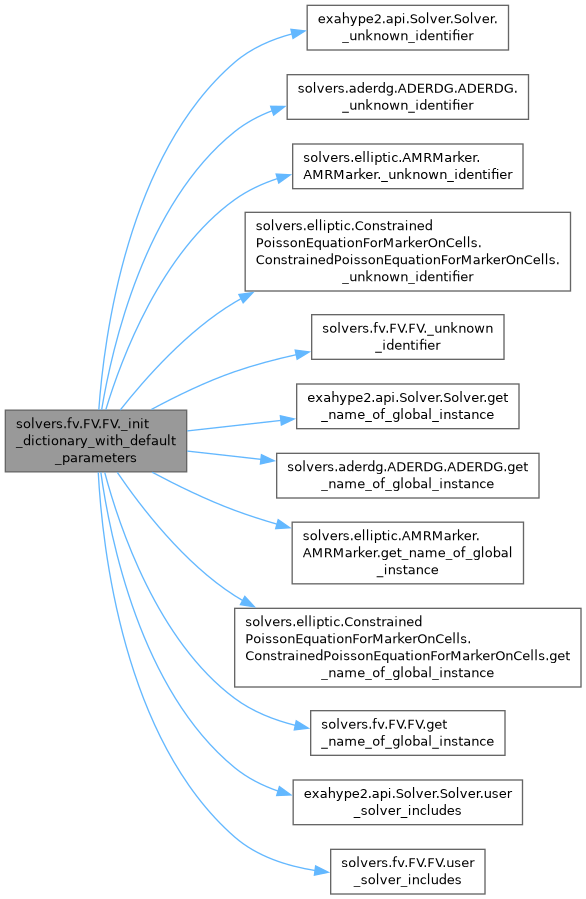
This one is called by all algorithmic steps before I invoke add_entries_to_text_replacement_dictionary().
See the remarks on set_postprocess_updated_patch_kernel to understand why we have to apply the (partially befilled) dictionary to create a new entry for this very dictionary.
Definition at line 1400 of file FV.py.
References solvers.aderdg.ADERDG.ADERDG._abstract_solver_user_declarations, solvers.aderdg.GlobalAdaptiveTimeStep.GlobalAdaptiveTimeStep._abstract_solver_user_declarations, solvers.aderdg.GlobalFixedTimeStep.GlobalFixedTimeStep._abstract_solver_user_declarations, _abstract_solver_user_declarations, solvers.aderdg.ADERDG.ADERDG._abstract_solver_user_definitions, solvers.aderdg.GlobalAdaptiveTimeStep.GlobalAdaptiveTimeStep._abstract_solver_user_definitions, solvers.aderdg.GlobalFixedTimeStep.GlobalFixedTimeStep._abstract_solver_user_definitions, _abstract_solver_user_definitions, exahype2.api.Solver.Solver._auxiliary_variables, solvers.aderdg.ADERDG.ADERDG._auxiliary_variables, _auxiliary_variables, solvers.aderdg.ADERDG.ADERDG._boundary_conditions_implementation, solvers.fv.EnclaveTasking.EnclaveTasking._boundary_conditions_implementation, _boundary_conditions_implementation, _compute_eigenvalue, _compute_kernel_call, _compute_kernel_call_stateless, solvers.aderdg.ADERDG.ADERDG._compute_new_time_step_size, solvers.aderdg.GlobalAdaptiveTimeStep.GlobalAdaptiveTimeStep._compute_new_time_step_size, solvers.aderdg.GlobalFixedTimeStep.GlobalFixedTimeStep._compute_new_time_step_size, _compute_new_time_step_size, solvers.aderdg.ADERDG.ADERDG._compute_time_step_size, solvers.aderdg.GlobalAdaptiveTimeStep.GlobalAdaptiveTimeStep._compute_time_step_size, solvers.aderdg.GlobalFixedTimeStep.GlobalFixedTimeStep._compute_time_step_size, _compute_time_step_size, solvers.aderdg.ADERDG.ADERDG._constructor_implementation, solvers.aderdg.GlobalAdaptiveTimeStep.GlobalAdaptiveTimeStep._constructor_implementation, solvers.aderdg.GlobalFixedTimeStep.GlobalFixedTimeStep._constructor_implementation, _constructor_implementation, solvers.aderdg.ADERDG.ADERDG._finish_time_step_implementation, solvers.aderdg.GlobalAdaptiveTimeStep.GlobalAdaptiveTimeStep._finish_time_step_implementation, solvers.aderdg.GlobalFixedTimeStep.GlobalFixedTimeStep._finish_time_step_implementation, _finish_time_step_implementation, solvers.aderdg.ADERDG.ADERDG._initial_conditions_implementation, solvers.fv.EnclaveTasking.EnclaveTasking._initial_conditions_implementation, _initial_conditions_implementation, _kernel_namespace, _max_volume_h, _min_volume_h, api.solvers.Solver.Solver._name, api.Tree.Tree._name, dastgen2.attributes.Attribute.Attribute._name, dastgen2.attributes.BooleanArray.BooleanArray._name, dastgen2.attributes.Enumeration.Enumeration._name, exagrype.api.euler.CCZ4WithEuler_OuterAdditiveCoupling.CCZ4WithEuler_OuterAdditiveCoupling._name, exagrype.api.euler.CCZ4WithEuler_OuterMultiplicativeCoupling.CCZ4WithEuler_OuterMultiplicativeCoupling._name, exagrype.api.FOSOSolver.FOSOSolver._name, exagrype.api.scalarfield.CCZ4WithScalarField_InnerCoupling.CCZ4WithScalarField_InnerCoupling._name, exagrype.api.scalarfield.CCZ4WithScalarField_OuterMultiplicativeCoupling.CCZ4WithScalarField_OuterMultiplicativeCoupling._name, exahype2.api.AuxiliaryVariables.AuxiliaryVariables._name, exahype2.api.dslhype.SyntaxTree.Construction._name, exahype2.api.dslhype.SyntaxTree.DataBlockConstructionFromDotProduct._name, exahype2.api.dslhype.SyntaxTree.DataBlockConstructionFromExisting._name, exahype2.api.dslhype.SyntaxTree.DataBlockConstructionFromFunction._name, exahype2.api.dslhype.SyntaxTree.DataBlockConstructionFromMatrixVectorProduct._name, exahype2.api.dslhype.SyntaxTree.DataBlockConstructionFromOperation._name, exahype2.api.dslhype.SyntaxTree.MemoryAllocation._name, exahype2.api.dslhype.SyntaxTree.MemoryDeallocation._name, exahype2.api.Solver.Solver._name, mghype::matrixfree::solvers::Solver._name, peano4.api.dastgen2.Peano4DoubleArray.Peano4DoubleArray._name, peano4.api.dastgen2.Peano4IntegerArray.Peano4IntegerArray._name, peano4.api.dastgen2.Peano4SmartPointerDoubleArray.Peano4SmartPointerDoubleArray._name, peano4::RunMultipleSteps._name, solvers.aderdg.ADERDG.ADERDG._name, solvers.api.Solver.Solver._name, solvers.elliptic.AMRMarker.AMRMarker._name, solvers.elliptic.ConstrainedPoissonEquationForMarkerOnCells.ConstrainedPoissonEquationForMarkerOnCells._name, solvers.fv.EnclaveTasking.EnclaveTasking._name, _name, tarch::services::ServiceRepository::ServiceEntry._name, exahype2.api.AuxiliaryVariables.AuxiliaryVariables._overlap, _overlap, api.ApplyPointWiselyToPatch.ApplyPointWiselyToPatch._patch, exagrype.api.actionsets.ApplyReconstructionFunctor.ApplyReconstructionFunctor._patch, exagrype.api.CCZ4SolverBase.CCZ4SolverBase._patch, _patch, _patch_overlap_old, solvers.aderdg.AbstractSolverDeclarations.AbstractSolverDeclarations._pde_terms_without_state, solvers.aderdg.AbstractSolverDefinitions.AbstractSolverDefinitions._pde_terms_without_state, solvers.aderdg.SolverDeclarations.SolverDeclarations._pde_terms_without_state, solvers.aderdg.SolverDefinitions.SolverDefinitions._pde_terms_without_state, _pde_terms_without_state, solvers.aderdg.ADERDG.ADERDG._postprocess_updated_patch, _postprocess_updated_patch, solvers.aderdg.ADERDG.ADERDG._refinement_criterion_implementation, solvers.fv.EnclaveTasking.EnclaveTasking._refinement_criterion_implementation, _refinement_criterion_implementation, exahype2.api.Solver.Solver._solver_constants, solvers.aderdg.ADERDG.ADERDG._solver_constants, _solver_constants, solvers.aderdg.ADERDG.ADERDG._solver_user_declarations, solvers.aderdg.GlobalAdaptiveTimeStep.GlobalAdaptiveTimeStep._solver_user_declarations, solvers.aderdg.GlobalFixedTimeStep.GlobalFixedTimeStep._solver_user_declarations, _solver_user_declarations, solvers.aderdg.ADERDG.ADERDG._solver_user_definitions, solvers.aderdg.GlobalAdaptiveTimeStep.GlobalAdaptiveTimeStep._solver_user_definitions, solvers.aderdg.GlobalFixedTimeStep.GlobalFixedTimeStep._solver_user_definitions, _solver_user_definitions, solvers.aderdg.ADERDG.ADERDG._start_time_step_implementation, solvers.aderdg.GlobalAdaptiveTimeStep.GlobalAdaptiveTimeStep._start_time_step_implementation, solvers.aderdg.GlobalFixedTimeStep.GlobalFixedTimeStep._start_time_step_implementation, _start_time_step_implementation, exahype2.api.Solver.Solver._unknown_identifier(), solvers.aderdg.ADERDG.ADERDG._unknown_identifier(), solvers.elliptic.AMRMarker.AMRMarker._unknown_identifier(), solvers.elliptic.ConstrainedPoissonEquationForMarkerOnCells.ConstrainedPoissonEquationForMarkerOnCells._unknown_identifier(), _unknown_identifier(), api.solvers.CollocatedLowOrderDiscretisation.CollocatedLowOrderDiscretisation._unknowns, exahype2.api.Solver.Solver._unknowns, exahype2::CellAccess._unknowns, exahype2::enumerator::AoSLexicographicEnumerator._unknowns, exahype2::enumerator::AoSoALexicographicEnumerator._unknowns, exahype2::enumerator::FaceAoSLexicographicEnumerator._unknowns, exahype2::enumerator::SingleDoFEnumerator._unknowns, exahype2::enumerator::SoALexicographicEnumerator._unknowns, solvers.aderdg.ADERDG.ADERDG._unknowns, _unknowns, tarch.plotter.api.output.Visualiser.PatchFileData._unknowns, solvers.aderdg.ADERDG.ADERDG._use_var_shortcut, _use_var_shortcut, solvers.aderdg.ADERDG.ADERDG._variable_names, _variable_names, solvers.aderdg.ADERDG.ADERDG._variable_pos, _variable_pos, exahype2.api.Solver.Solver.get_name_of_global_instance(), solvers.aderdg.ADERDG.ADERDG.get_name_of_global_instance(), solvers.elliptic.AMRMarker.AMRMarker.get_name_of_global_instance(), solvers.elliptic.ConstrainedPoissonEquationForMarkerOnCells.ConstrainedPoissonEquationForMarkerOnCells.get_name_of_global_instance(), get_name_of_global_instance(), exagrype.api.CCZ4SolverBase.CCZ4SolverBase.user_solver_includes, exahype2.api.Solver.Solver.user_solver_includes(), solvers.aderdg.ADERDG.ADERDG.user_solver_includes, user_solver_includes(), solvers.limiting.PosterioriLimiting.PosterioriLimiting.user_solver_includes, and solvers.limiting.StaticLimiting.StaticLimiting.user_solver_includes.
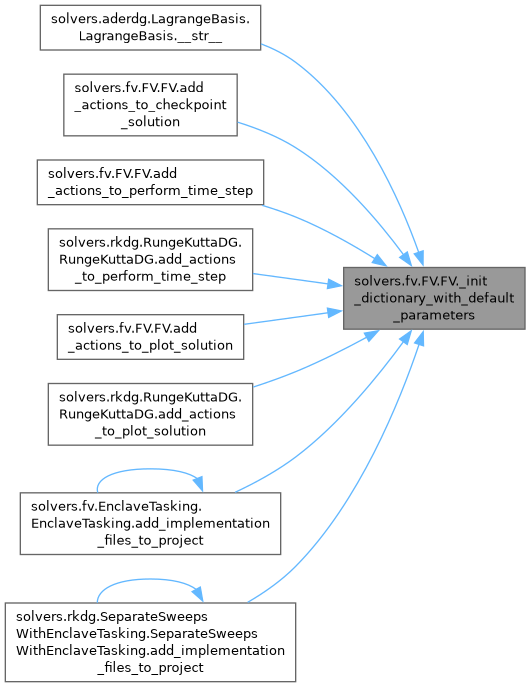
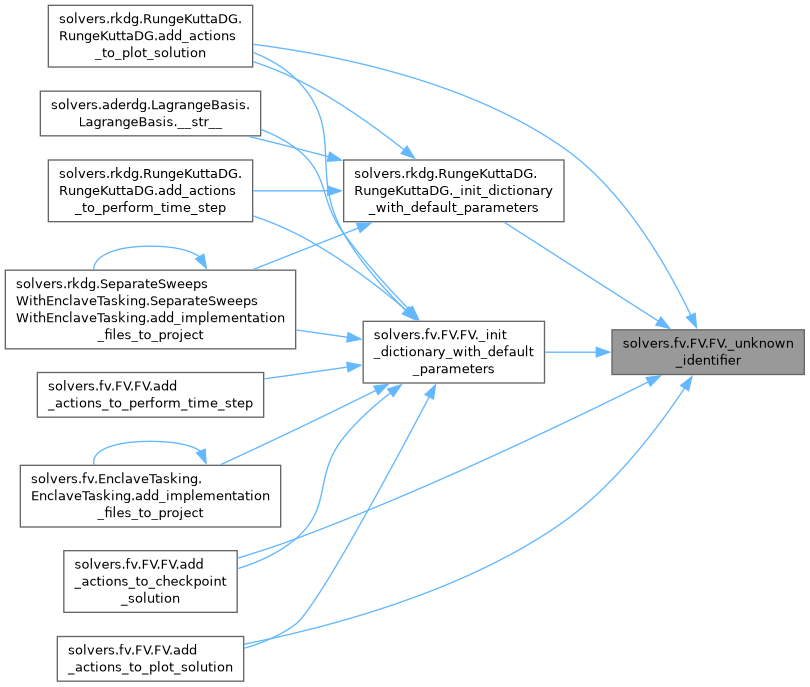
Referenced by solvers.aderdg.LagrangeBasis.LagrangeBasis.__str__(), add_actions_to_checkpoint_solution(), add_actions_to_perform_time_step(), solvers.rkdg.RungeKuttaDG.RungeKuttaDG.add_actions_to_perform_time_step(), add_actions_to_plot_solution(), solvers.rkdg.RungeKuttaDG.RungeKuttaDG.add_actions_to_plot_solution(), solvers.fv.EnclaveTasking.EnclaveTasking.add_implementation_files_to_project(), and solvers.rkdg.SeparateSweepsWithEnclaveTasking.SeparateSweepsWithEnclaveTasking.add_implementation_files_to_project().
|
protected |
Extend the guard via ands only.
Never use an or, as subclasses might extend it as well, and they will append further ends.
Definition at line 927 of file FV.py.
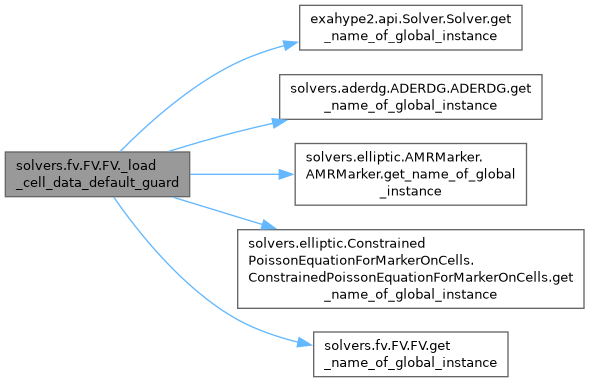
References api.solvers.Solver.Solver._name, api.Tree.Tree._name, dastgen2.attributes.Attribute.Attribute._name, dastgen2.attributes.BooleanArray.BooleanArray._name, dastgen2.attributes.Enumeration.Enumeration._name, exagrype.api.euler.CCZ4WithEuler_OuterAdditiveCoupling.CCZ4WithEuler_OuterAdditiveCoupling._name, exagrype.api.euler.CCZ4WithEuler_OuterMultiplicativeCoupling.CCZ4WithEuler_OuterMultiplicativeCoupling._name, exagrype.api.FOSOSolver.FOSOSolver._name, exagrype.api.scalarfield.CCZ4WithScalarField_InnerCoupling.CCZ4WithScalarField_InnerCoupling._name, exagrype.api.scalarfield.CCZ4WithScalarField_OuterMultiplicativeCoupling.CCZ4WithScalarField_OuterMultiplicativeCoupling._name, exahype2.api.AuxiliaryVariables.AuxiliaryVariables._name, exahype2.api.dslhype.SyntaxTree.Construction._name, exahype2.api.dslhype.SyntaxTree.DataBlockConstructionFromDotProduct._name, exahype2.api.dslhype.SyntaxTree.DataBlockConstructionFromExisting._name, exahype2.api.dslhype.SyntaxTree.DataBlockConstructionFromFunction._name, exahype2.api.dslhype.SyntaxTree.DataBlockConstructionFromMatrixVectorProduct._name, exahype2.api.dslhype.SyntaxTree.DataBlockConstructionFromOperation._name, exahype2.api.dslhype.SyntaxTree.MemoryAllocation._name, exahype2.api.dslhype.SyntaxTree.MemoryDeallocation._name, exahype2.api.Solver.Solver._name, mghype::matrixfree::solvers::Solver._name, peano4.api.dastgen2.Peano4DoubleArray.Peano4DoubleArray._name, peano4.api.dastgen2.Peano4IntegerArray.Peano4IntegerArray._name, peano4.api.dastgen2.Peano4SmartPointerDoubleArray.Peano4SmartPointerDoubleArray._name, peano4::RunMultipleSteps._name, solvers.aderdg.ADERDG.ADERDG._name, solvers.api.Solver.Solver._name, solvers.elliptic.AMRMarker.AMRMarker._name, solvers.elliptic.ConstrainedPoissonEquationForMarkerOnCells.ConstrainedPoissonEquationForMarkerOnCells._name, solvers.fv.EnclaveTasking.EnclaveTasking._name, _name, tarch::services::ServiceRepository::ServiceEntry._name, exahype2.api.Solver.Solver.get_name_of_global_instance(), solvers.aderdg.ADERDG.ADERDG.get_name_of_global_instance(), solvers.elliptic.AMRMarker.AMRMarker.get_name_of_global_instance(), solvers.elliptic.ConstrainedPoissonEquationForMarkerOnCells.ConstrainedPoissonEquationForMarkerOnCells.get_name_of_global_instance(), and get_name_of_global_instance().
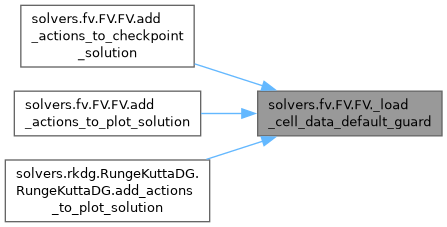
Referenced by add_actions_to_checkpoint_solution(), add_actions_to_plot_solution(), and solvers.rkdg.RungeKuttaDG.RungeKuttaDG.add_actions_to_plot_solution().
|
protected |
Extend the guard via ands only.
Never use an or, as subclasses might extend it as well, and they will append further ends.
Definition at line 962 of file FV.py.
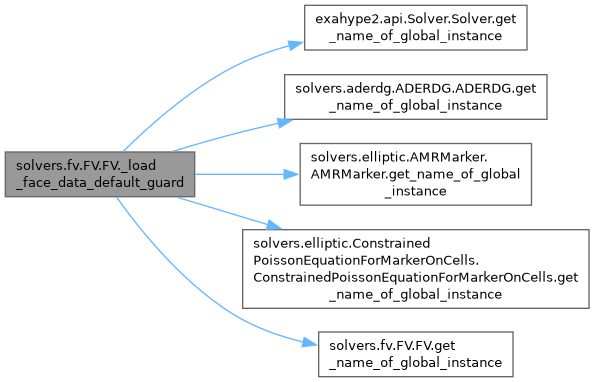
References api.solvers.Solver.Solver._name, api.Tree.Tree._name, dastgen2.attributes.Attribute.Attribute._name, dastgen2.attributes.BooleanArray.BooleanArray._name, dastgen2.attributes.Enumeration.Enumeration._name, exagrype.api.euler.CCZ4WithEuler_OuterAdditiveCoupling.CCZ4WithEuler_OuterAdditiveCoupling._name, exagrype.api.euler.CCZ4WithEuler_OuterMultiplicativeCoupling.CCZ4WithEuler_OuterMultiplicativeCoupling._name, exagrype.api.FOSOSolver.FOSOSolver._name, exagrype.api.scalarfield.CCZ4WithScalarField_InnerCoupling.CCZ4WithScalarField_InnerCoupling._name, exagrype.api.scalarfield.CCZ4WithScalarField_OuterMultiplicativeCoupling.CCZ4WithScalarField_OuterMultiplicativeCoupling._name, exahype2.api.AuxiliaryVariables.AuxiliaryVariables._name, exahype2.api.dslhype.SyntaxTree.Construction._name, exahype2.api.dslhype.SyntaxTree.DataBlockConstructionFromDotProduct._name, exahype2.api.dslhype.SyntaxTree.DataBlockConstructionFromExisting._name, exahype2.api.dslhype.SyntaxTree.DataBlockConstructionFromFunction._name, exahype2.api.dslhype.SyntaxTree.DataBlockConstructionFromMatrixVectorProduct._name, exahype2.api.dslhype.SyntaxTree.DataBlockConstructionFromOperation._name, exahype2.api.dslhype.SyntaxTree.MemoryAllocation._name, exahype2.api.dslhype.SyntaxTree.MemoryDeallocation._name, exahype2.api.Solver.Solver._name, mghype::matrixfree::solvers::Solver._name, peano4.api.dastgen2.Peano4DoubleArray.Peano4DoubleArray._name, peano4.api.dastgen2.Peano4IntegerArray.Peano4IntegerArray._name, peano4.api.dastgen2.Peano4SmartPointerDoubleArray.Peano4SmartPointerDoubleArray._name, peano4::RunMultipleSteps._name, solvers.aderdg.ADERDG.ADERDG._name, solvers.api.Solver.Solver._name, solvers.elliptic.AMRMarker.AMRMarker._name, solvers.elliptic.ConstrainedPoissonEquationForMarkerOnCells.ConstrainedPoissonEquationForMarkerOnCells._name, solvers.fv.EnclaveTasking.EnclaveTasking._name, _name, tarch::services::ServiceRepository::ServiceEntry._name, exahype2.api.Solver.Solver.get_name_of_global_instance(), solvers.aderdg.ADERDG.ADERDG.get_name_of_global_instance(), solvers.elliptic.AMRMarker.AMRMarker.get_name_of_global_instance(), solvers.elliptic.ConstrainedPoissonEquationForMarkerOnCells.ConstrainedPoissonEquationForMarkerOnCells.get_name_of_global_instance(), and get_name_of_global_instance().
|
protected |
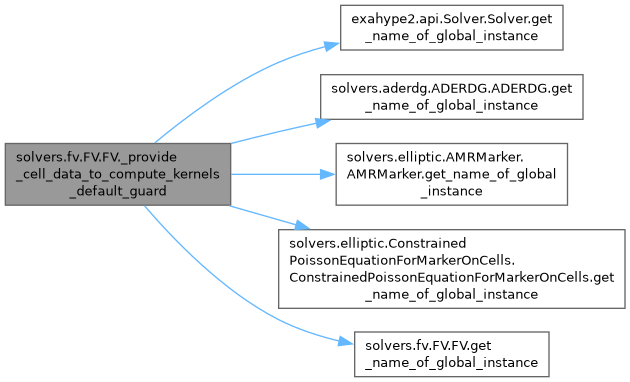
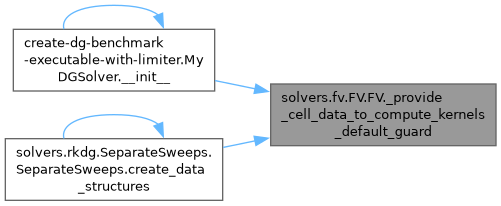
Default logic when to create cell data or not.
ExaHyPE allows you to define when you want to load or store data, and you can also define if you need some grid data for your computations. You might have some temporary data per cell which is neither stored nor loaded, but that has to be there while you compute. Or there might be cells which don't need to store a particular piece of data. See peano4.grid.LoadStoreComputeFlag for some details. This predicate here is a default. Particular solvers will take it as a starting point to make more detailed rules: an enclave solver for example might decide to take the information where to store data, but to toggle the storage on and off depending on the solver phase.
Definition at line 881 of file FV.py.
References api.solvers.Solver.Solver._name, api.Tree.Tree._name, dastgen2.attributes.Attribute.Attribute._name, dastgen2.attributes.BooleanArray.BooleanArray._name, dastgen2.attributes.Enumeration.Enumeration._name, exagrype.api.euler.CCZ4WithEuler_OuterAdditiveCoupling.CCZ4WithEuler_OuterAdditiveCoupling._name, exagrype.api.euler.CCZ4WithEuler_OuterMultiplicativeCoupling.CCZ4WithEuler_OuterMultiplicativeCoupling._name, exagrype.api.FOSOSolver.FOSOSolver._name, exagrype.api.scalarfield.CCZ4WithScalarField_InnerCoupling.CCZ4WithScalarField_InnerCoupling._name, exagrype.api.scalarfield.CCZ4WithScalarField_OuterMultiplicativeCoupling.CCZ4WithScalarField_OuterMultiplicativeCoupling._name, exahype2.api.AuxiliaryVariables.AuxiliaryVariables._name, exahype2.api.dslhype.SyntaxTree.Construction._name, exahype2.api.dslhype.SyntaxTree.DataBlockConstructionFromDotProduct._name, exahype2.api.dslhype.SyntaxTree.DataBlockConstructionFromExisting._name, exahype2.api.dslhype.SyntaxTree.DataBlockConstructionFromFunction._name, exahype2.api.dslhype.SyntaxTree.DataBlockConstructionFromMatrixVectorProduct._name, exahype2.api.dslhype.SyntaxTree.DataBlockConstructionFromOperation._name, exahype2.api.dslhype.SyntaxTree.MemoryAllocation._name, exahype2.api.dslhype.SyntaxTree.MemoryDeallocation._name, exahype2.api.Solver.Solver._name, mghype::matrixfree::solvers::Solver._name, peano4.api.dastgen2.Peano4DoubleArray.Peano4DoubleArray._name, peano4.api.dastgen2.Peano4IntegerArray.Peano4IntegerArray._name, peano4.api.dastgen2.Peano4SmartPointerDoubleArray.Peano4SmartPointerDoubleArray._name, peano4::RunMultipleSteps._name, solvers.aderdg.ADERDG.ADERDG._name, solvers.api.Solver.Solver._name, solvers.elliptic.AMRMarker.AMRMarker._name, solvers.elliptic.ConstrainedPoissonEquationForMarkerOnCells.ConstrainedPoissonEquationForMarkerOnCells._name, solvers.fv.EnclaveTasking.EnclaveTasking._name, _name, tarch::services::ServiceRepository::ServiceEntry._name, exahype2.api.Solver.Solver.get_name_of_global_instance(), solvers.aderdg.ADERDG.ADERDG.get_name_of_global_instance(), solvers.elliptic.AMRMarker.AMRMarker.get_name_of_global_instance(), solvers.elliptic.ConstrainedPoissonEquationForMarkerOnCells.ConstrainedPoissonEquationForMarkerOnCells.get_name_of_global_instance(), and get_name_of_global_instance().
Referenced by create-dg-benchmark-executable-with-limiter.MyDGSolver.__init__(), and solvers.rkdg.SeparateSweeps.SeparateSweeps.create_data_structures().
|
protected |
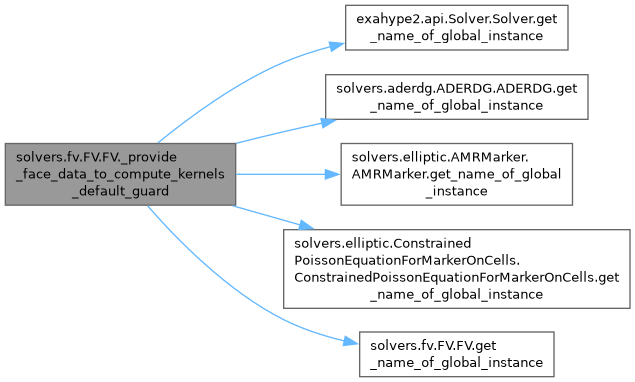
Definition at line 901 of file FV.py.
References api.solvers.Solver.Solver._name, api.Tree.Tree._name, dastgen2.attributes.Attribute.Attribute._name, dastgen2.attributes.BooleanArray.BooleanArray._name, dastgen2.attributes.Enumeration.Enumeration._name, exagrype.api.euler.CCZ4WithEuler_OuterAdditiveCoupling.CCZ4WithEuler_OuterAdditiveCoupling._name, exagrype.api.euler.CCZ4WithEuler_OuterMultiplicativeCoupling.CCZ4WithEuler_OuterMultiplicativeCoupling._name, exagrype.api.FOSOSolver.FOSOSolver._name, exagrype.api.scalarfield.CCZ4WithScalarField_InnerCoupling.CCZ4WithScalarField_InnerCoupling._name, exagrype.api.scalarfield.CCZ4WithScalarField_OuterMultiplicativeCoupling.CCZ4WithScalarField_OuterMultiplicativeCoupling._name, exahype2.api.AuxiliaryVariables.AuxiliaryVariables._name, exahype2.api.dslhype.SyntaxTree.Construction._name, exahype2.api.dslhype.SyntaxTree.DataBlockConstructionFromDotProduct._name, exahype2.api.dslhype.SyntaxTree.DataBlockConstructionFromExisting._name, exahype2.api.dslhype.SyntaxTree.DataBlockConstructionFromFunction._name, exahype2.api.dslhype.SyntaxTree.DataBlockConstructionFromMatrixVectorProduct._name, exahype2.api.dslhype.SyntaxTree.DataBlockConstructionFromOperation._name, exahype2.api.dslhype.SyntaxTree.MemoryAllocation._name, exahype2.api.dslhype.SyntaxTree.MemoryDeallocation._name, exahype2.api.Solver.Solver._name, mghype::matrixfree::solvers::Solver._name, peano4.api.dastgen2.Peano4DoubleArray.Peano4DoubleArray._name, peano4.api.dastgen2.Peano4IntegerArray.Peano4IntegerArray._name, peano4.api.dastgen2.Peano4SmartPointerDoubleArray.Peano4SmartPointerDoubleArray._name, peano4::RunMultipleSteps._name, solvers.aderdg.ADERDG.ADERDG._name, solvers.api.Solver.Solver._name, solvers.elliptic.AMRMarker.AMRMarker._name, solvers.elliptic.ConstrainedPoissonEquationForMarkerOnCells.ConstrainedPoissonEquationForMarkerOnCells._name, solvers.fv.EnclaveTasking.EnclaveTasking._name, _name, tarch::services::ServiceRepository::ServiceEntry._name, exahype2.api.Solver.Solver.get_name_of_global_instance(), solvers.aderdg.ADERDG.ADERDG.get_name_of_global_instance(), solvers.elliptic.AMRMarker.AMRMarker.get_name_of_global_instance(), solvers.elliptic.ConstrainedPoissonEquationForMarkerOnCells.ConstrainedPoissonEquationForMarkerOnCells.get_name_of_global_instance(), and get_name_of_global_instance().
|
protected |
Extend the guard via ands only.
Never use an or, as subclasses might extend it as well, and they will append further ends.
Definition at line 912 of file FV.py.
References api.solvers.Solver.Solver._name, api.Tree.Tree._name, dastgen2.attributes.Attribute.Attribute._name, dastgen2.attributes.BooleanArray.BooleanArray._name, dastgen2.attributes.Enumeration.Enumeration._name, exagrype.api.euler.CCZ4WithEuler_OuterAdditiveCoupling.CCZ4WithEuler_OuterAdditiveCoupling._name, exagrype.api.euler.CCZ4WithEuler_OuterMultiplicativeCoupling.CCZ4WithEuler_OuterMultiplicativeCoupling._name, exagrype.api.FOSOSolver.FOSOSolver._name, exagrype.api.scalarfield.CCZ4WithScalarField_InnerCoupling.CCZ4WithScalarField_InnerCoupling._name, exagrype.api.scalarfield.CCZ4WithScalarField_OuterMultiplicativeCoupling.CCZ4WithScalarField_OuterMultiplicativeCoupling._name, exahype2.api.AuxiliaryVariables.AuxiliaryVariables._name, exahype2.api.dslhype.SyntaxTree.Construction._name, exahype2.api.dslhype.SyntaxTree.DataBlockConstructionFromDotProduct._name, exahype2.api.dslhype.SyntaxTree.DataBlockConstructionFromExisting._name, exahype2.api.dslhype.SyntaxTree.DataBlockConstructionFromFunction._name, exahype2.api.dslhype.SyntaxTree.DataBlockConstructionFromMatrixVectorProduct._name, exahype2.api.dslhype.SyntaxTree.DataBlockConstructionFromOperation._name, exahype2.api.dslhype.SyntaxTree.MemoryAllocation._name, exahype2.api.dslhype.SyntaxTree.MemoryDeallocation._name, exahype2.api.Solver.Solver._name, mghype::matrixfree::solvers::Solver._name, peano4.api.dastgen2.Peano4DoubleArray.Peano4DoubleArray._name, peano4.api.dastgen2.Peano4IntegerArray.Peano4IntegerArray._name, peano4.api.dastgen2.Peano4SmartPointerDoubleArray.Peano4SmartPointerDoubleArray._name, peano4::RunMultipleSteps._name, solvers.aderdg.ADERDG.ADERDG._name, solvers.api.Solver.Solver._name, solvers.elliptic.AMRMarker.AMRMarker._name, solvers.elliptic.ConstrainedPoissonEquationForMarkerOnCells.ConstrainedPoissonEquationForMarkerOnCells._name, solvers.fv.EnclaveTasking.EnclaveTasking._name, _name, tarch::services::ServiceRepository::ServiceEntry._name, exahype2.api.Solver.Solver.get_name_of_global_instance(), solvers.aderdg.ADERDG.ADERDG.get_name_of_global_instance(), solvers.elliptic.AMRMarker.AMRMarker.get_name_of_global_instance(), solvers.elliptic.ConstrainedPoissonEquationForMarkerOnCells.ConstrainedPoissonEquationForMarkerOnCells.get_name_of_global_instance(), and get_name_of_global_instance().
Referenced by solvers.rkdg.RungeKuttaDG.RungeKuttaDG._query_fine_grid_cell_in_action_set_if_it_holds_solution(), add_actions_to_init_grid(), create_action_sets(), and solvers.rkdg.SeparateSweeps.SeparateSweeps.create_action_sets().
|
protected |
Extend the guard via ands only.
Never use an or, as subclasses might extend it as well, and they will append further ends.
Definition at line 947 of file FV.py.
References api.solvers.Solver.Solver._name, api.Tree.Tree._name, dastgen2.attributes.Attribute.Attribute._name, dastgen2.attributes.BooleanArray.BooleanArray._name, dastgen2.attributes.Enumeration.Enumeration._name, exagrype.api.euler.CCZ4WithEuler_OuterAdditiveCoupling.CCZ4WithEuler_OuterAdditiveCoupling._name, exagrype.api.euler.CCZ4WithEuler_OuterMultiplicativeCoupling.CCZ4WithEuler_OuterMultiplicativeCoupling._name, exagrype.api.FOSOSolver.FOSOSolver._name, exagrype.api.scalarfield.CCZ4WithScalarField_InnerCoupling.CCZ4WithScalarField_InnerCoupling._name, exagrype.api.scalarfield.CCZ4WithScalarField_OuterMultiplicativeCoupling.CCZ4WithScalarField_OuterMultiplicativeCoupling._name, exahype2.api.AuxiliaryVariables.AuxiliaryVariables._name, exahype2.api.dslhype.SyntaxTree.Construction._name, exahype2.api.dslhype.SyntaxTree.DataBlockConstructionFromDotProduct._name, exahype2.api.dslhype.SyntaxTree.DataBlockConstructionFromExisting._name, exahype2.api.dslhype.SyntaxTree.DataBlockConstructionFromFunction._name, exahype2.api.dslhype.SyntaxTree.DataBlockConstructionFromMatrixVectorProduct._name, exahype2.api.dslhype.SyntaxTree.DataBlockConstructionFromOperation._name, exahype2.api.dslhype.SyntaxTree.MemoryAllocation._name, exahype2.api.dslhype.SyntaxTree.MemoryDeallocation._name, exahype2.api.Solver.Solver._name, mghype::matrixfree::solvers::Solver._name, peano4.api.dastgen2.Peano4DoubleArray.Peano4DoubleArray._name, peano4.api.dastgen2.Peano4IntegerArray.Peano4IntegerArray._name, peano4.api.dastgen2.Peano4SmartPointerDoubleArray.Peano4SmartPointerDoubleArray._name, peano4::RunMultipleSteps._name, solvers.aderdg.ADERDG.ADERDG._name, solvers.api.Solver.Solver._name, solvers.elliptic.AMRMarker.AMRMarker._name, solvers.elliptic.ConstrainedPoissonEquationForMarkerOnCells.ConstrainedPoissonEquationForMarkerOnCells._name, solvers.fv.EnclaveTasking.EnclaveTasking._name, _name, tarch::services::ServiceRepository::ServiceEntry._name, exahype2.api.Solver.Solver.get_name_of_global_instance(), solvers.aderdg.ADERDG.ADERDG.get_name_of_global_instance(), solvers.elliptic.AMRMarker.AMRMarker.get_name_of_global_instance(), solvers.elliptic.ConstrainedPoissonEquationForMarkerOnCells.ConstrainedPoissonEquationForMarkerOnCells.get_name_of_global_instance(), and get_name_of_global_instance().
Referenced by create_action_sets().
|
protected |
Definition at line 982 of file FV.py.
References api.solvers.Solver.Solver._name, api.Tree.Tree._name, dastgen2.attributes.Attribute.Attribute._name, dastgen2.attributes.BooleanArray.BooleanArray._name, dastgen2.attributes.Enumeration.Enumeration._name, exagrype.api.euler.CCZ4WithEuler_OuterAdditiveCoupling.CCZ4WithEuler_OuterAdditiveCoupling._name, exagrype.api.euler.CCZ4WithEuler_OuterMultiplicativeCoupling.CCZ4WithEuler_OuterMultiplicativeCoupling._name, exagrype.api.FOSOSolver.FOSOSolver._name, exagrype.api.scalarfield.CCZ4WithScalarField_InnerCoupling.CCZ4WithScalarField_InnerCoupling._name, exagrype.api.scalarfield.CCZ4WithScalarField_OuterMultiplicativeCoupling.CCZ4WithScalarField_OuterMultiplicativeCoupling._name, exahype2.api.AuxiliaryVariables.AuxiliaryVariables._name, exahype2.api.dslhype.SyntaxTree.Construction._name, exahype2.api.dslhype.SyntaxTree.DataBlockConstructionFromDotProduct._name, exahype2.api.dslhype.SyntaxTree.DataBlockConstructionFromExisting._name, exahype2.api.dslhype.SyntaxTree.DataBlockConstructionFromFunction._name, exahype2.api.dslhype.SyntaxTree.DataBlockConstructionFromMatrixVectorProduct._name, exahype2.api.dslhype.SyntaxTree.DataBlockConstructionFromOperation._name, exahype2.api.dslhype.SyntaxTree.MemoryAllocation._name, exahype2.api.dslhype.SyntaxTree.MemoryDeallocation._name, exahype2.api.Solver.Solver._name, mghype::matrixfree::solvers::Solver._name, peano4.api.dastgen2.Peano4DoubleArray.Peano4DoubleArray._name, peano4.api.dastgen2.Peano4IntegerArray.Peano4IntegerArray._name, peano4.api.dastgen2.Peano4SmartPointerDoubleArray.Peano4SmartPointerDoubleArray._name, peano4::RunMultipleSteps._name, solvers.aderdg.ADERDG.ADERDG._name, solvers.api.Solver.Solver._name, solvers.elliptic.AMRMarker.AMRMarker._name, solvers.elliptic.ConstrainedPoissonEquationForMarkerOnCells.ConstrainedPoissonEquationForMarkerOnCells._name, solvers.fv.EnclaveTasking.EnclaveTasking._name, _name, and tarch::services::ServiceRepository::ServiceEntry._name.
Referenced by _init_dictionary_with_default_parameters(), solvers.rkdg.RungeKuttaDG.RungeKuttaDG._init_dictionary_with_default_parameters(), add_actions_to_checkpoint_solution(), add_actions_to_plot_solution(), and solvers.rkdg.RungeKuttaDG.RungeKuttaDG.add_actions_to_plot_solution().
| solvers.fv.FV.FV.add_actions_to_checkpoint_solution | ( | self, | |
| step, | |||
| output_path, | |||
| restart_from_checkpoint = False ) |
Add action sets to plot solution step.
Consult the discussion in add_actions_to_init_grid() around the order of the individual action sets.
It is important that we have the coupling/dynamic AMR part in here, as there might be pending AMR refinement requests that now are realised. For the same reason, we need the update of the face label and the update of the cell label in here: The AMR might just propagate over into the plotting, i.e. we might create new grid entities throughout the plot. These entities (faces and cells) have to be initialised properly. Otherwise, their un-initialised data will propagate through to the next time step.
To make the restriction work, we have to project the solutions onto the faces.
Definition at line 1210 of file FV.py.
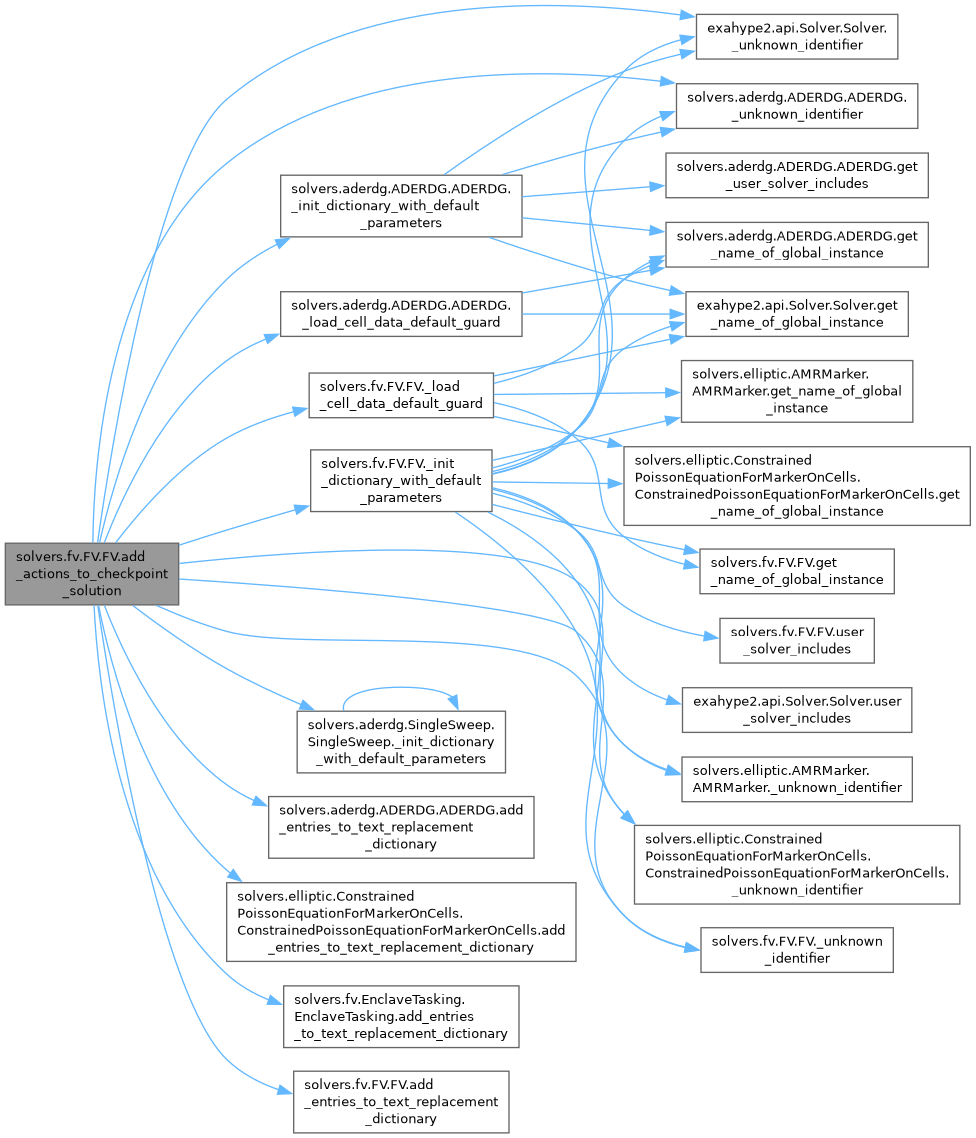
References solvers.aderdg.ADERDG.ADERDG._action_set_couple_resolution_transitions_and_handle_dynamic_mesh_refinement, _action_set_couple_resolution_transitions_and_handle_dynamic_mesh_refinement, _action_set_project_patch_onto_faces, _action_set_roll_over_update_of_faces, solvers.aderdg.ADERDG.ADERDG._action_set_update_cell_label, _action_set_update_cell_label, solvers.aderdg.ADERDG.ADERDG._action_set_update_face_label, _action_set_update_face_label, _baseline_action_set_descend_invocation_order, solvers.aderdg.ADERDG.ADERDG._init_dictionary_with_default_parameters(), solvers.aderdg.SingleSweep.SingleSweep._init_dictionary_with_default_parameters(), _init_dictionary_with_default_parameters(), solvers.aderdg.ADERDG.ADERDG._load_cell_data_default_guard(), _load_cell_data_default_guard(), api.solvers.Solver.Solver._name, api.Tree.Tree._name, dastgen2.attributes.Attribute.Attribute._name, dastgen2.attributes.BooleanArray.BooleanArray._name, dastgen2.attributes.Enumeration.Enumeration._name, exagrype.api.euler.CCZ4WithEuler_OuterAdditiveCoupling.CCZ4WithEuler_OuterAdditiveCoupling._name, exagrype.api.euler.CCZ4WithEuler_OuterMultiplicativeCoupling.CCZ4WithEuler_OuterMultiplicativeCoupling._name, exagrype.api.FOSOSolver.FOSOSolver._name, exagrype.api.scalarfield.CCZ4WithScalarField_InnerCoupling.CCZ4WithScalarField_InnerCoupling._name, exagrype.api.scalarfield.CCZ4WithScalarField_OuterMultiplicativeCoupling.CCZ4WithScalarField_OuterMultiplicativeCoupling._name, exahype2.api.AuxiliaryVariables.AuxiliaryVariables._name, exahype2.api.dslhype.SyntaxTree.Construction._name, exahype2.api.dslhype.SyntaxTree.DataBlockConstructionFromDotProduct._name, exahype2.api.dslhype.SyntaxTree.DataBlockConstructionFromExisting._name, exahype2.api.dslhype.SyntaxTree.DataBlockConstructionFromFunction._name, exahype2.api.dslhype.SyntaxTree.DataBlockConstructionFromMatrixVectorProduct._name, exahype2.api.dslhype.SyntaxTree.DataBlockConstructionFromOperation._name, exahype2.api.dslhype.SyntaxTree.MemoryAllocation._name, exahype2.api.dslhype.SyntaxTree.MemoryDeallocation._name, exahype2.api.Solver.Solver._name, mghype::matrixfree::solvers::Solver._name, peano4.api.dastgen2.Peano4DoubleArray.Peano4DoubleArray._name, peano4.api.dastgen2.Peano4IntegerArray.Peano4IntegerArray._name, peano4.api.dastgen2.Peano4SmartPointerDoubleArray.Peano4SmartPointerDoubleArray._name, peano4::RunMultipleSteps._name, solvers.aderdg.ADERDG.ADERDG._name, solvers.api.Solver.Solver._name, solvers.elliptic.AMRMarker.AMRMarker._name, solvers.elliptic.ConstrainedPoissonEquationForMarkerOnCells.ConstrainedPoissonEquationForMarkerOnCells._name, solvers.fv.EnclaveTasking.EnclaveTasking._name, _name, tarch::services::ServiceRepository::ServiceEntry._name, api.ApplyPointWiselyToPatch.ApplyPointWiselyToPatch._patch, exagrype.api.actionsets.ApplyReconstructionFunctor.ApplyReconstructionFunctor._patch, exagrype.api.CCZ4SolverBase.CCZ4SolverBase._patch, _patch, _plot_description, solvers.aderdg.ADERDG.ADERDG._plot_grid_properties, _plot_grid_properties, exahype2.api.Solver.Solver._unknown_identifier(), solvers.aderdg.ADERDG.ADERDG._unknown_identifier(), solvers.elliptic.AMRMarker.AMRMarker._unknown_identifier(), solvers.elliptic.ConstrainedPoissonEquationForMarkerOnCells.ConstrainedPoissonEquationForMarkerOnCells._unknown_identifier(), _unknown_identifier(), solvers.aderdg.ADERDG.ADERDG.add_entries_to_text_replacement_dictionary(), solvers.elliptic.ConstrainedPoissonEquationForMarkerOnCells.ConstrainedPoissonEquationForMarkerOnCells.add_entries_to_text_replacement_dictionary(), solvers.fv.EnclaveTasking.EnclaveTasking.add_entries_to_text_replacement_dictionary(), and add_entries_to_text_replacement_dictionary().
| solvers.fv.FV.FV.add_actions_to_create_grid | ( | self, | |
| step, | |||
| evaluate_refinement_criterion ) |
The boundary information is set only once.
It is therefore important that we ues the face label and initialise it properly.
Reimplemented in solvers.fv.EnclaveTasking.EnclaveTasking.
Definition at line 1109 of file FV.py.
References solvers.aderdg.ADERDG.ADERDG._action_set_AMR_commit_without_further_analysis, _action_set_AMR_commit_without_further_analysis, solvers.aderdg.ADERDG.ADERDG._action_set_AMR_throughout_grid_construction, _action_set_AMR_throughout_grid_construction, solvers.aderdg.ADERDG.ADERDG._action_set_initial_conditions_for_grid_construction, _action_set_initial_conditions_for_grid_construction, solvers.aderdg.ADERDG.ADERDG._action_set_update_cell_label, _action_set_update_cell_label, solvers.aderdg.ADERDG.ADERDG._action_set_update_face_label, and _action_set_update_face_label.
| solvers.fv.FV.FV.add_actions_to_init_grid | ( | self, | |
| step, | |||
| restart_from_checkpoint = False ) |
Add all the action sets to init grid.
The AMR stuff has to be the very first thing. Actually, the AMR routines' interpolation doesn't play any role here. But the restriction indeed is very important, as we have to get the face data for BCs et al. The action set order is inverted while we ascend within the tree again. Therefore, we add the AMR action set first which means it will be called last when we go from fine to coarse levels within the tree.
The order of the action sets is preserved throughout the steps down within the tree hierarchy. It is inverted throughout the backrolling.
This is what we want to achieve:
Reimplemented in solvers.fv.EnclaveTasking.EnclaveTasking.
Definition at line 1043 of file FV.py.
References solvers.aderdg.ADERDG.ADERDG._action_set_AMR, _action_set_AMR, _action_set_copy_new_faces_onto_old_faces, solvers.aderdg.ADERDG.ADERDG._action_set_couple_resolution_transitions_and_handle_dynamic_mesh_refinement, _action_set_couple_resolution_transitions_and_handle_dynamic_mesh_refinement, solvers.aderdg.ADERDG.ADERDG._action_set_initial_conditions, _action_set_initial_conditions, solvers.aderdg.ADERDG.ADERDG._action_set_postprocess_solution, _action_set_postprocess_solution, _action_set_preprocess_solution, _action_set_project_patch_onto_faces, _action_set_roll_over_update_of_faces, solvers.aderdg.ADERDG.ADERDG._action_set_update_cell_label, _action_set_update_cell_label, solvers.aderdg.ADERDG.ADERDG._action_set_update_face_label, _action_set_update_face_label, solvers.aderdg.ADERDG.ADERDG._store_cell_data_default_guard(), and _store_cell_data_default_guard().
| solvers.fv.FV.FV.add_actions_to_perform_time_step | ( | self, | |
| step ) |
Add action sets to time step.
See exahype2.solvers.fv.FV.add_actions_to_init_grid() for details on the ordering of the action sets.
It is important that we do the inter-grid transfer operators before we apply the boundary conditions.
Reimplemented in solvers.fv.EnclaveTasking.EnclaveTasking.
Definition at line 1274 of file FV.py.
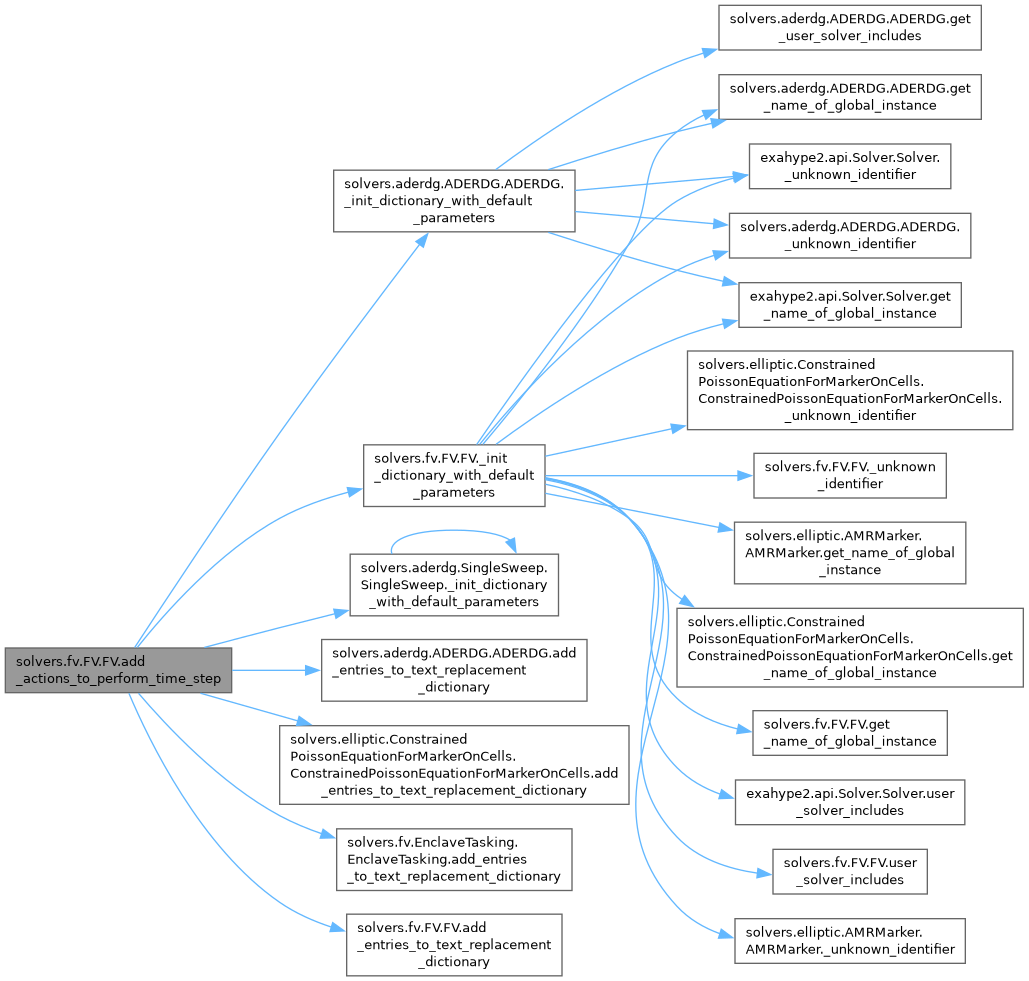
References solvers.aderdg.ADERDG.ADERDG._action_set_AMR, _action_set_AMR, solvers.aderdg.ADERDG.ADERDG._action_set_couple_resolution_transitions_and_handle_dynamic_mesh_refinement, _action_set_couple_resolution_transitions_and_handle_dynamic_mesh_refinement, solvers.aderdg.ADERDG.ADERDG._action_set_handle_boundary, _action_set_handle_boundary, solvers.aderdg.ADERDG.ADERDG._action_set_postprocess_solution, _action_set_postprocess_solution, _action_set_preprocess_solution, _action_set_project_patch_onto_faces, _action_set_roll_over_update_of_faces, solvers.fv.EnclaveTasking.EnclaveTasking._action_set_update_cell, _action_set_update_cell, solvers.aderdg.ADERDG.ADERDG._action_set_update_cell_label, _action_set_update_cell_label, solvers.aderdg.ADERDG.ADERDG._action_set_update_face_label, _action_set_update_face_label, solvers.aderdg.ADERDG.ADERDG._init_dictionary_with_default_parameters(), solvers.aderdg.SingleSweep.SingleSweep._init_dictionary_with_default_parameters(), _init_dictionary_with_default_parameters(), solvers.aderdg.ADERDG.ADERDG.add_entries_to_text_replacement_dictionary(), solvers.elliptic.ConstrainedPoissonEquationForMarkerOnCells.ConstrainedPoissonEquationForMarkerOnCells.add_entries_to_text_replacement_dictionary(), solvers.fv.EnclaveTasking.EnclaveTasking.add_entries_to_text_replacement_dictionary(), and add_entries_to_text_replacement_dictionary().
| solvers.fv.FV.FV.add_actions_to_plot_solution | ( | self, | |
| step, | |||
| output_path, | |||
| restart_from_checkpoint = False ) |
Add action sets to plot solution step.
Consult the discussion in add_actions_to_init_grid() around the order of the individual action sets.
It is important that we have the coupling/dynamic AMR part in here, as there might be pending AMR refinement requests that now are realised. For the same reason, we need the update of the face label and the update of the cell label in here: The AMR might just propagate over into the plotting, i.e. we might create new grid entities throughout the plot. These entities (faces and cells) have to be initialised properly. Otherwise, their un-initialised data will propagate through to the next time step.
To make the restriction work, we have to project the solutions onto the faces.
Definition at line 1142 of file FV.py.
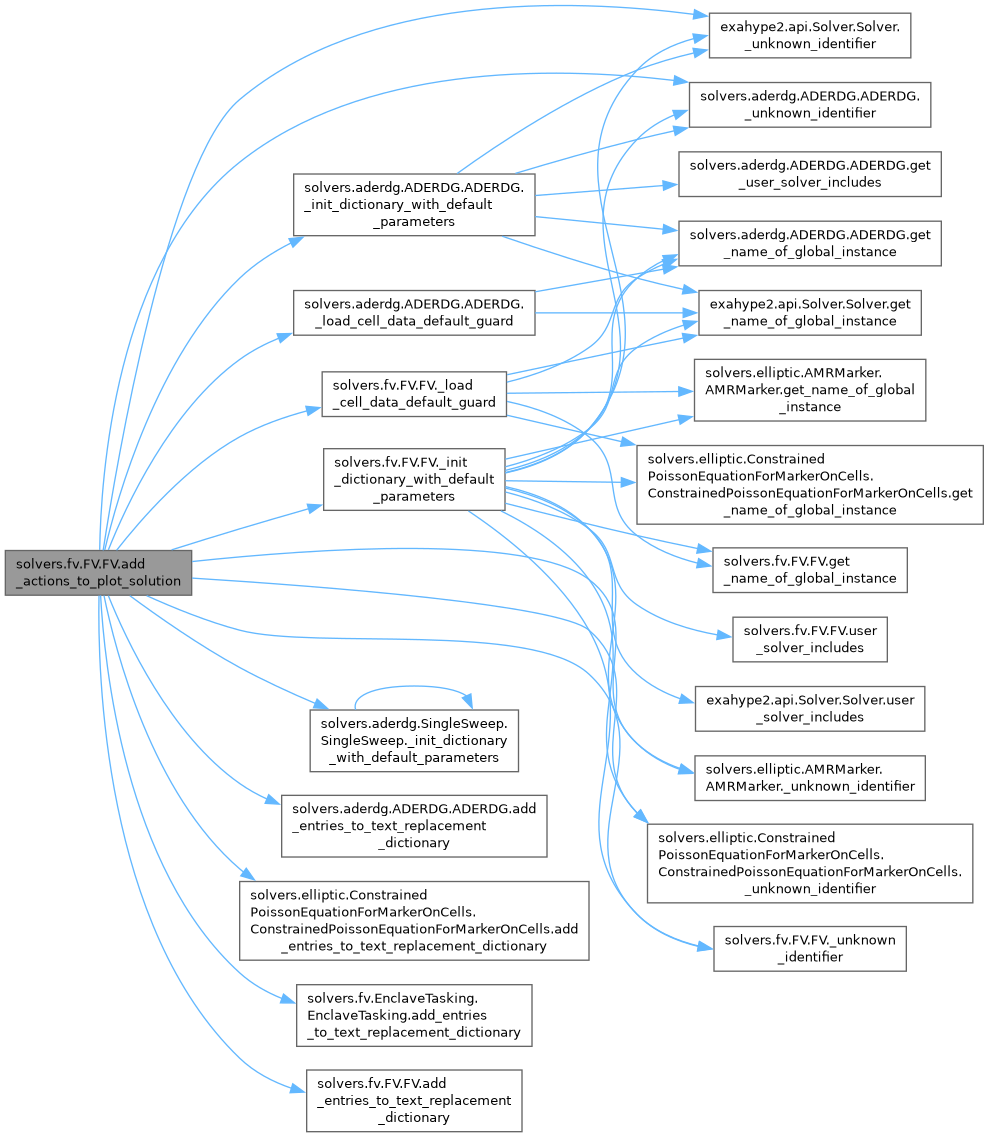
References solvers.aderdg.ADERDG.ADERDG._action_set_couple_resolution_transitions_and_handle_dynamic_mesh_refinement, _action_set_couple_resolution_transitions_and_handle_dynamic_mesh_refinement, _action_set_project_patch_onto_faces, _action_set_roll_over_update_of_faces, solvers.aderdg.ADERDG.ADERDG._action_set_update_cell_label, _action_set_update_cell_label, solvers.aderdg.ADERDG.ADERDG._action_set_update_face_label, _action_set_update_face_label, _baseline_action_set_descend_invocation_order, solvers.aderdg.ADERDG.ADERDG._init_dictionary_with_default_parameters(), solvers.aderdg.SingleSweep.SingleSweep._init_dictionary_with_default_parameters(), _init_dictionary_with_default_parameters(), solvers.aderdg.ADERDG.ADERDG._load_cell_data_default_guard(), _load_cell_data_default_guard(), api.solvers.Solver.Solver._name, api.Tree.Tree._name, dastgen2.attributes.Attribute.Attribute._name, dastgen2.attributes.BooleanArray.BooleanArray._name, dastgen2.attributes.Enumeration.Enumeration._name, exagrype.api.euler.CCZ4WithEuler_OuterAdditiveCoupling.CCZ4WithEuler_OuterAdditiveCoupling._name, exagrype.api.euler.CCZ4WithEuler_OuterMultiplicativeCoupling.CCZ4WithEuler_OuterMultiplicativeCoupling._name, exagrype.api.FOSOSolver.FOSOSolver._name, exagrype.api.scalarfield.CCZ4WithScalarField_InnerCoupling.CCZ4WithScalarField_InnerCoupling._name, exagrype.api.scalarfield.CCZ4WithScalarField_OuterMultiplicativeCoupling.CCZ4WithScalarField_OuterMultiplicativeCoupling._name, exahype2.api.AuxiliaryVariables.AuxiliaryVariables._name, exahype2.api.dslhype.SyntaxTree.Construction._name, exahype2.api.dslhype.SyntaxTree.DataBlockConstructionFromDotProduct._name, exahype2.api.dslhype.SyntaxTree.DataBlockConstructionFromExisting._name, exahype2.api.dslhype.SyntaxTree.DataBlockConstructionFromFunction._name, exahype2.api.dslhype.SyntaxTree.DataBlockConstructionFromMatrixVectorProduct._name, exahype2.api.dslhype.SyntaxTree.DataBlockConstructionFromOperation._name, exahype2.api.dslhype.SyntaxTree.MemoryAllocation._name, exahype2.api.dslhype.SyntaxTree.MemoryDeallocation._name, exahype2.api.Solver.Solver._name, mghype::matrixfree::solvers::Solver._name, peano4.api.dastgen2.Peano4DoubleArray.Peano4DoubleArray._name, peano4.api.dastgen2.Peano4IntegerArray.Peano4IntegerArray._name, peano4.api.dastgen2.Peano4SmartPointerDoubleArray.Peano4SmartPointerDoubleArray._name, peano4::RunMultipleSteps._name, solvers.aderdg.ADERDG.ADERDG._name, solvers.api.Solver.Solver._name, solvers.elliptic.AMRMarker.AMRMarker._name, solvers.elliptic.ConstrainedPoissonEquationForMarkerOnCells.ConstrainedPoissonEquationForMarkerOnCells._name, solvers.fv.EnclaveTasking.EnclaveTasking._name, _name, tarch::services::ServiceRepository::ServiceEntry._name, api.ApplyPointWiselyToPatch.ApplyPointWiselyToPatch._patch, exagrype.api.actionsets.ApplyReconstructionFunctor.ApplyReconstructionFunctor._patch, exagrype.api.CCZ4SolverBase.CCZ4SolverBase._patch, _patch, _plot_description, solvers.aderdg.ADERDG.ADERDG._plot_grid_properties, _plot_grid_properties, exahype2.api.Solver.Solver._unknown_identifier(), solvers.aderdg.ADERDG.ADERDG._unknown_identifier(), solvers.elliptic.AMRMarker.AMRMarker._unknown_identifier(), solvers.elliptic.ConstrainedPoissonEquationForMarkerOnCells.ConstrainedPoissonEquationForMarkerOnCells._unknown_identifier(), _unknown_identifier(), solvers.aderdg.ADERDG.ADERDG.add_entries_to_text_replacement_dictionary(), solvers.elliptic.ConstrainedPoissonEquationForMarkerOnCells.ConstrainedPoissonEquationForMarkerOnCells.add_entries_to_text_replacement_dictionary(), solvers.fv.EnclaveTasking.EnclaveTasking.add_entries_to_text_replacement_dictionary(), add_entries_to_text_replacement_dictionary(), solvers.aderdg.ADERDG.ADERDG.select_dofs_to_print, and select_dofs_to_print.
| solvers.fv.FV.FV.add_entries_to_text_replacement_dictionary | ( | self, | |
| d ) |
Reimplemented in solvers.fv.EnclaveTasking.EnclaveTasking, and solvers.fv.SingleSweep.SingleSweep.
Definition at line 1305 of file FV.py.
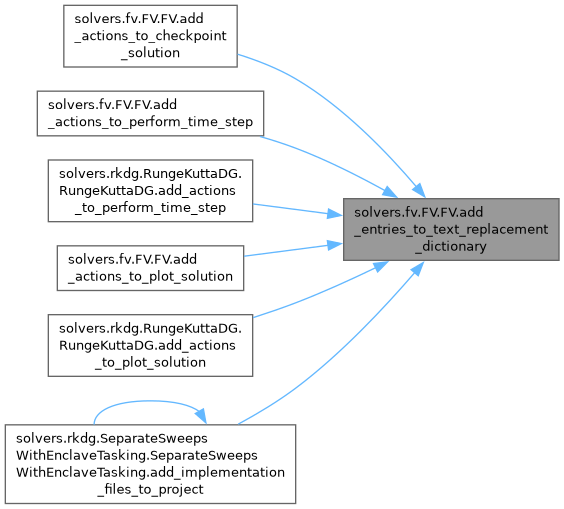
Referenced by add_actions_to_checkpoint_solution(), add_actions_to_perform_time_step(), solvers.rkdg.RungeKuttaDG.RungeKuttaDG.add_actions_to_perform_time_step(), add_actions_to_plot_solution(), solvers.rkdg.RungeKuttaDG.RungeKuttaDG.add_actions_to_plot_solution(), and solvers.rkdg.SeparateSweepsWithEnclaveTasking.SeparateSweepsWithEnclaveTasking.add_implementation_files_to_project().
| solvers.fv.FV.FV.add_implementation_files_to_project | ( | self, | |
| namespace, | |||
| output, | |||
| dimensions, | |||
| subdirectory = "", | |||
| abstract_overwrite = True ) |
The ExaHyPE project will call this operation when it sets up the overall environment.
This routine is typically not invoked by a user.
output: peano4.api.output.Output
Reimplemented in solvers.fv.EnclaveTasking.EnclaveTasking.
| solvers.fv.FV.FV.add_solver_constants | ( | self, | |
| datastring ) |
Definition at line 1396 of file FV.py.
References exahype2.api.Solver.Solver._solver_constants, solvers.aderdg.ADERDG.ADERDG._solver_constants, and _solver_constants.
| solvers.fv.FV.FV.add_to_Peano4_datamodel | ( | self, | |
| datamodel, | |||
| verbose ) |
Add all required data to the Peano project's datamodel so it is properly built up.
Definition at line 990 of file FV.py.
References solvers.aderdg.ADERDG.ADERDG._cell_label, _cell_label, solvers.aderdg.ADERDG.ADERDG._face_label, _face_label, api.ApplyPointWiselyToPatch.ApplyPointWiselyToPatch._patch, exagrype.api.actionsets.ApplyReconstructionFunctor.ApplyReconstructionFunctor._patch, exagrype.api.CCZ4SolverBase.CCZ4SolverBase._patch, _patch, _patch_overlap_new, _patch_overlap_old, and _patch_overlap_update.
| solvers.fv.FV.FV.add_use_data_statements_to_Peano4_solver_step | ( | self, | |
| step ) |
Tell Peano what data to move around.
Inform Peano4 step which data are to be moved around via the use_cell and use_face commands. This operation is generic from ExaHyPE's point of view, i.e. I use it for all grid sweep types.
It is important that the cell label comes first, as some other data might make their load/store decisions depend on the label.
Definition at line 1013 of file FV.py.
References solvers.aderdg.ADERDG.ADERDG._cell_label, _cell_label, solvers.aderdg.ADERDG.ADERDG._face_label, _face_label, api.ApplyPointWiselyToPatch.ApplyPointWiselyToPatch._patch, exagrype.api.actionsets.ApplyReconstructionFunctor.ApplyReconstructionFunctor._patch, exagrype.api.CCZ4SolverBase.CCZ4SolverBase._patch, _patch, _patch_overlap_new, _patch_overlap_old, and _patch_overlap_update.
| solvers.fv.FV.FV.add_user_action_set_includes | ( | self, | |
| value ) |
Add further includes to this property, if your action sets require some additional routines from other header files.
Definition at line 509 of file FV.py.
References _user_action_set_includes.
Referenced by solvers.rkdg.RungeKuttaDG.RungeKuttaDG.set_implementation().

| solvers.fv.FV.FV.add_user_solver_includes | ( | self, | |
| value ) |
Add further includes to this property, if your solver requires some additional routines from other header files.
Definition at line 517 of file FV.py.
References exahype2.api.Solver.Solver._user_solver_includes, and _user_solver_includes.
Referenced by solvers.rkdg.RungeKuttaDG.RungeKuttaDG.set_implementation().

| solvers.fv.FV.FV.auxiliary_variables | ( | self | ) |
Definition at line 1500 of file FV.py.
References exahype2.api.Solver.Solver._auxiliary_variables, solvers.aderdg.ADERDG.ADERDG._auxiliary_variables, and _auxiliary_variables.
| solvers.fv.FV.FV.auxiliary_variables | ( | self, | |
| value ) |
Definition at line 1519 of file FV.py.
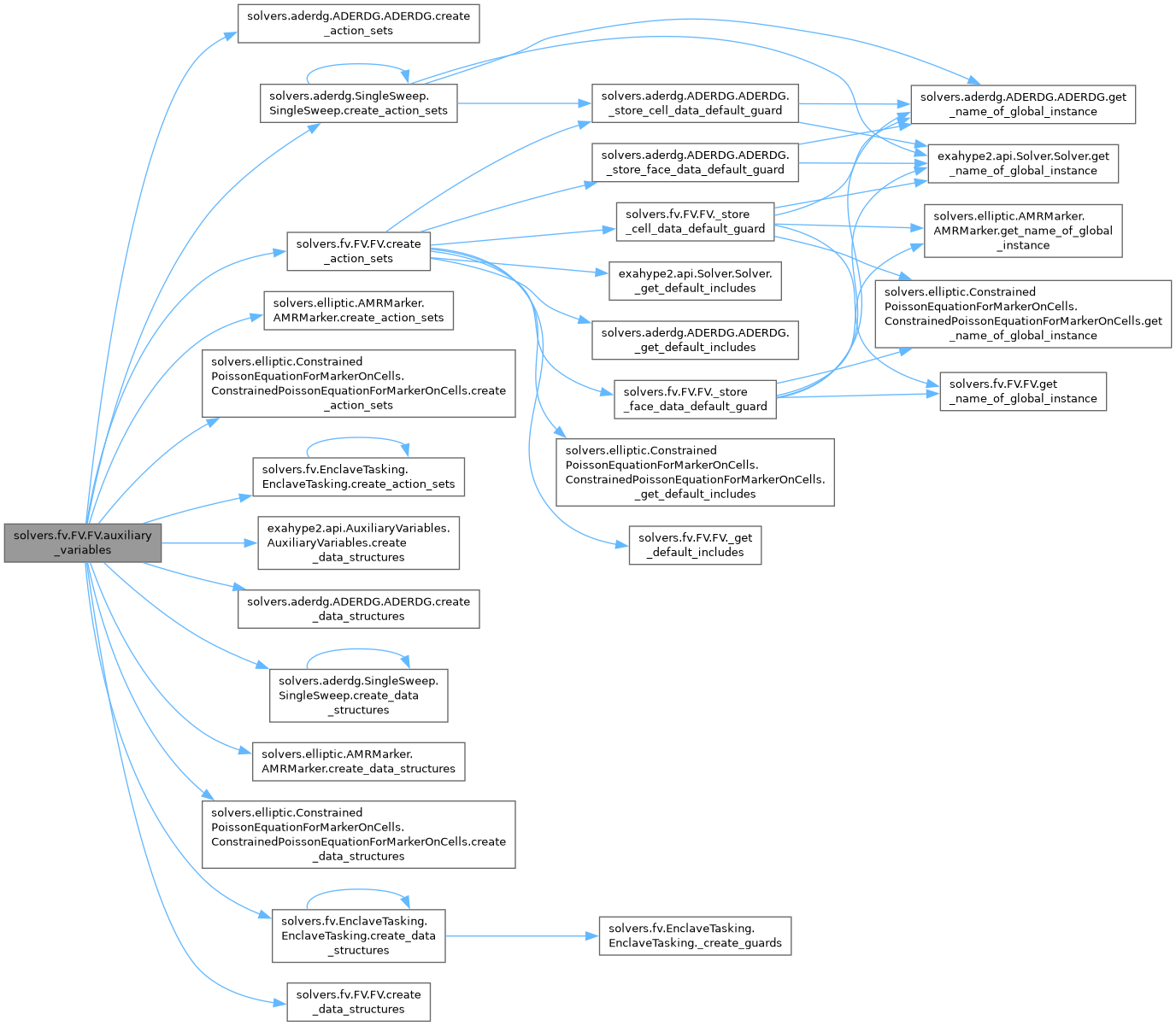
References exahype2.api.Solver.Solver._auxiliary_variables, solvers.aderdg.ADERDG.ADERDG._auxiliary_variables, _auxiliary_variables, solvers.aderdg.ADERDG.ADERDG.create_action_sets(), solvers.aderdg.SingleSweep.SingleSweep.create_action_sets(), solvers.elliptic.AMRMarker.AMRMarker.create_action_sets(), solvers.elliptic.ConstrainedPoissonEquationForMarkerOnCells.ConstrainedPoissonEquationForMarkerOnCells.create_action_sets(), solvers.fv.EnclaveTasking.EnclaveTasking.create_action_sets(), create_action_sets(), exahype2.api.AuxiliaryVariables.AuxiliaryVariables.create_data_structures(), solvers.aderdg.ADERDG.ADERDG.create_data_structures(), solvers.aderdg.SingleSweep.SingleSweep.create_data_structures(), solvers.elliptic.AMRMarker.AMRMarker.create_data_structures(), solvers.elliptic.ConstrainedPoissonEquationForMarkerOnCells.ConstrainedPoissonEquationForMarkerOnCells.create_data_structures(), solvers.fv.EnclaveTasking.EnclaveTasking.create_data_structures(), and create_data_structures().
| solvers.fv.FV.FV.create_action_sets | ( | self | ) |
Create all the action sets.
Overwrite in subclasses if you wanna create different action sets. Subclasses also might redefine the invocation order.
This operation can be called multiple times. However, only the very last call matters. All previous calls are wiped out.
If you have a hierarchy of solvers, every create_data_structures() should first(!) call its parent version. This way, you always ensure that all data are in place before you continue to alter the more specialised versions. So it is (logically) a top-down (general to specialised) run through all create_data_structures() variants within the inheritance tree.
We faced some issues with action sets that should not be overwritten. For example, the postprocessing should not be overwritten as users might want to set it and then later on reset the number of unknowns, e.g. In this case, you would loose your postprocessing if create_action_sets() recreated them. So I decided to make an exception here: the postprocessing step is never overwritten by the standard classes.
There are further action sets which have a state, which users might want to alter. The most prominent one is the AMR routines, where users often alter the interpolation and restriction scheme. Here, things are tricky: If we keep the default one, the action set would not pick up if you changed the number of unknowns, e.g. However, if we recreated the action set, we'd miss out on any changed interpolation/restriction scheme. Therefore, I have to hold the interpolation and restriction scheme separate.
Reimplemented in solvers.fv.EnclaveTasking.EnclaveTasking, and solvers.fv.SingleSweep.SingleSweep.
Definition at line 730 of file FV.py.
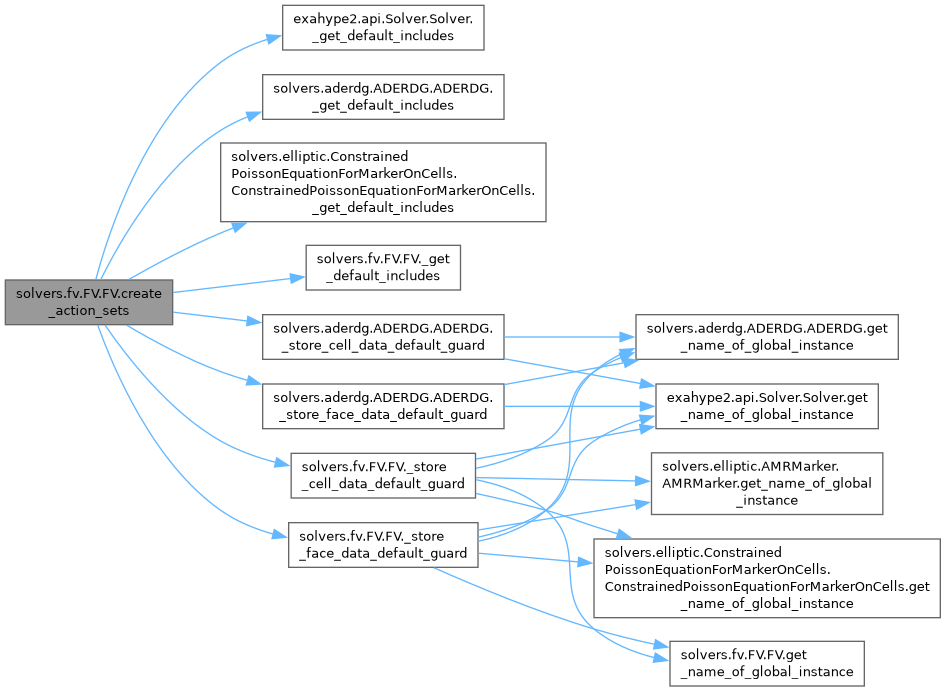
References solvers.aderdg.ADERDG.ADERDG._action_set_AMR, _action_set_AMR, solvers.aderdg.ADERDG.ADERDG._action_set_AMR_commit_without_further_analysis, _action_set_AMR_commit_without_further_analysis, solvers.aderdg.ADERDG.ADERDG._action_set_AMR_throughout_grid_construction, _action_set_AMR_throughout_grid_construction, _action_set_copy_new_faces_onto_old_faces, solvers.aderdg.ADERDG.ADERDG._action_set_couple_resolution_transitions_and_handle_dynamic_mesh_refinement, _action_set_couple_resolution_transitions_and_handle_dynamic_mesh_refinement, solvers.aderdg.ADERDG.ADERDG._action_set_handle_boundary, _action_set_handle_boundary, solvers.aderdg.ADERDG.ADERDG._action_set_initial_conditions, _action_set_initial_conditions, solvers.aderdg.ADERDG.ADERDG._action_set_initial_conditions_for_grid_construction, _action_set_initial_conditions_for_grid_construction, solvers.aderdg.ADERDG.ADERDG._action_set_postprocess_solution, _action_set_postprocess_solution, _action_set_preprocess_solution, _action_set_project_patch_onto_faces, _action_set_roll_over_update_of_faces, exahype2.api.Solver.Solver._get_default_includes(), solvers.aderdg.ADERDG.ADERDG._get_default_includes(), solvers.elliptic.ConstrainedPoissonEquationForMarkerOnCells.ConstrainedPoissonEquationForMarkerOnCells._get_default_includes(), _get_default_includes(), _interpolation, _patch_overlap_new, _patch_overlap_old, _restriction, solvers.aderdg.ADERDG.ADERDG._store_cell_data_default_guard(), _store_cell_data_default_guard(), solvers.aderdg.ADERDG.ADERDG._store_face_data_default_guard(), and _store_face_data_default_guard().
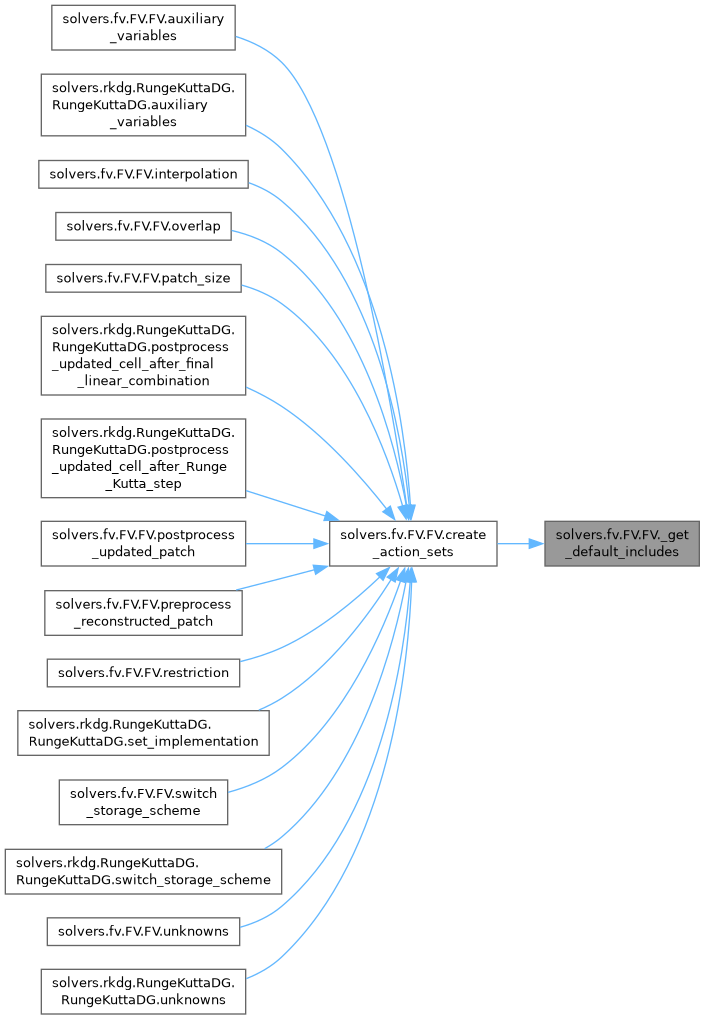
Referenced by auxiliary_variables(), solvers.rkdg.RungeKuttaDG.RungeKuttaDG.auxiliary_variables(), interpolation(), overlap(), patch_size(), solvers.rkdg.RungeKuttaDG.RungeKuttaDG.postprocess_updated_cell_after_final_linear_combination(), solvers.rkdg.RungeKuttaDG.RungeKuttaDG.postprocess_updated_cell_after_Runge_Kutta_step(), postprocess_updated_patch(), preprocess_reconstructed_patch(), restriction(), solvers.rkdg.RungeKuttaDG.RungeKuttaDG.set_implementation(), switch_storage_scheme(), solvers.rkdg.RungeKuttaDG.RungeKuttaDG.switch_storage_scheme(), unknowns(), and solvers.rkdg.RungeKuttaDG.RungeKuttaDG.unknowns().
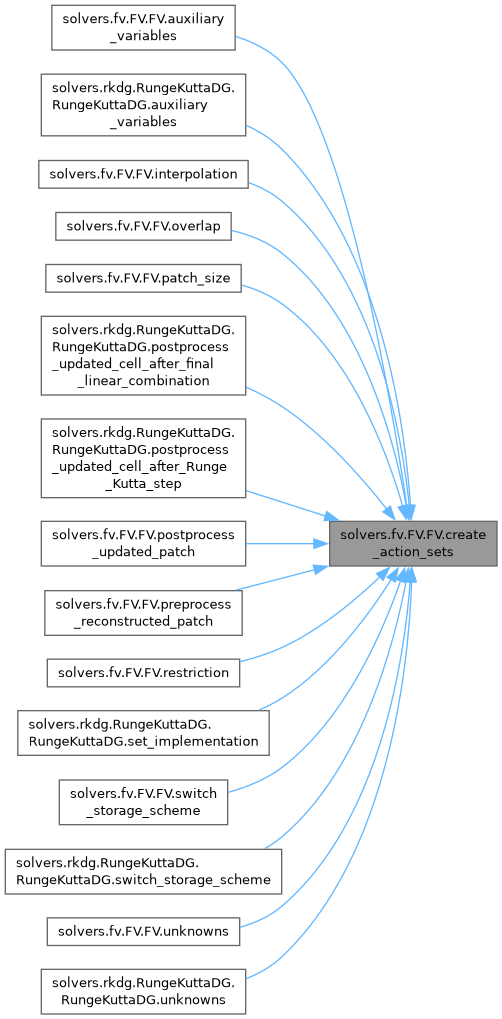
| solvers.fv.FV.FV.create_data_structures | ( | self | ) |
Create data structures required by all Finite Volume solvers.
Recall in subclasses if you wanna change the number of unknowns or auxiliary variables. See class description's subsection on data flow.
:: Call order and ownership
This operation can be called multiple times. However, only the very last call matters. All previous calls are wiped out.
If you have a hierarchy of solvers, every create_data_structures() should first(!) call its parent version. This way, you always ensure that all data are in place before you continue to alter the more specialised versions. So it is (logically) a top-down (general to specialised) run through all create_data_structures() variants within the inheritance tree.
:: Arguments
_patch: Patch (NxNxN) Actual patch data. We use Finite Volumes, so this is always the current snapshot, i.e. the valid data at one point.
_patch_overlap_old, _patch_overlap_new: Patch (2xNxN) This is a copy/excerpt from the two adjacent finite volume snapshots plus the old data as backup. If I want to implement local timestepping, I don't have to backup the whole patch (see _patch), but I need a backup of the face data to be able to interpolate in time.
_patch_overlap_update: Patch (2xNxN) This is the new update. After the time step, I roll this information over into _patch_overlap_new, while I backup the previous _patch_overlap_new into _patch_overlap_old. If I worked with regular meshes only, I would not need this update field and could work directly with _patch_overlap_new. However, AMR requires me to accumulate data within new while I need the new and old data temporarily. Therefore, I employ this accumulation/roll-over data which usually is not stored persistently.
Reimplemented in solvers.fv.EnclaveTasking.EnclaveTasking, and solvers.fv.SingleSweep.SingleSweep.
Definition at line 526 of file FV.py.
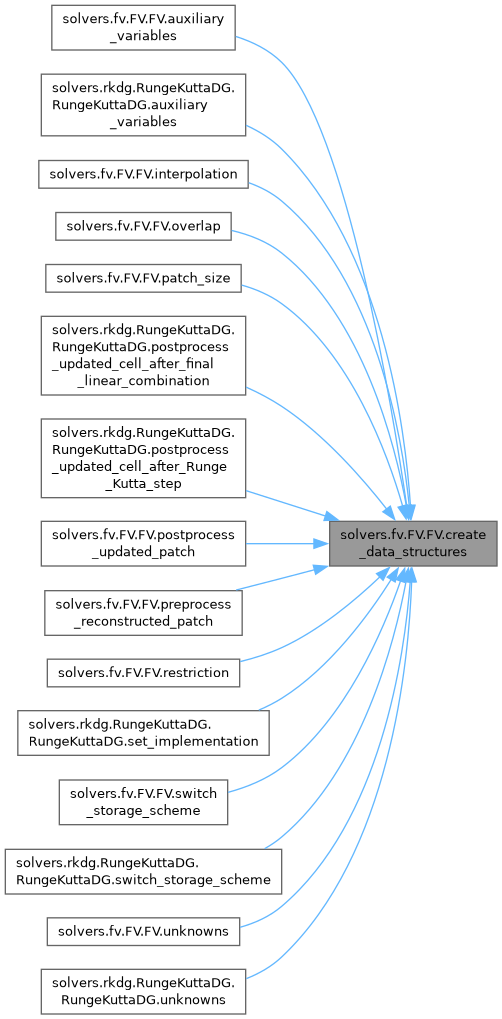
Referenced by auxiliary_variables(), solvers.rkdg.RungeKuttaDG.RungeKuttaDG.auxiliary_variables(), interpolation(), overlap(), patch_size(), solvers.rkdg.RungeKuttaDG.RungeKuttaDG.postprocess_updated_cell_after_final_linear_combination(), solvers.rkdg.RungeKuttaDG.RungeKuttaDG.postprocess_updated_cell_after_Runge_Kutta_step(), postprocess_updated_patch(), preprocess_reconstructed_patch(), restriction(), solvers.rkdg.RungeKuttaDG.RungeKuttaDG.set_implementation(), switch_storage_scheme(), solvers.rkdg.RungeKuttaDG.RungeKuttaDG.switch_storage_scheme(), unknowns(), and solvers.rkdg.RungeKuttaDG.RungeKuttaDG.unknowns().
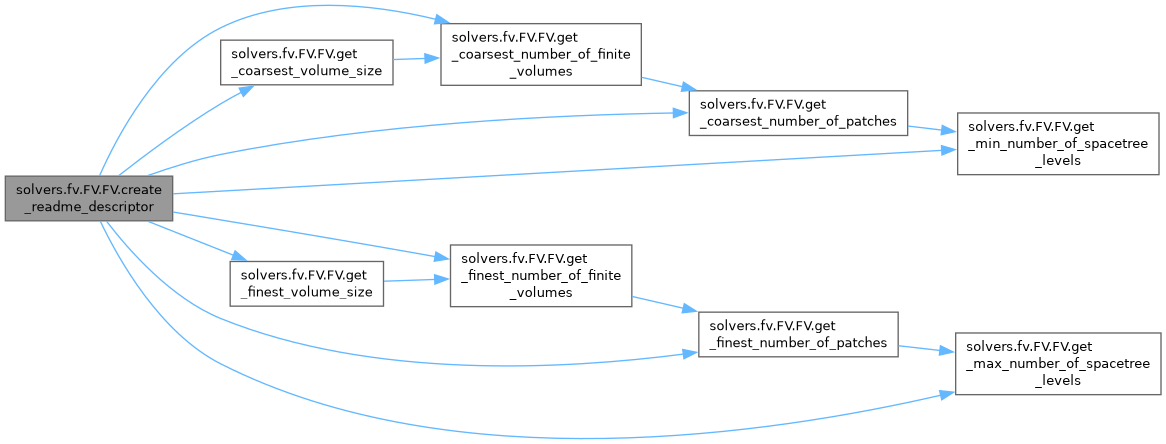
| solvers.fv.FV.FV.create_readme_descriptor | ( | self, | |
| domain_offset, | |||
| domain_size ) |
Definition at line 430 of file FV.py.
References _max_volume_h, _min_volume_h, exahype2.api.AuxiliaryVariables.AuxiliaryVariables._patch_size, _patch_size, get_coarsest_number_of_finite_volumes(), get_coarsest_number_of_patches(), get_coarsest_volume_size(), get_finest_number_of_finite_volumes(), get_finest_number_of_patches(), get_finest_volume_size(), get_max_number_of_spacetree_levels(), and get_min_number_of_spacetree_levels().
| solvers.fv.FV.FV.get_coarsest_number_of_finite_volumes | ( | self, | |
| domain_size ) |
Definition at line 414 of file FV.py.
References exahype2.api.AuxiliaryVariables.AuxiliaryVariables._patch_size, _patch_size, and get_coarsest_number_of_patches().
Referenced by create_readme_descriptor(), and get_coarsest_volume_size().


| solvers.fv.FV.FV.get_coarsest_number_of_patches | ( | self, | |
| domain_size ) |
Definition at line 406 of file FV.py.
References get_min_number_of_spacetree_levels().
Referenced by create_readme_descriptor(), and get_coarsest_number_of_finite_volumes().


| solvers.fv.FV.FV.get_coarsest_volume_size | ( | self, | |
| domain_size ) |
Definition at line 422 of file FV.py.
References get_coarsest_number_of_finite_volumes().
Referenced by create_readme_descriptor().


| solvers.fv.FV.FV.get_finest_number_of_finite_volumes | ( | self, | |
| domain_size ) |
Definition at line 418 of file FV.py.
References exahype2.api.AuxiliaryVariables.AuxiliaryVariables._patch_size, _patch_size, and get_finest_number_of_patches().
Referenced by create_readme_descriptor(), and get_finest_volume_size().


| solvers.fv.FV.FV.get_finest_number_of_patches | ( | self, | |
| domain_size ) |
Definition at line 410 of file FV.py.
References get_max_number_of_spacetree_levels().
Referenced by create_readme_descriptor(), and get_finest_number_of_finite_volumes().


| solvers.fv.FV.FV.get_finest_volume_size | ( | self, | |
| domain_size ) |
Definition at line 426 of file FV.py.
References get_finest_number_of_finite_volumes().
Referenced by create_readme_descriptor().


| solvers.fv.FV.FV.get_max_number_of_spacetree_levels | ( | self, | |
| domain_size ) |
Definition at line 393 of file FV.py.
References _min_volume_h, exahype2.api.AuxiliaryVariables.AuxiliaryVariables._patch_size, and _patch_size.
Referenced by create_readme_descriptor(), solvers.rkdg.RungeKuttaDG.RungeKuttaDG.create_readme_descriptor(), solvers.rkdg.RungeKuttaDG.RungeKuttaDG.get_finest_number_of_cells(), and get_finest_number_of_patches().
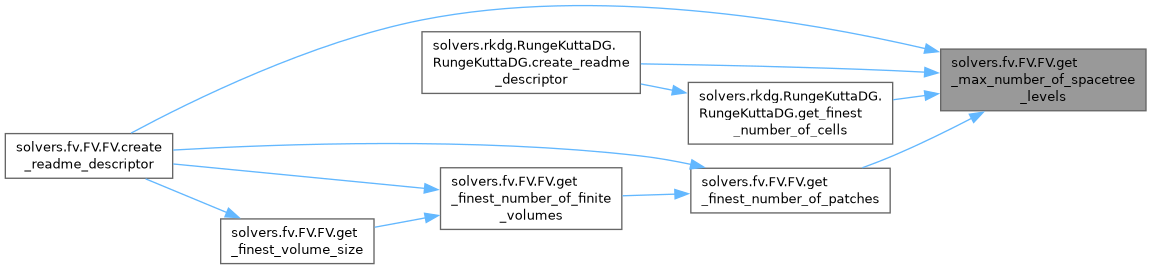
| solvers.fv.FV.FV.get_min_number_of_spacetree_levels | ( | self, | |
| domain_size ) |
Definition at line 383 of file FV.py.
References _max_volume_h, exahype2.api.AuxiliaryVariables.AuxiliaryVariables._patch_size, and _patch_size.
Referenced by create_readme_descriptor(), solvers.rkdg.RungeKuttaDG.RungeKuttaDG.create_readme_descriptor(), solvers.rkdg.RungeKuttaDG.RungeKuttaDG.get_coarsest_number_of_cells(), and get_coarsest_number_of_patches().
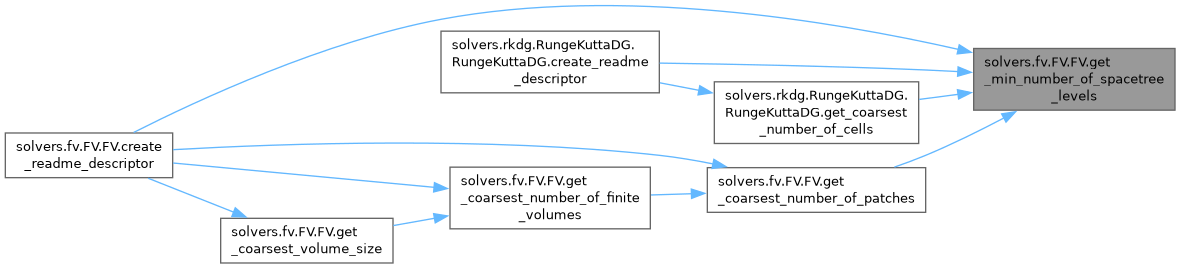
| solvers.fv.FV.FV.get_name_of_global_instance | ( | self | ) |
Definition at line 986 of file FV.py.
References api.solvers.Solver.Solver._name, api.Tree.Tree._name, dastgen2.attributes.Attribute.Attribute._name, dastgen2.attributes.BooleanArray.BooleanArray._name, dastgen2.attributes.Enumeration.Enumeration._name, exagrype.api.euler.CCZ4WithEuler_OuterAdditiveCoupling.CCZ4WithEuler_OuterAdditiveCoupling._name, exagrype.api.euler.CCZ4WithEuler_OuterMultiplicativeCoupling.CCZ4WithEuler_OuterMultiplicativeCoupling._name, exagrype.api.FOSOSolver.FOSOSolver._name, exagrype.api.scalarfield.CCZ4WithScalarField_InnerCoupling.CCZ4WithScalarField_InnerCoupling._name, exagrype.api.scalarfield.CCZ4WithScalarField_OuterMultiplicativeCoupling.CCZ4WithScalarField_OuterMultiplicativeCoupling._name, exahype2.api.AuxiliaryVariables.AuxiliaryVariables._name, exahype2.api.dslhype.SyntaxTree.Construction._name, exahype2.api.dslhype.SyntaxTree.DataBlockConstructionFromDotProduct._name, exahype2.api.dslhype.SyntaxTree.DataBlockConstructionFromExisting._name, exahype2.api.dslhype.SyntaxTree.DataBlockConstructionFromFunction._name, exahype2.api.dslhype.SyntaxTree.DataBlockConstructionFromMatrixVectorProduct._name, exahype2.api.dslhype.SyntaxTree.DataBlockConstructionFromOperation._name, exahype2.api.dslhype.SyntaxTree.MemoryAllocation._name, exahype2.api.dslhype.SyntaxTree.MemoryDeallocation._name, exahype2.api.Solver.Solver._name, mghype::matrixfree::solvers::Solver._name, peano4.api.dastgen2.Peano4DoubleArray.Peano4DoubleArray._name, peano4.api.dastgen2.Peano4IntegerArray.Peano4IntegerArray._name, peano4.api.dastgen2.Peano4SmartPointerDoubleArray.Peano4SmartPointerDoubleArray._name, peano4::RunMultipleSteps._name, solvers.aderdg.ADERDG.ADERDG._name, solvers.api.Solver.Solver._name, solvers.elliptic.AMRMarker.AMRMarker._name, solvers.elliptic.ConstrainedPoissonEquationForMarkerOnCells.ConstrainedPoissonEquationForMarkerOnCells._name, solvers.fv.EnclaveTasking.EnclaveTasking._name, _name, and tarch::services::ServiceRepository::ServiceEntry._name.
Referenced by _init_dictionary_with_default_parameters(), solvers.rkdg.RungeKuttaDG.RungeKuttaDG._init_dictionary_with_default_parameters(), _load_cell_data_default_guard(), solvers.rkdg.RungeKuttaDG.RungeKuttaDG._load_cell_data_default_guard(), _load_face_data_default_guard(), solvers.rkdg.RungeKuttaDG.RungeKuttaDG._load_face_data_default_guard(), _provide_cell_data_to_compute_kernels_default_guard(), solvers.rkdg.RungeKuttaDG.RungeKuttaDG._provide_cell_data_to_compute_kernels_default_guard(), _provide_face_data_to_compute_kernels_default_guard(), solvers.rkdg.RungeKuttaDG.RungeKuttaDG._provide_face_data_to_compute_kernels_default_guard(), _store_cell_data_default_guard(), solvers.rkdg.RungeKuttaDG.RungeKuttaDG._store_cell_data_default_guard(), _store_face_data_default_guard(), solvers.rkdg.RungeKuttaDG.RungeKuttaDG._store_face_data_default_guard(), solvers.rkdg.SeparateSweeps.SeparateSweeps.create_action_sets(), and solvers.fv.SingleSweep.SingleSweep.create_data_structures().
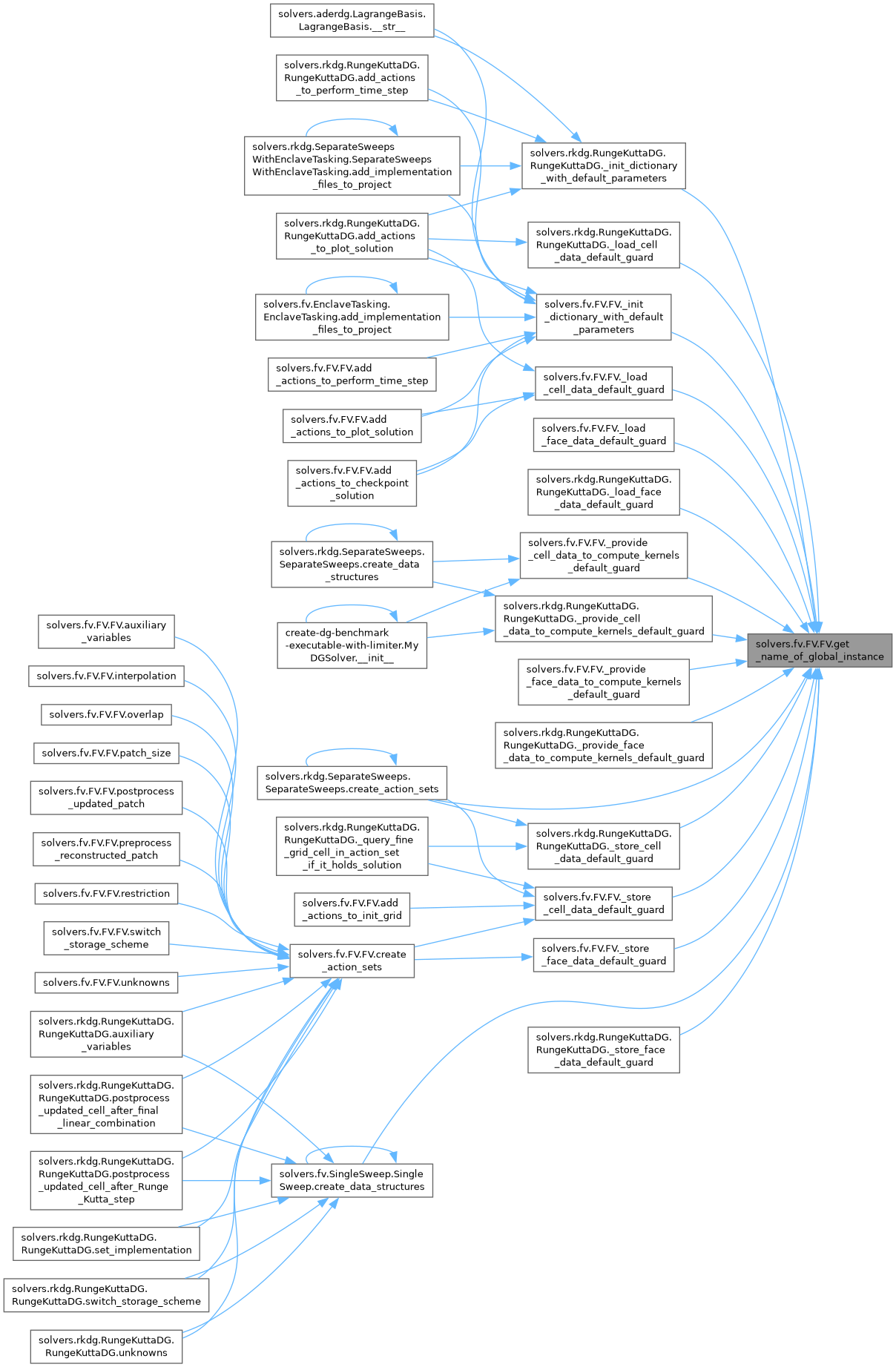
| solvers.fv.FV.FV.interpolation | ( | self | ) |
Definition at line 1669 of file FV.py.
References _interpolation.
| solvers.fv.FV.FV.interpolation | ( | self, | |
| value ) |
Definition at line 1674 of file FV.py.
References _interpolation, solvers.aderdg.ADERDG.ADERDG.create_action_sets(), solvers.aderdg.SingleSweep.SingleSweep.create_action_sets(), solvers.elliptic.AMRMarker.AMRMarker.create_action_sets(), solvers.elliptic.ConstrainedPoissonEquationForMarkerOnCells.ConstrainedPoissonEquationForMarkerOnCells.create_action_sets(), solvers.fv.EnclaveTasking.EnclaveTasking.create_action_sets(), create_action_sets(), exahype2.api.AuxiliaryVariables.AuxiliaryVariables.create_data_structures(), solvers.aderdg.ADERDG.ADERDG.create_data_structures(), solvers.aderdg.SingleSweep.SingleSweep.create_data_structures(), solvers.elliptic.AMRMarker.AMRMarker.create_data_structures(), solvers.elliptic.ConstrainedPoissonEquationForMarkerOnCells.ConstrainedPoissonEquationForMarkerOnCells.create_data_structures(), solvers.fv.EnclaveTasking.EnclaveTasking.create_data_structures(), and create_data_structures().
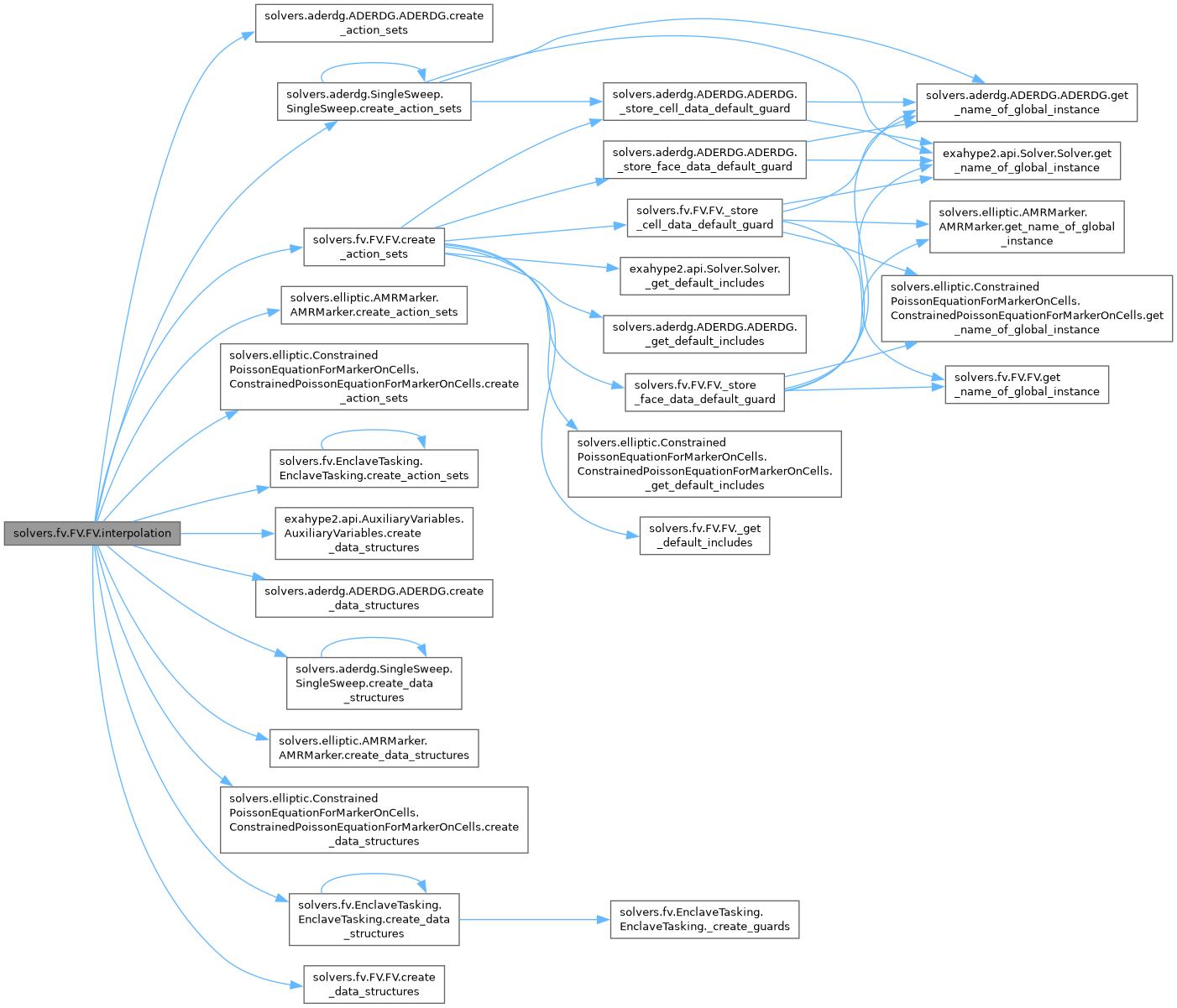
| solvers.fv.FV.FV.name | ( | self | ) |
Definition at line 1582 of file FV.py.
References api.solvers.Solver.Solver._name, api.Tree.Tree._name, dastgen2.attributes.Attribute.Attribute._name, dastgen2.attributes.BooleanArray.BooleanArray._name, dastgen2.attributes.Enumeration.Enumeration._name, exagrype.api.euler.CCZ4WithEuler_OuterAdditiveCoupling.CCZ4WithEuler_OuterAdditiveCoupling._name, exagrype.api.euler.CCZ4WithEuler_OuterMultiplicativeCoupling.CCZ4WithEuler_OuterMultiplicativeCoupling._name, exagrype.api.FOSOSolver.FOSOSolver._name, exagrype.api.scalarfield.CCZ4WithScalarField_InnerCoupling.CCZ4WithScalarField_InnerCoupling._name, exagrype.api.scalarfield.CCZ4WithScalarField_OuterMultiplicativeCoupling.CCZ4WithScalarField_OuterMultiplicativeCoupling._name, exahype2.api.AuxiliaryVariables.AuxiliaryVariables._name, exahype2.api.dslhype.SyntaxTree.Construction._name, exahype2.api.dslhype.SyntaxTree.DataBlockConstructionFromDotProduct._name, exahype2.api.dslhype.SyntaxTree.DataBlockConstructionFromExisting._name, exahype2.api.dslhype.SyntaxTree.DataBlockConstructionFromFunction._name, exahype2.api.dslhype.SyntaxTree.DataBlockConstructionFromMatrixVectorProduct._name, exahype2.api.dslhype.SyntaxTree.DataBlockConstructionFromOperation._name, exahype2.api.dslhype.SyntaxTree.MemoryAllocation._name, exahype2.api.dslhype.SyntaxTree.MemoryDeallocation._name, exahype2.api.Solver.Solver._name, mghype::matrixfree::solvers::Solver._name, peano4.api.dastgen2.Peano4DoubleArray.Peano4DoubleArray._name, peano4.api.dastgen2.Peano4IntegerArray.Peano4IntegerArray._name, peano4.api.dastgen2.Peano4SmartPointerDoubleArray.Peano4SmartPointerDoubleArray._name, peano4::RunMultipleSteps._name, solvers.aderdg.ADERDG.ADERDG._name, solvers.api.Solver.Solver._name, solvers.elliptic.AMRMarker.AMRMarker._name, solvers.elliptic.ConstrainedPoissonEquationForMarkerOnCells.ConstrainedPoissonEquationForMarkerOnCells._name, solvers.fv.EnclaveTasking.EnclaveTasking._name, _name, and tarch::services::ServiceRepository::ServiceEntry._name.
| solvers.fv.FV.FV.overlap | ( | self | ) |
Definition at line 1651 of file FV.py.
References exahype2.api.AuxiliaryVariables.AuxiliaryVariables._overlap, and _overlap.
| solvers.fv.FV.FV.overlap | ( | self, | |
| value ) |
Definition at line 1656 of file FV.py.
References exahype2.api.AuxiliaryVariables.AuxiliaryVariables._overlap, _overlap, solvers.aderdg.ADERDG.ADERDG.create_action_sets(), solvers.aderdg.SingleSweep.SingleSweep.create_action_sets(), solvers.elliptic.AMRMarker.AMRMarker.create_action_sets(), solvers.elliptic.ConstrainedPoissonEquationForMarkerOnCells.ConstrainedPoissonEquationForMarkerOnCells.create_action_sets(), solvers.fv.EnclaveTasking.EnclaveTasking.create_action_sets(), create_action_sets(), exahype2.api.AuxiliaryVariables.AuxiliaryVariables.create_data_structures(), solvers.aderdg.ADERDG.ADERDG.create_data_structures(), solvers.aderdg.SingleSweep.SingleSweep.create_data_structures(), solvers.elliptic.AMRMarker.AMRMarker.create_data_structures(), solvers.elliptic.ConstrainedPoissonEquationForMarkerOnCells.ConstrainedPoissonEquationForMarkerOnCells.create_data_structures(), solvers.fv.EnclaveTasking.EnclaveTasking.create_data_structures(), and create_data_structures().
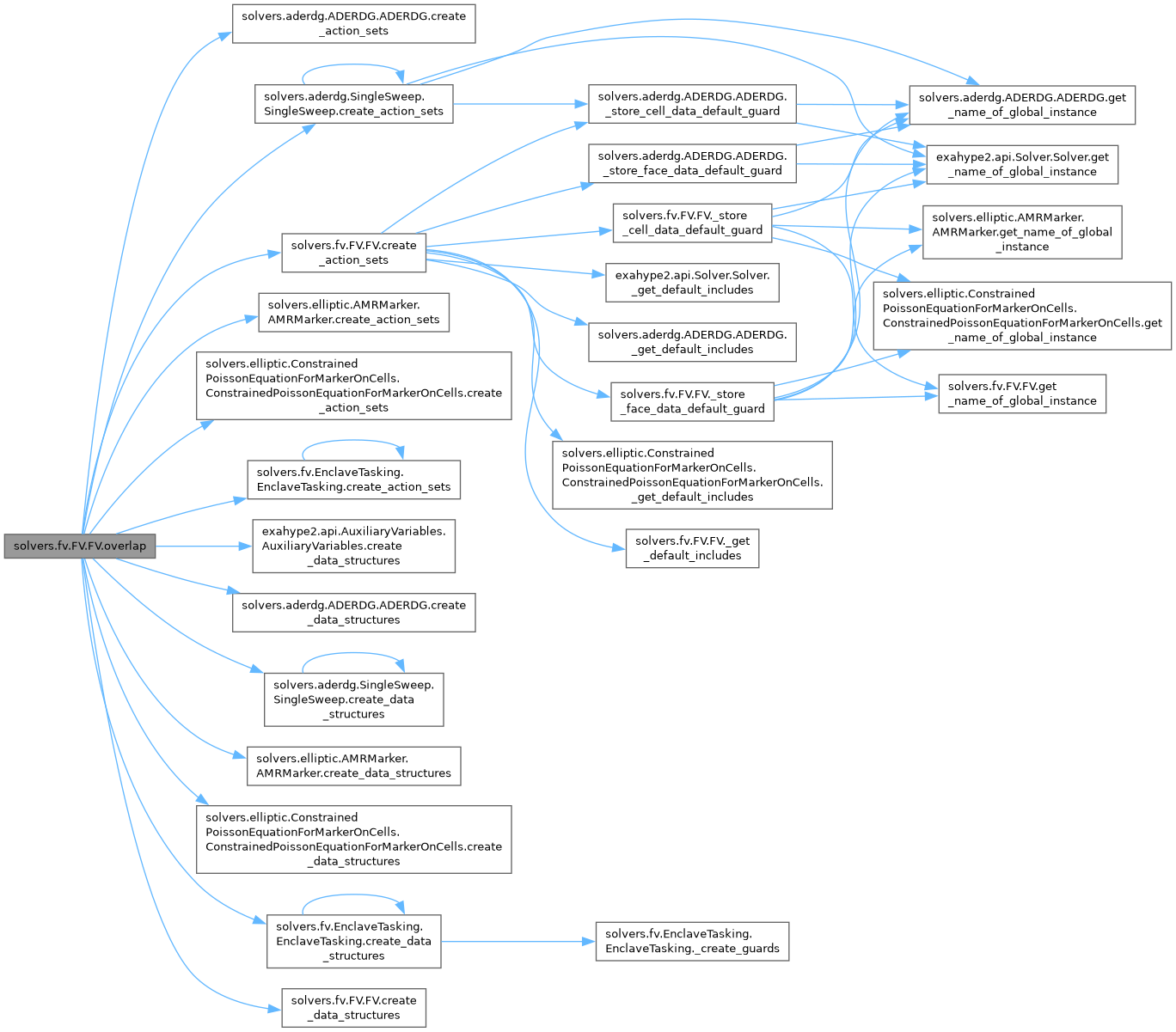
| solvers.fv.FV.FV.patch_size | ( | self | ) |
Definition at line 1495 of file FV.py.
References exahype2.api.AuxiliaryVariables.AuxiliaryVariables._patch_size, and _patch_size.
| solvers.fv.FV.FV.patch_size | ( | self, | |
| value ) |
Definition at line 1505 of file FV.py.
References exahype2.api.AuxiliaryVariables.AuxiliaryVariables._patch_size, _patch_size, solvers.aderdg.ADERDG.ADERDG.create_action_sets(), solvers.aderdg.SingleSweep.SingleSweep.create_action_sets(), solvers.elliptic.AMRMarker.AMRMarker.create_action_sets(), solvers.elliptic.ConstrainedPoissonEquationForMarkerOnCells.ConstrainedPoissonEquationForMarkerOnCells.create_action_sets(), solvers.fv.EnclaveTasking.EnclaveTasking.create_action_sets(), create_action_sets(), exahype2.api.AuxiliaryVariables.AuxiliaryVariables.create_data_structures(), solvers.aderdg.ADERDG.ADERDG.create_data_structures(), solvers.aderdg.SingleSweep.SingleSweep.create_data_structures(), solvers.elliptic.AMRMarker.AMRMarker.create_data_structures(), solvers.elliptic.ConstrainedPoissonEquationForMarkerOnCells.ConstrainedPoissonEquationForMarkerOnCells.create_data_structures(), solvers.fv.EnclaveTasking.EnclaveTasking.create_data_structures(), and create_data_structures().
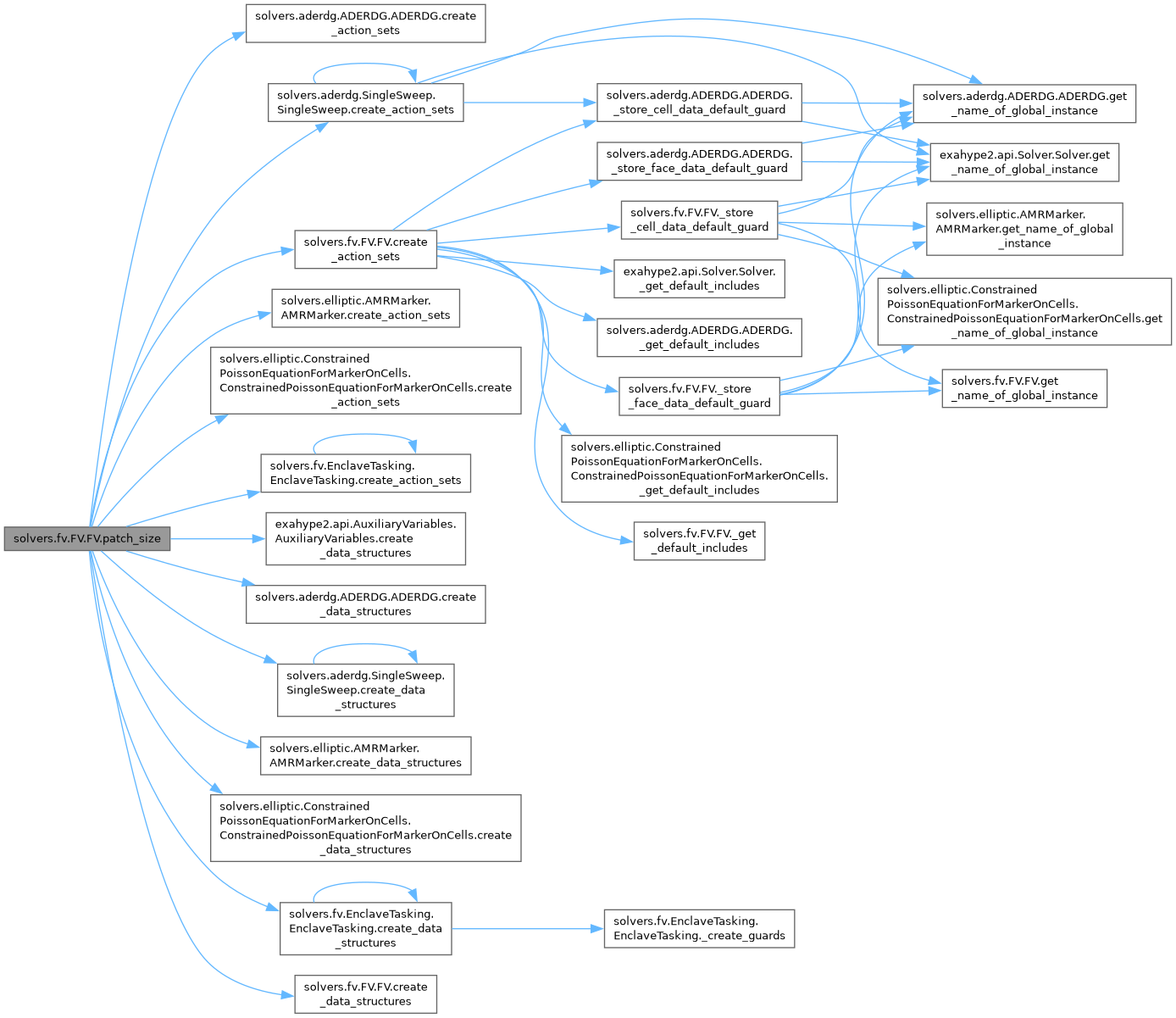
| solvers.fv.FV.FV.plot_description | ( | self | ) |
Definition at line 1124 of file FV.py.
References _plot_description.
| solvers.fv.FV.FV.plot_description | ( | self, | |
| description ) |
Add a proper description to the plots.
Use this one to set a description within the output patch file that tells the solver what the semantics of the entries are. Typically, I use a comma-separated list here.
Definition at line 1131 of file FV.py.
References _plot_description.
| solvers.fv.FV.FV.postprocess_updated_patch | ( | self | ) |
Definition at line 1587 of file FV.py.
References solvers.aderdg.ADERDG.ADERDG._postprocess_updated_patch, and _postprocess_updated_patch.
| solvers.fv.FV.FV.postprocess_updated_patch | ( | self, | |
| kernel ) |
Define a postprocessing routine over the data.
The postprocessing kernel often looks similar to the following code:
 {
   int index = 0;
   dfor( volume, {{NUMBER_OF_VOLUMES_PER_AXIS}} ) {
     enforceCCZ4constraints( newQ+index );
     index += {{NUMBER_OF_UNKNOWNS}} + {{NUMBER_OF_AUXILIARY_VARIABLES}};
   }
 }
but often, it is nicer ot user one of the pre-defined kernels in ExaHyPE for postprocessing:
::exahype2::fv::mapInnerNeighbourVoxelAlongBoundayOntoAuxiliaryVariable(
  newQ,
  {{NUMBER_OF_VOLUMES_PER_AXIS}},
  {{NUMBER_OF_UNKNOWNS}},
  {{NUMBER_OF_AUXILIARY_VARIABLES}}
);
As highlighted from the examples above, you can use normal ExaHyPE constant within your injected code. Furthermore, you have the following two variables available:
In ExaHyPE's finite volume solvers, there are two different ways how to inject postprocessing: You can either define your own postprocessing step by setting _action_set_postprocess_solution, or you can use this setter to inject some source code. The two options are not equivalent: The snippet injected here is executed directly after the kernel update. Consequently, it also runs on a GPU if GPUs are employed, or it runs directly after a task has been launched to update a cell.
The postprocessing action set is launched when the cell update is committed, i.e., after the cell task has terminated or a task result came back from the GPU. Consequently, the snippet injected here might not have access to global variables (if it executes on a GPU) while the postprocessing action set always has access to the global program state.
kernel: String C++ code that holds the postprocessing kernel
Definition at line 1592 of file FV.py.
References solvers.aderdg.ADERDG.ADERDG._postprocess_updated_patch, _postprocess_updated_patch, solvers.aderdg.ADERDG.ADERDG.create_action_sets(), solvers.aderdg.SingleSweep.SingleSweep.create_action_sets(), solvers.elliptic.AMRMarker.AMRMarker.create_action_sets(), solvers.elliptic.ConstrainedPoissonEquationForMarkerOnCells.ConstrainedPoissonEquationForMarkerOnCells.create_action_sets(), solvers.fv.EnclaveTasking.EnclaveTasking.create_action_sets(), create_action_sets(), exahype2.api.AuxiliaryVariables.AuxiliaryVariables.create_data_structures(), solvers.aderdg.ADERDG.ADERDG.create_data_structures(), solvers.aderdg.SingleSweep.SingleSweep.create_data_structures(), solvers.elliptic.AMRMarker.AMRMarker.create_data_structures(), solvers.elliptic.ConstrainedPoissonEquationForMarkerOnCells.ConstrainedPoissonEquationForMarkerOnCells.create_data_structures(), solvers.fv.EnclaveTasking.EnclaveTasking.create_data_structures(), and create_data_structures().
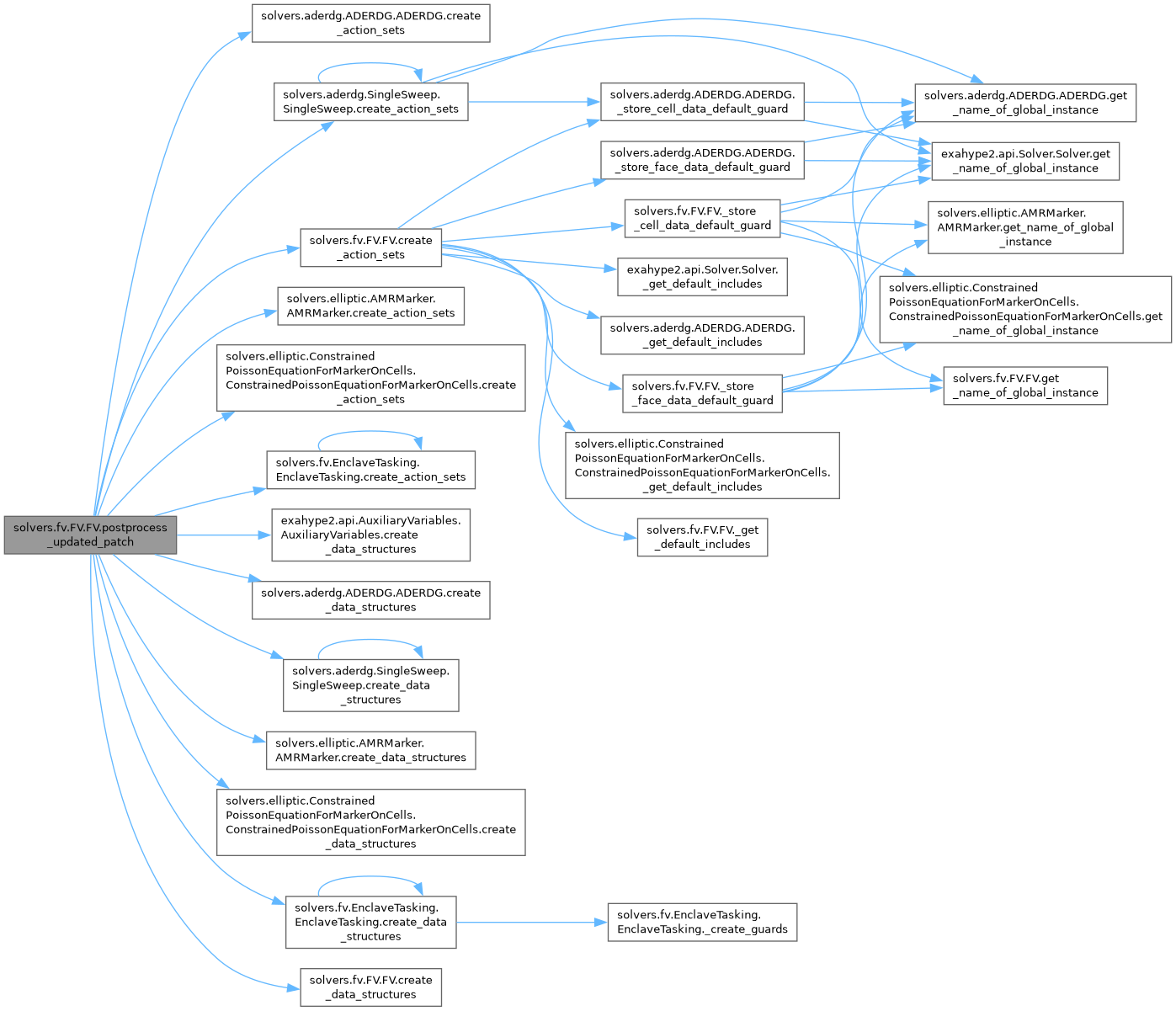
| solvers.fv.FV.FV.preprocess_reconstructed_patch | ( | self | ) |
Definition at line 1526 of file FV.py.
References solvers.aderdg.ADERDG.ADERDG._preprocess_reconstructed_patch, and _preprocess_reconstructed_patch.
| solvers.fv.FV.FV.preprocess_reconstructed_patch | ( | self, | |
| kernel ) |
Set a new processing kernel.
Before the actual update, the numerical solver takes the actual solution including all auxiliary variables and copies it into another array which is calls reconstructedPatch (in FD4, this field is called oldQWithHalo). This array is bigger than the actual patch data, as it also holds the halo. One the solution is copied over, the kernel writes in the halo data using data from the faces. This reconstructed object is now passed into the compute kernel, which derives new values for all evolution variables. That is, the compute kernels' output does not hold the auxiliary variables anymore, as they are not subject to the PDE. The new variables are eventually written back into the real data, where they replace the old quantities (the auxiliary variables in there remain untouched). After the compute kernel has terminated, the reconstructed data including the halo is thrown away.
If you alter the auxiliary variables (material parameters) in the patch preparation, this is absolutely fine, but the change will not be committed into the real data. It is only there temporarily while the actual patch will continue to hold the original material parameters.
You can alter the actual patch data Q in the preprocessing. If this actual data are evolution (PDE) parameters, these changes however will be overwritten by the compute kernel. If you alter auxiliary variables within the preprocessing within the patch (Q), then this is fine, but the changes will not be visible to the reconstructed patch immediately. They will be visible there in the next time step. So you might be well-advised to alter the auxiliary variables in both the patch data and the reconstructed data.
We recommend that you use the AoS enumerator exahype2.enumerator.AoSLexicographicEnumerator. This one has to be given 1 as number of cells/patches, it requires the size of the patch, its halo size, you have to pass it the unknowns and the correct number of auxiliary parameters. If you want the preprocessing also to alter the actual input, you need a second enumerator. In this second one, all parameters are the same besides the halo size, which you have to set to 0: The input patch has no halo. This halo is only added temporarily in the reconstruction step.
Definition at line 1531 of file FV.py.
References solvers.aderdg.ADERDG.ADERDG._preprocess_reconstructed_patch, _preprocess_reconstructed_patch, solvers.aderdg.ADERDG.ADERDG.create_action_sets(), solvers.aderdg.SingleSweep.SingleSweep.create_action_sets(), solvers.elliptic.AMRMarker.AMRMarker.create_action_sets(), solvers.elliptic.ConstrainedPoissonEquationForMarkerOnCells.ConstrainedPoissonEquationForMarkerOnCells.create_action_sets(), solvers.fv.EnclaveTasking.EnclaveTasking.create_action_sets(), create_action_sets(), exahype2.api.AuxiliaryVariables.AuxiliaryVariables.create_data_structures(), solvers.aderdg.ADERDG.ADERDG.create_data_structures(), solvers.aderdg.SingleSweep.SingleSweep.create_data_structures(), solvers.elliptic.AMRMarker.AMRMarker.create_data_structures(), solvers.elliptic.ConstrainedPoissonEquationForMarkerOnCells.ConstrainedPoissonEquationForMarkerOnCells.create_data_structures(), solvers.fv.EnclaveTasking.EnclaveTasking.create_data_structures(), and create_data_structures().
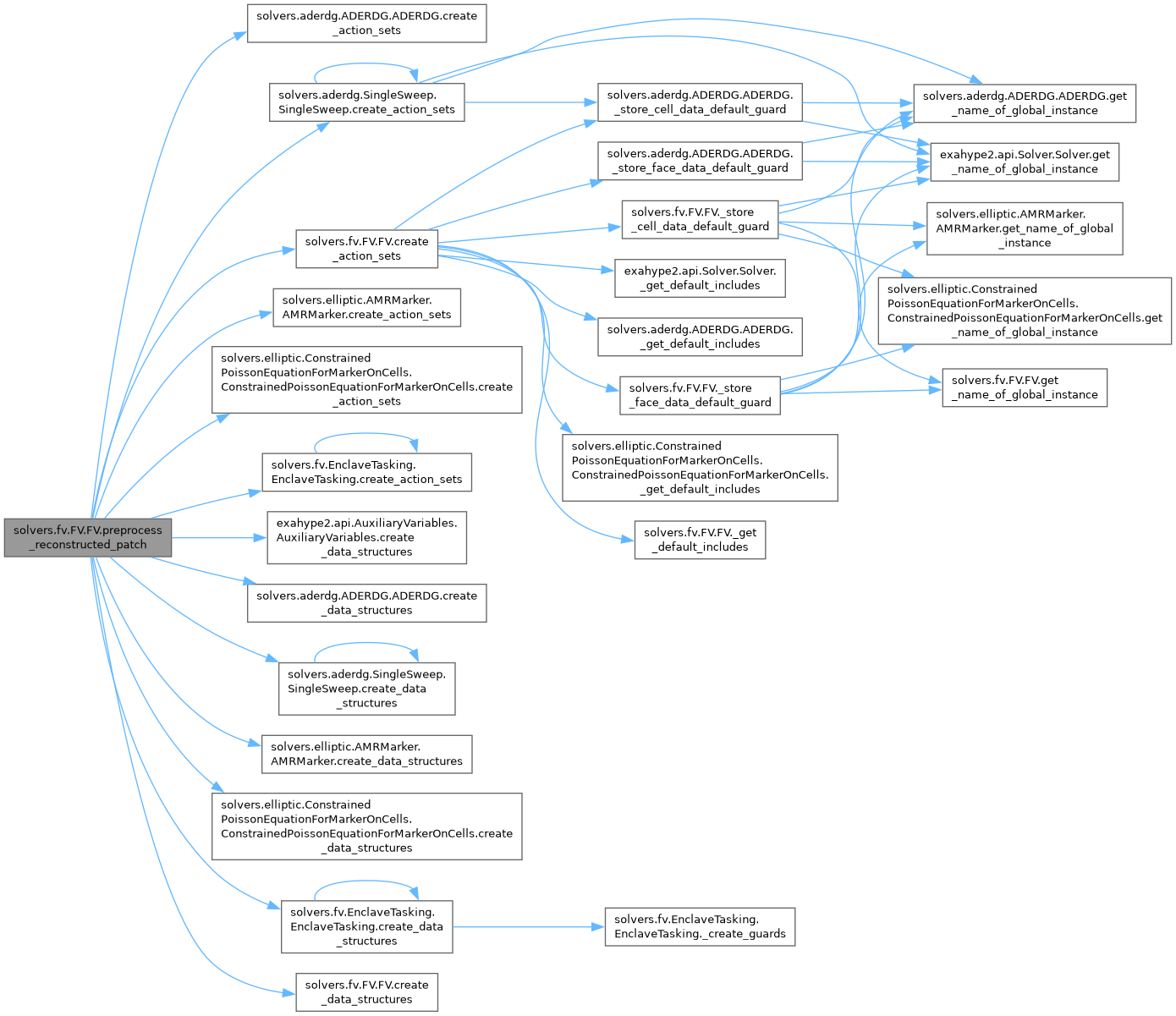
| solvers.fv.FV.FV.restriction | ( | self | ) |
Definition at line 1681 of file FV.py.
References _restriction.
| solvers.fv.FV.FV.restriction | ( | self, | |
| value ) |
Definition at line 1686 of file FV.py.
References _restriction, solvers.aderdg.ADERDG.ADERDG.create_action_sets(), solvers.aderdg.SingleSweep.SingleSweep.create_action_sets(), solvers.elliptic.AMRMarker.AMRMarker.create_action_sets(), solvers.elliptic.ConstrainedPoissonEquationForMarkerOnCells.ConstrainedPoissonEquationForMarkerOnCells.create_action_sets(), solvers.fv.EnclaveTasking.EnclaveTasking.create_action_sets(), create_action_sets(), exahype2.api.AuxiliaryVariables.AuxiliaryVariables.create_data_structures(), solvers.aderdg.ADERDG.ADERDG.create_data_structures(), solvers.aderdg.SingleSweep.SingleSweep.create_data_structures(), solvers.elliptic.AMRMarker.AMRMarker.create_data_structures(), solvers.elliptic.ConstrainedPoissonEquationForMarkerOnCells.ConstrainedPoissonEquationForMarkerOnCells.create_data_structures(), solvers.fv.EnclaveTasking.EnclaveTasking.create_data_structures(), and create_data_structures().
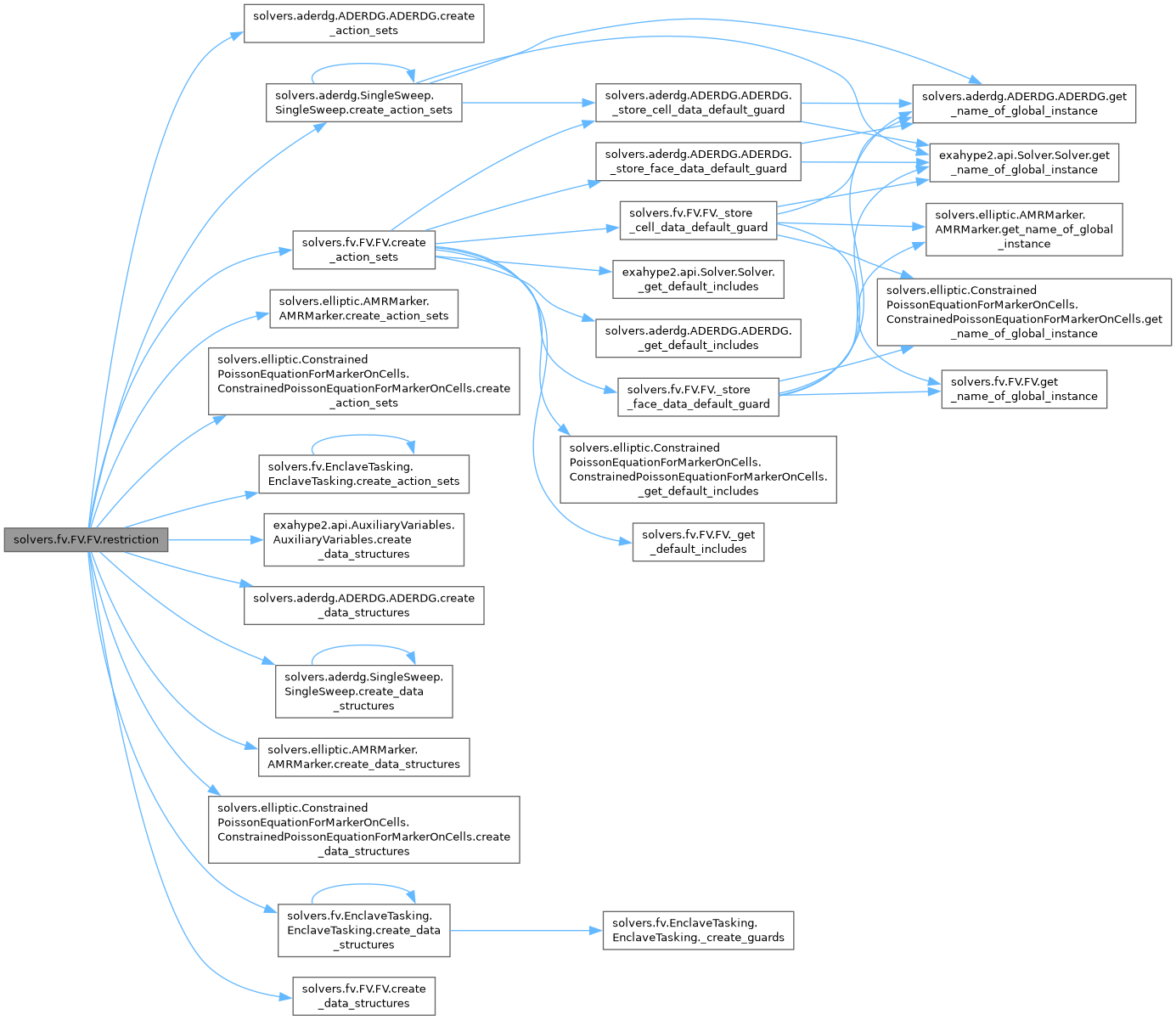
| solvers.fv.FV.FV.set_solver_constants | ( | self, | |
| datastring ) |
Definition at line 1392 of file FV.py.
References exahype2.api.Solver.Solver._solver_constants, solvers.aderdg.ADERDG.ADERDG._solver_constants, and _solver_constants.
| solvers.fv.FV.FV.switch_storage_scheme | ( | self, | |
| Storage | cell_data_storage, | ||
| Storage | face_data_storage ) |
By default, we hold all data on the heap using smart pointers.
You can explicitly switch to storage on the call stack or heap using raw pointers.
Reimplemented in solvers.fv.EnclaveTasking.EnclaveTasking.
Definition at line 1692 of file FV.py.
References solvers.aderdg.ADERDG.ADERDG._cell_data_storage, _cell_data_storage, solvers.aderdg.ADERDG.ADERDG._face_data_storage, _face_data_storage, solvers.aderdg.ADERDG.ADERDG.create_action_sets(), solvers.aderdg.SingleSweep.SingleSweep.create_action_sets(), solvers.elliptic.AMRMarker.AMRMarker.create_action_sets(), solvers.elliptic.ConstrainedPoissonEquationForMarkerOnCells.ConstrainedPoissonEquationForMarkerOnCells.create_action_sets(), solvers.fv.EnclaveTasking.EnclaveTasking.create_action_sets(), create_action_sets(), exahype2.api.AuxiliaryVariables.AuxiliaryVariables.create_data_structures(), solvers.aderdg.ADERDG.ADERDG.create_data_structures(), solvers.aderdg.SingleSweep.SingleSweep.create_data_structures(), solvers.elliptic.AMRMarker.AMRMarker.create_data_structures(), solvers.elliptic.ConstrainedPoissonEquationForMarkerOnCells.ConstrainedPoissonEquationForMarkerOnCells.create_data_structures(), solvers.fv.EnclaveTasking.EnclaveTasking.create_data_structures(), and create_data_structures().
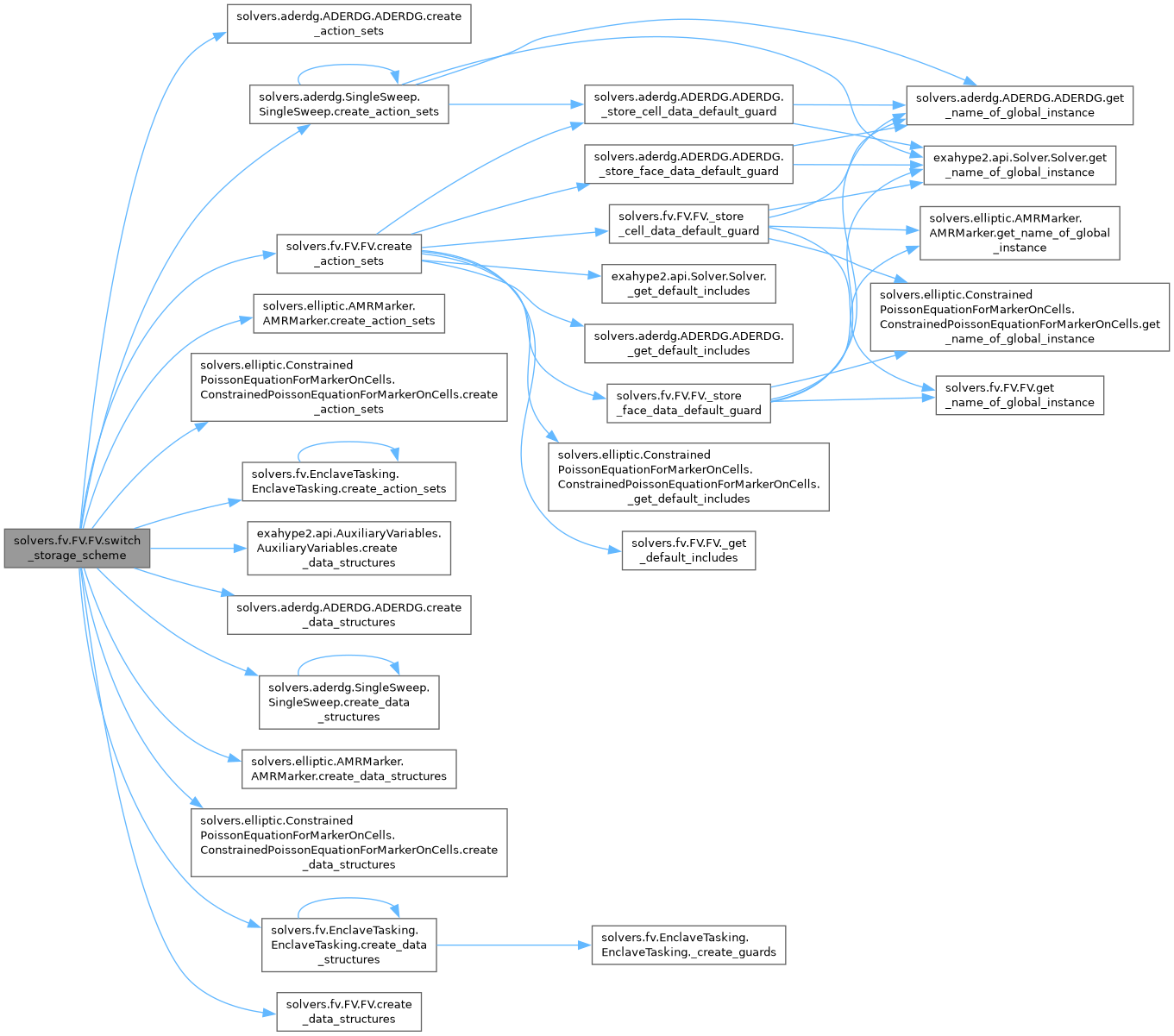
| solvers.fv.FV.FV.unknowns | ( | self | ) |
Definition at line 1490 of file FV.py.
References api.solvers.CollocatedLowOrderDiscretisation.CollocatedLowOrderDiscretisation._unknowns, exahype2.api.Solver.Solver._unknowns, exahype2::CellAccess._unknowns, exahype2::enumerator::AoSLexicographicEnumerator._unknowns, exahype2::enumerator::AoSoALexicographicEnumerator._unknowns, exahype2::enumerator::FaceAoSLexicographicEnumerator._unknowns, exahype2::enumerator::SingleDoFEnumerator._unknowns, exahype2::enumerator::SoALexicographicEnumerator._unknowns, solvers.aderdg.ADERDG.ADERDG._unknowns, _unknowns, and tarch.plotter.api.output.Visualiser.PatchFileData._unknowns.
| solvers.fv.FV.FV.unknowns | ( | self, | |
| value ) |
Definition at line 1512 of file FV.py.
References api.solvers.CollocatedLowOrderDiscretisation.CollocatedLowOrderDiscretisation._unknowns, exahype2.api.Solver.Solver._unknowns, exahype2::CellAccess._unknowns, exahype2::enumerator::AoSLexicographicEnumerator._unknowns, exahype2::enumerator::AoSoALexicographicEnumerator._unknowns, exahype2::enumerator::FaceAoSLexicographicEnumerator._unknowns, exahype2::enumerator::SingleDoFEnumerator._unknowns, exahype2::enumerator::SoALexicographicEnumerator._unknowns, solvers.aderdg.ADERDG.ADERDG._unknowns, _unknowns, tarch.plotter.api.output.Visualiser.PatchFileData._unknowns, solvers.aderdg.ADERDG.ADERDG.create_action_sets(), solvers.aderdg.SingleSweep.SingleSweep.create_action_sets(), solvers.elliptic.AMRMarker.AMRMarker.create_action_sets(), solvers.elliptic.ConstrainedPoissonEquationForMarkerOnCells.ConstrainedPoissonEquationForMarkerOnCells.create_action_sets(), solvers.fv.EnclaveTasking.EnclaveTasking.create_action_sets(), create_action_sets(), exahype2.api.AuxiliaryVariables.AuxiliaryVariables.create_data_structures(), solvers.aderdg.ADERDG.ADERDG.create_data_structures(), solvers.aderdg.SingleSweep.SingleSweep.create_data_structures(), solvers.elliptic.AMRMarker.AMRMarker.create_data_structures(), solvers.elliptic.ConstrainedPoissonEquationForMarkerOnCells.ConstrainedPoissonEquationForMarkerOnCells.create_data_structures(), solvers.fv.EnclaveTasking.EnclaveTasking.create_data_structures(), and create_data_structures().
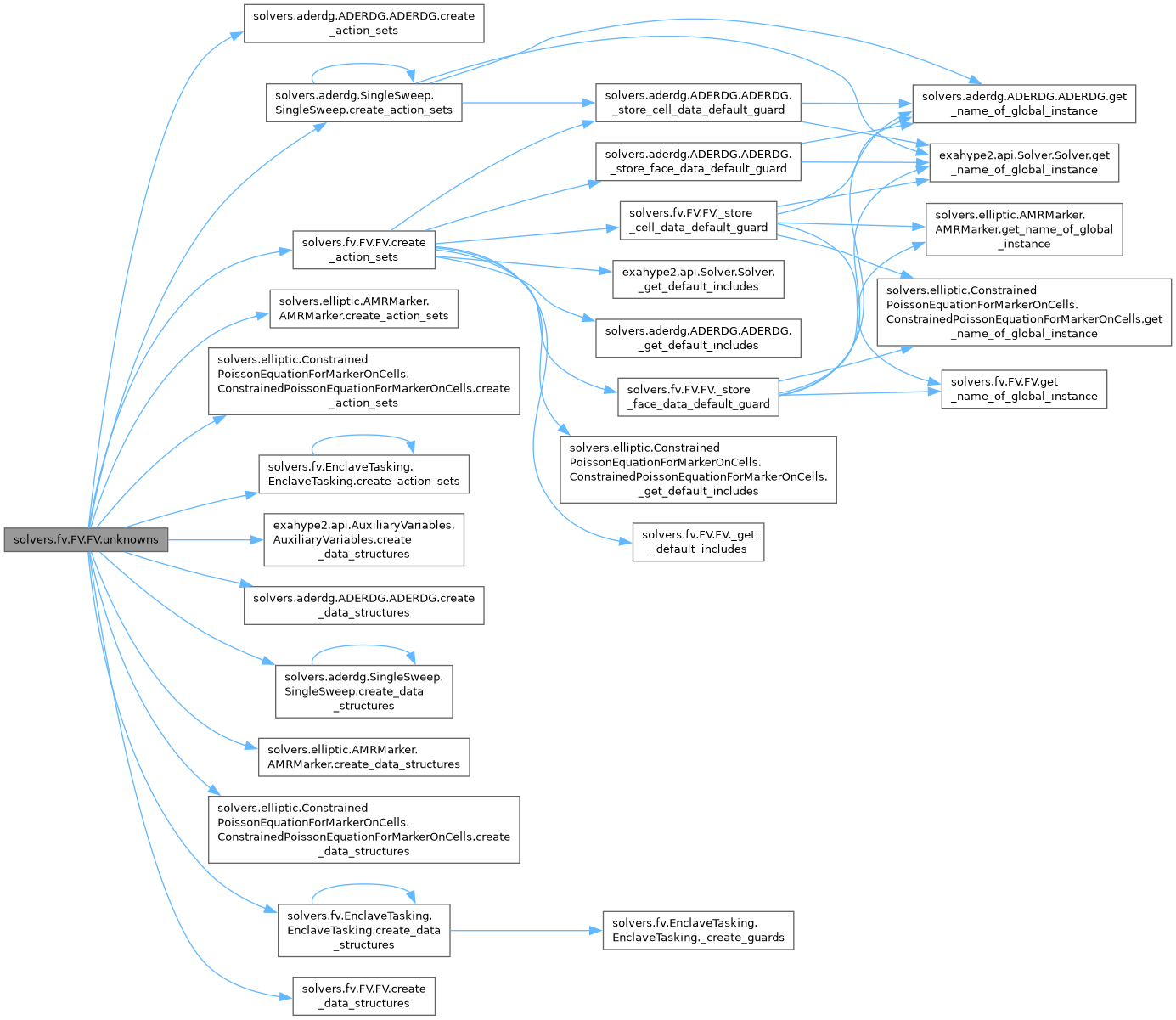
| solvers.fv.FV.FV.user_action_set_includes | ( | self | ) |
Add further includes to this property, if your action sets require some additional routines from other header files.
Reimplemented in solvers.fv.SingleSweep.SingleSweep.
Definition at line 492 of file FV.py.
References _user_action_set_includes.
Referenced by solvers.fv.EnclaveTasking.EnclaveTasking.add_implementation_files_to_project(), and solvers.rkdg.SeparateSweepsWithEnclaveTasking.SeparateSweepsWithEnclaveTasking.add_implementation_files_to_project().
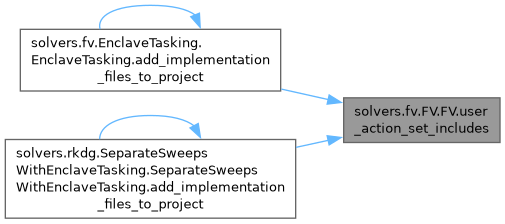
| solvers.fv.FV.FV.user_solver_includes | ( | self | ) |
Add further includes to this property, if your solver requires some additional routines from other header files.
Definition at line 501 of file FV.py.
References exahype2.api.Solver.Solver._user_solver_includes, and _user_solver_includes.
Referenced by _init_dictionary_with_default_parameters(), solvers.rkdg.RungeKuttaDG.RungeKuttaDG._init_dictionary_with_default_parameters(), solvers.fv.EnclaveTasking.EnclaveTasking.add_implementation_files_to_project(), and solvers.rkdg.SeparateSweepsWithEnclaveTasking.SeparateSweepsWithEnclaveTasking.add_implementation_files_to_project().
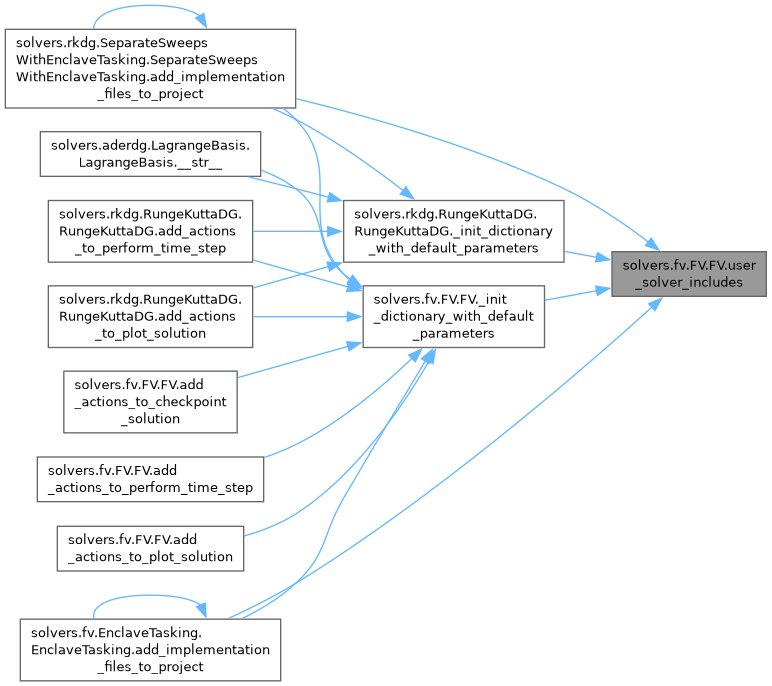
|
protected |
Definition at line 299 of file FV.py.
Referenced by _init_dictionary_with_default_parameters(), and solvers.rkdg.RungeKuttaDG.RungeKuttaDG._init_dictionary_with_default_parameters().
|
protected |
Definition at line 300 of file FV.py.
Referenced by _init_dictionary_with_default_parameters(), and solvers.rkdg.RungeKuttaDG.RungeKuttaDG._init_dictionary_with_default_parameters().
|
protected |
Definition at line 276 of file FV.py.
Referenced by add_actions_to_init_grid(), solvers.rkdg.RungeKuttaDG.RungeKuttaDG.add_actions_to_init_grid(), add_actions_to_perform_time_step(), solvers.rkdg.RungeKuttaDG.RungeKuttaDG.add_actions_to_perform_time_step(), create_action_sets(), solvers.fv.rusanov.LocalTimeStepWithEnclaveTasking.LocalTimeStepWithEnclaveTasking.create_action_sets(), solvers.fv.rusanov.SubcyclingAdaptiveTimeStepWithEnclaveTasking.SubcyclingAdaptiveTimeStepWithEnclaveTasking.create_action_sets(), solvers.fv.rusanov.SubcyclingFixedTimeStep.SubcyclingFixedTimeStep.create_action_sets(), and solvers.fv.rusanov.SubcyclingFixedTimeStepWithEnclaveTasking.SubcyclingFixedTimeStepWithEnclaveTasking.create_action_sets().
|
protected |
Definition at line 278 of file FV.py.
Referenced by add_actions_to_create_grid(), solvers.rkdg.RungeKuttaDG.RungeKuttaDG.add_actions_to_create_grid(), and create_action_sets().
|
protected |
Definition at line 277 of file FV.py.
Referenced by add_actions_to_create_grid(), solvers.rkdg.RungeKuttaDG.RungeKuttaDG.add_actions_to_create_grid(), and create_action_sets().
|
protected |
Definition at line 282 of file FV.py.
Referenced by add_actions_to_init_grid(), and create_action_sets().
|
protected |
Definition at line 283 of file FV.py.
Referenced by add_actions_to_checkpoint_solution(), add_actions_to_init_grid(), add_actions_to_perform_time_step(), solvers.rkdg.RungeKuttaDG.RungeKuttaDG.add_actions_to_perform_time_step(), add_actions_to_plot_solution(), kernel_testbed.CCZ4Solver.create_action_sets(), create_action_sets(), and solvers.rkdg.SeparateSweeps.SeparateSweeps.create_action_sets().
|
protected |
Definition at line 279 of file FV.py.
Referenced by add_actions_to_perform_time_step(), solvers.rkdg.RungeKuttaDG.RungeKuttaDG.add_actions_to_perform_time_step(), create_action_sets(), and solvers.rkdg.SeparateSweeps.SeparateSweeps.create_action_sets().
|
protected |
Definition at line 274 of file FV.py.
Referenced by add_actions_to_init_grid(), solvers.rkdg.RungeKuttaDG.RungeKuttaDG.add_actions_to_init_grid(), and create_action_sets().
|
protected |
Definition at line 275 of file FV.py.
Referenced by add_actions_to_create_grid(), solvers.rkdg.RungeKuttaDG.RungeKuttaDG.add_actions_to_create_grid(), and create_action_sets().
|
protected |
Definition at line 286 of file FV.py.
Referenced by add_actions_to_init_grid(), solvers.rkdg.RungeKuttaDG.RungeKuttaDG.add_actions_to_init_grid(), add_actions_to_perform_time_step(), solvers.rkdg.RungeKuttaDG.RungeKuttaDG.add_actions_to_perform_time_step(), and create_action_sets().
|
protected |
Definition at line 287 of file FV.py.
Referenced by add_actions_to_init_grid(), solvers.rkdg.RungeKuttaDG.RungeKuttaDG.add_actions_to_init_grid(), add_actions_to_perform_time_step(), solvers.rkdg.RungeKuttaDG.RungeKuttaDG.add_actions_to_perform_time_step(), and create_action_sets().
|
protected |
Definition at line 280 of file FV.py.
Referenced by add_actions_to_checkpoint_solution(), add_actions_to_init_grid(), add_actions_to_perform_time_step(), add_actions_to_plot_solution(), and create_action_sets().
|
protected |
Definition at line 281 of file FV.py.
Referenced by add_actions_to_checkpoint_solution(), add_actions_to_init_grid(), add_actions_to_perform_time_step(), add_actions_to_plot_solution(), and create_action_sets().
|
protected |
Definition at line 845 of file FV.py.
Referenced by add_actions_to_perform_time_step(), solvers.fv.rusanov.LocalTimeStepWithEnclaveTasking.LocalTimeStepWithEnclaveTasking.create_action_sets(), solvers.fv.rusanov.SubcyclingAdaptiveTimeStepWithEnclaveTasking.SubcyclingAdaptiveTimeStepWithEnclaveTasking.create_action_sets(), solvers.fv.rusanov.SubcyclingFixedTimeStep.SubcyclingFixedTimeStep.create_action_sets(), and solvers.fv.rusanov.SubcyclingFixedTimeStepWithEnclaveTasking.SubcyclingFixedTimeStepWithEnclaveTasking.create_action_sets().
|
protected |
Definition at line 843 of file FV.py.
Referenced by add_actions_to_checkpoint_solution(), add_actions_to_create_grid(), solvers.rkdg.RungeKuttaDG.RungeKuttaDG.add_actions_to_create_grid(), add_actions_to_init_grid(), solvers.rkdg.RungeKuttaDG.RungeKuttaDG.add_actions_to_init_grid(), add_actions_to_perform_time_step(), solvers.rkdg.RungeKuttaDG.RungeKuttaDG.add_actions_to_perform_time_step(), add_actions_to_plot_solution(), and solvers.rkdg.RungeKuttaDG.RungeKuttaDG.add_actions_to_plot_solution().
|
protected |
Definition at line 842 of file FV.py.
Referenced by add_actions_to_checkpoint_solution(), add_actions_to_create_grid(), solvers.rkdg.RungeKuttaDG.RungeKuttaDG.add_actions_to_create_grid(), add_actions_to_init_grid(), solvers.rkdg.RungeKuttaDG.RungeKuttaDG.add_actions_to_init_grid(), add_actions_to_perform_time_step(), solvers.rkdg.RungeKuttaDG.RungeKuttaDG.add_actions_to_perform_time_step(), add_actions_to_plot_solution(), and solvers.rkdg.RungeKuttaDG.RungeKuttaDG.add_actions_to_plot_solution().
|
protected |
Definition at line 240 of file FV.py.
Referenced by __str__(), solvers.rkdg.RungeKuttaDG.RungeKuttaDG.__str__(), _init_dictionary_with_default_parameters(), solvers.rkdg.RungeKuttaDG.RungeKuttaDG._init_dictionary_with_default_parameters(), auxiliary_variables(), auxiliary_variables(), solvers.rkdg.RungeKuttaDG.RungeKuttaDG.auxiliary_variables(), and solvers.rkdg.RungeKuttaDG.RungeKuttaDG.auxiliary_variables().
|
protected |
Definition at line 317 of file FV.py.
Referenced by add_actions_to_checkpoint_solution(), add_actions_to_plot_solution(), and solvers.rkdg.RungeKuttaDG.RungeKuttaDG.add_actions_to_plot_solution().
|
protected |
Definition at line 308 of file FV.py.
Referenced by __str__(), solvers.rkdg.RungeKuttaDG.RungeKuttaDG.__str__(), _init_dictionary_with_default_parameters(), solvers.rkdg.RungeKuttaDG.RungeKuttaDG._init_dictionary_with_default_parameters(), and solvers.rkdg.RungeKuttaDG.RungeKuttaDG.set_implementation().
|
protected |
Definition at line 592 of file FV.py.
Referenced by __str__(), switch_storage_scheme(), and solvers.rkdg.RungeKuttaDG.RungeKuttaDG.switch_storage_scheme().
|
protected |
|
protected |
Definition at line 298 of file FV.py.
Referenced by _init_dictionary_with_default_parameters(), and solvers.rkdg.RungeKuttaDG.RungeKuttaDG._init_dictionary_with_default_parameters().
|
protected |
Definition at line 294 of file FV.py.
Referenced by _init_dictionary_with_default_parameters().
|
protected |
Definition at line 295 of file FV.py.
Referenced by _init_dictionary_with_default_parameters().
|
protected |
Definition at line 290 of file FV.py.
Referenced by _init_dictionary_with_default_parameters(), and solvers.rkdg.RungeKuttaDG.RungeKuttaDG._init_dictionary_with_default_parameters().
|
protected |
Definition at line 289 of file FV.py.
Referenced by _init_dictionary_with_default_parameters(), and solvers.rkdg.RungeKuttaDG.RungeKuttaDG._init_dictionary_with_default_parameters().
|
protected |
Definition at line 306 of file FV.py.
Referenced by _init_dictionary_with_default_parameters(), and solvers.rkdg.RungeKuttaDG.RungeKuttaDG._init_dictionary_with_default_parameters().
|
protected |
Definition at line 609 of file FV.py.
Referenced by __str__(), switch_storage_scheme(), and solvers.rkdg.RungeKuttaDG.RungeKuttaDG.switch_storage_scheme().
|
protected |
|
protected |
Definition at line 305 of file FV.py.
Referenced by _init_dictionary_with_default_parameters(), and solvers.rkdg.RungeKuttaDG.RungeKuttaDG._init_dictionary_with_default_parameters().
|
protected |
Definition at line 310 of file FV.py.
Referenced by __str__(), solvers.rkdg.RungeKuttaDG.RungeKuttaDG.__str__(), _init_dictionary_with_default_parameters(), solvers.rkdg.RungeKuttaDG.RungeKuttaDG._init_dictionary_with_default_parameters(), and solvers.rkdg.RungeKuttaDG.RungeKuttaDG.set_implementation().
|
protected |
Definition at line 312 of file FV.py.
Referenced by create_action_sets(), interpolation(), and interpolation().
|
protected |
Definition at line 315 of file FV.py.
Referenced by _init_dictionary_with_default_parameters(), solvers.rkdg.RungeKuttaDG.RungeKuttaDG._init_dictionary_with_default_parameters(), solvers.rkdg.rusanov.GlobalAdaptiveTimeStep.GlobalAdaptiveTimeStep.set_implementation(), and solvers.rkdg.rusanov.GlobalAdaptiveTimeStepWithEnclaveTasking.GlobalAdaptiveTimeStepWithEnclaveTasking.set_implementation().
|
protected |
Definition at line 199 of file FV.py.
Referenced by __str__(), _init_dictionary_with_default_parameters(), solvers.fv.rusanov.LocalTimeStepWithEnclaveTasking.LocalTimeStepWithEnclaveTasking.create_action_sets(), solvers.fv.rusanov.SubcyclingAdaptiveTimeStepWithEnclaveTasking.SubcyclingAdaptiveTimeStepWithEnclaveTasking.create_action_sets(), solvers.fv.rusanov.SubcyclingFixedTimeStep.SubcyclingFixedTimeStep.create_action_sets(), solvers.fv.rusanov.SubcyclingFixedTimeStepWithEnclaveTasking.SubcyclingFixedTimeStepWithEnclaveTasking.create_action_sets(), create_readme_descriptor(), and get_min_number_of_spacetree_levels().
|
protected |
Definition at line 198 of file FV.py.
Referenced by __str__(), _init_dictionary_with_default_parameters(), solvers.fv.rusanov.LocalTimeStepWithEnclaveTasking.LocalTimeStepWithEnclaveTasking.create_action_sets(), solvers.fv.rusanov.SubcyclingAdaptiveTimeStepWithEnclaveTasking.SubcyclingAdaptiveTimeStepWithEnclaveTasking.create_action_sets(), solvers.fv.rusanov.SubcyclingFixedTimeStep.SubcyclingFixedTimeStep.create_action_sets(), solvers.fv.rusanov.SubcyclingFixedTimeStepWithEnclaveTasking.SubcyclingFixedTimeStepWithEnclaveTasking.create_action_sets(), create_readme_descriptor(), and get_max_number_of_spacetree_levels().
|
protected |
Definition at line 196 of file FV.py.
Referenced by __str__(), solvers.rkdg.RungeKuttaDG.RungeKuttaDG.__str__(), _init_dictionary_with_default_parameters(), solvers.rkdg.RungeKuttaDG.RungeKuttaDG._init_dictionary_with_default_parameters(), _load_cell_data_default_guard(), solvers.rkdg.RungeKuttaDG.RungeKuttaDG._load_cell_data_default_guard(), _load_face_data_default_guard(), solvers.rkdg.RungeKuttaDG.RungeKuttaDG._load_face_data_default_guard(), _provide_cell_data_to_compute_kernels_default_guard(), solvers.rkdg.RungeKuttaDG.RungeKuttaDG._provide_cell_data_to_compute_kernels_default_guard(), _provide_face_data_to_compute_kernels_default_guard(), solvers.rkdg.RungeKuttaDG.RungeKuttaDG._provide_face_data_to_compute_kernels_default_guard(), _store_cell_data_default_guard(), solvers.rkdg.RungeKuttaDG.RungeKuttaDG._store_cell_data_default_guard(), _store_face_data_default_guard(), solvers.rkdg.RungeKuttaDG.RungeKuttaDG._store_face_data_default_guard(), _unknown_identifier(), solvers.rkdg.RungeKuttaDG.RungeKuttaDG._unknown_identifier(), add_actions_to_checkpoint_solution(), add_actions_to_plot_solution(), solvers.rkdg.RungeKuttaDG.RungeKuttaDG.add_actions_to_plot_solution(), solvers.rkdg.SeparateSweepsWithEnclaveTasking.SeparateSweepsWithEnclaveTasking.add_entries_to_text_replacement_dictionary(), solvers.fv.rusanov.LocalTimeStepWithEnclaveTasking.LocalTimeStepWithEnclaveTasking.create_action_sets(), solvers.fv.rusanov.SubcyclingAdaptiveTimeStepWithEnclaveTasking.SubcyclingAdaptiveTimeStepWithEnclaveTasking.create_action_sets(), solvers.fv.rusanov.SubcyclingFixedTimeStep.SubcyclingFixedTimeStep.create_action_sets(), solvers.fv.rusanov.SubcyclingFixedTimeStepWithEnclaveTasking.SubcyclingFixedTimeStepWithEnclaveTasking.create_action_sets(), solvers.rkdg.SeparateSweeps.SeparateSweeps.create_action_sets(), solvers.fv.SingleSweep.SingleSweep.create_data_structures(), get_name_of_global_instance(), solvers.rkdg.RungeKuttaDG.RungeKuttaDG.get_name_of_global_instance(), and name().
|
protected |
|
protected |
Definition at line 571 of file FV.py.
Referenced by _init_dictionary_with_default_parameters(), add_actions_to_checkpoint_solution(), add_actions_to_plot_solution(), add_to_Peano4_datamodel(), and add_use_data_statements_to_Peano4_solver_step().
|
protected |
Definition at line 581 of file FV.py.
Referenced by add_to_Peano4_datamodel(), add_use_data_statements_to_Peano4_solver_step(), create_action_sets(), solvers.fv.EnclaveTasking.EnclaveTasking.create_data_structures(), solvers.fv.rusanov.LocalTimeStepWithEnclaveTasking.LocalTimeStepWithEnclaveTasking.create_data_structures(), solvers.fv.rusanov.SubcyclingAdaptiveTimeStepWithEnclaveTasking.SubcyclingAdaptiveTimeStepWithEnclaveTasking.create_data_structures(), solvers.fv.rusanov.SubcyclingFixedTimeStepWithEnclaveTasking.SubcyclingFixedTimeStepWithEnclaveTasking.create_data_structures(), and solvers.fv.SingleSweep.SingleSweep.create_data_structures().
|
protected |
Definition at line 576 of file FV.py.
Referenced by _init_dictionary_with_default_parameters(), add_to_Peano4_datamodel(), add_use_data_statements_to_Peano4_solver_step(), create_action_sets(), solvers.fv.EnclaveTasking.EnclaveTasking.create_data_structures(), solvers.fv.rusanov.LocalTimeStepWithEnclaveTasking.LocalTimeStepWithEnclaveTasking.create_data_structures(), solvers.fv.rusanov.SubcyclingAdaptiveTimeStepWithEnclaveTasking.SubcyclingAdaptiveTimeStepWithEnclaveTasking.create_data_structures(), solvers.fv.rusanov.SubcyclingFixedTimeStep.SubcyclingFixedTimeStep.create_data_structures(), solvers.fv.rusanov.SubcyclingFixedTimeStepWithEnclaveTasking.SubcyclingFixedTimeStepWithEnclaveTasking.create_data_structures(), and solvers.fv.SingleSweep.SingleSweep.create_data_structures().
|
protected |
Definition at line 586 of file FV.py.
Referenced by add_to_Peano4_datamodel(), and add_use_data_statements_to_Peano4_solver_step().
|
protected |
Definition at line 202 of file FV.py.
Referenced by __str__(), create_readme_descriptor(), get_coarsest_number_of_finite_volumes(), get_finest_number_of_finite_volumes(), get_max_number_of_spacetree_levels(), get_min_number_of_spacetree_levels(), patch_size(), and patch_size().
|
protected |
Definition at line 296 of file FV.py.
Referenced by __str__(), solvers.rkdg.RungeKuttaDG.RungeKuttaDG.__str__(), _init_dictionary_with_default_parameters(), and solvers.rkdg.RungeKuttaDG.RungeKuttaDG._init_dictionary_with_default_parameters().
|
protected |
Definition at line 271 of file FV.py.
Referenced by add_actions_to_checkpoint_solution(), add_actions_to_plot_solution(), plot_description(), and plot_description().
|
protected |
Definition at line 200 of file FV.py.
Referenced by add_actions_to_checkpoint_solution(), add_actions_to_plot_solution(), and solvers.rkdg.RungeKuttaDG.RungeKuttaDG.add_actions_to_plot_solution().
|
protected |
Definition at line 292 of file FV.py.
Referenced by _init_dictionary_with_default_parameters(), postprocess_updated_patch(), and postprocess_updated_patch().
|
protected |
Definition at line 291 of file FV.py.
Referenced by preprocess_reconstructed_patch(), and preprocess_reconstructed_patch().
|
protected |
|
protected |
Definition at line 309 of file FV.py.
Referenced by __str__(), solvers.rkdg.RungeKuttaDG.RungeKuttaDG.__str__(), _init_dictionary_with_default_parameters(), solvers.rkdg.RungeKuttaDG.RungeKuttaDG._init_dictionary_with_default_parameters(), and solvers.rkdg.RungeKuttaDG.RungeKuttaDG.set_implementation().
|
protected |
Definition at line 313 of file FV.py.
Referenced by create_action_sets(), restriction(), and restriction().
|
protected |
Definition at line 252 of file FV.py.
Referenced by _init_dictionary_with_default_parameters(), solvers.rkdg.RungeKuttaDG.RungeKuttaDG._init_dictionary_with_default_parameters(), add_solver_constants(), solvers.rkdg.RungeKuttaDG.RungeKuttaDG.add_solver_constants(), set_solver_constants(), and solvers.rkdg.RungeKuttaDG.RungeKuttaDG.set_solver_constants().
|
protected |
Definition at line 269 of file FV.py.
Referenced by solvers.aderdg.ADERDG.ADERDG.add_implementation_files_to_project().
|
protected |
Definition at line 301 of file FV.py.
Referenced by _init_dictionary_with_default_parameters(), and solvers.rkdg.RungeKuttaDG.RungeKuttaDG._init_dictionary_with_default_parameters().
|
protected |
Definition at line 302 of file FV.py.
Referenced by _init_dictionary_with_default_parameters(), and solvers.rkdg.RungeKuttaDG.RungeKuttaDG._init_dictionary_with_default_parameters().
|
protected |
Definition at line 304 of file FV.py.
Referenced by _init_dictionary_with_default_parameters(), and solvers.rkdg.RungeKuttaDG.RungeKuttaDG._init_dictionary_with_default_parameters().
|
protected |
Definition at line 227 of file FV.py.
Referenced by __str__(), solvers.rkdg.RungeKuttaDG.RungeKuttaDG.__str__(), _init_dictionary_with_default_parameters(), solvers.rkdg.RungeKuttaDG.RungeKuttaDG._init_dictionary_with_default_parameters(), unknowns(), unknowns(), solvers.rkdg.RungeKuttaDG.RungeKuttaDG.unknowns(), and solvers.rkdg.RungeKuttaDG.RungeKuttaDG.unknowns().
|
protected |
Definition at line 222 of file FV.py.
Referenced by _init_dictionary_with_default_parameters(), and solvers.rkdg.RungeKuttaDG.RungeKuttaDG._init_dictionary_with_default_parameters().
|
protected |
Definition at line 253 of file FV.py.
Referenced by add_user_action_set_includes(), solvers.rkdg.RungeKuttaDG.RungeKuttaDG.add_user_action_set_includes(), user_action_set_includes(), and solvers.rkdg.RungeKuttaDG.RungeKuttaDG.user_action_set_includes().
|
protected |
Definition at line 254 of file FV.py.
Referenced by add_user_solver_includes(), solvers.rkdg.RungeKuttaDG.RungeKuttaDG.add_user_solver_includes(), user_solver_includes(), and solvers.rkdg.RungeKuttaDG.RungeKuttaDG.user_solver_includes().
|
protected |
Definition at line 223 of file FV.py.
Referenced by _init_dictionary_with_default_parameters(), and solvers.rkdg.RungeKuttaDG.RungeKuttaDG._init_dictionary_with_default_parameters().
|
protected |
Definition at line 224 of file FV.py.
Referenced by _init_dictionary_with_default_parameters(), and solvers.rkdg.RungeKuttaDG.RungeKuttaDG._init_dictionary_with_default_parameters().
| solvers.fv.FV.FV.select_dofs_to_print = None |
Definition at line 272 of file FV.py.
Referenced by add_actions_to_plot_solution(), and solvers.rkdg.RungeKuttaDG.RungeKuttaDG.add_actions_to_plot_solution().
 1.15.0