 |
Peano
|
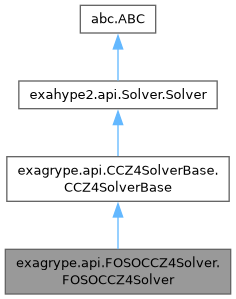
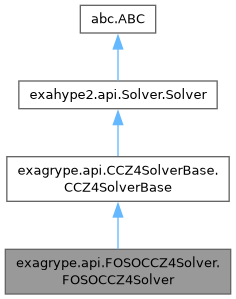
Solver for the Einstein equations in the first-/second-order reconstructed CCZ4 formulation. More...
Public Member Functions | |
| __init__ (self, str name, Dict[str, Union[int, float]] parameters=None, exahype2.api.InitPointWisely initial_condition=None) | |
| Create a second-order reconstructed CCZ4 solver. | |
| str | task_graph_title_suffix (self) |
| List[str] | advected_quantities (self) |
| The unknowns whose advection terms the kernels omit. | |
| Public Member Functions inherited from exagrype.api.CCZ4SolverBase.CCZ4SolverBase | |
| __init__ (self, str name, Dict[str, int] unknowns, Dict[str, Union[int, float]] parameters=None) | |
| Create a CCZ4 solver. | |
| bool | ncp_adds_advection (self) |
| Whether the non-conservative product has to add the advection terms. | |
| enforce_ccz4_constraint (self, "CCZ4SolverBase.EnforceCCZ4Constraint" value) | |
| Set when the solver pushes the solution back onto the CCZ4 constraints. | |
| generate_solver_realisation (self, exahype2_project, peano_project, setup_simulation, time_step, plot, mesh_adaptation, add_global_tasks=True) | |
| Create the solver's task graphs and insert the constraint enforcement. | |
| Dict[str, Union[int, float]] | parameters (self) |
| The CCZ4 parameters the solver is generated with (read-only copy). | |
| Public Member Functions inherited from exahype2.api.Solver.Solver | |
| __init__ (self, str name, VariableSpecification unknowns) | |
| Create solver. | |
| str | __str__ (self) |
| str | name (self) |
| Unique solver name. | |
| "Solver.NumericalScheme" | numerical_scheme (self) |
| numerical_scheme (self, "Solver.NumericalScheme" value) | |
| List["Solver.Plotter"] | plotters (self) |
| All plotters of the solver, in the order they have been added. | |
| add_plotter (self, "Solver.Plotter" plotter) | |
| Add a plotter to the solver. | |
| "Solver.Plotter" | plotter (self) |
| Shorthand for solvers with at most one plotter. | |
| plotter (self, "Solver.Plotter" value) | |
| int | unknowns (self) |
| List["AuxiliaryVariables"] | auxiliary_variables (self) |
| All sets of auxiliary variables in the order they have been attached. | |
| int | number_of_auxiliary_variables (self) |
| Total number of entries of all sets of auxiliary variables. | |
| int | auxiliary_variable_offset (self, "AuxiliaryVariables" auxiliary) |
| Offset of the first entry of a set within the buffer the compute kernels work on, i.e. | |
| add_auxiliary_variables (self, "AuxiliaryVariables" auxiliary) | |
| Attach a set of auxiliary variables to the solver. | |
| str | signature_of (self, PDETerm term) |
| The signature of a PDE term including the pointers to the auxiliary variables. | |
| str | user_solver_includes (self) |
| Add further includes to this property, if your solver requires some additional routines from other header files. | |
| add_user_solver_includes (self, str value) | |
| Add further includes to this property, if your solver requires some additional routines from other header files. | |
| set_solver_constants (self, str datastring) | |
| add_solver_constants (self, str datastring) | |
| List[str] | variable_names_per_entry (self) |
| One name per entry of Q, i.e. | |
| str | get_name_of_global_instance (self) |
| List[PDETerm] | pde_terms (self) |
| All PDE terms (flux, eigenvalues, ...) registered with this solver, in registration order. | |
| bool | requires_user_class (self) |
| True iff at least one PDE term has no implementation. | |
| str | get_name_of_solver_class (self) |
| Name of the C++ class the solver repository instantiates: <SolverName> if requires_user_class, Abstract<SolverName> otherwise. | |
| add_pde_term (self, PDETerm term) | |
| Register a PDE term with this solver, or replace the one already registered under the same name and statelessness. | |
| remove_pde_term (self, str name, bool stateless=False) | |
| Remove a previously registered PDE term by name and statelessness. | |
| PDETerm | get_pde_term (self, str name, bool stateless=False) |
| Look up a previously registered PDE term by name and statelessness. | |
| add_abstract_solver_attribute (self, str declaration) | |
| Add a raw C++ member attribute declaration to the generated Abstract<SolverName> class (. | |
| add_abstract_solver_method (self, str declaration, Callable[[str], str] definition_generator) | |
| Add a raw C++ method to the generated Abstract<SolverName> class: declaration goes into the class body (public section), verbatim. | |
| str | create_readme_descriptor (self, domain_offset, domain_size) |
| Return a human-readable description of this solver instance, to be embedded into the generated project's README. | |
Data Fields | |
| derivatives | |
| Data Fields inherited from exahype2.api.Solver.Solver | |
| solver_generator = SolverToCPPFiles(self) | |
| grid_construction = None | |
| tuple | mesh_adaptation = None |
| Turn this solver specification into a task graph and create the required C++ kernels/stubs. | |
| tuple | grid_selector |
| str | compute_kernel_call = None |
| pde_terms | |
| True iff at least one PDE term has no implementation. | |
Static Public Attributes | |
| dict | Unknowns |
| dict | DerivativeUnknowns |
| Static Public Attributes inherited from exagrype.api.CCZ4SolverBase.CCZ4SolverBase | |
| int | NUMBER_OF_CCZ4_ENTRIES = 58 |
| DefaultParameters | |
| tuple | Switches = ("CCZ4LapseType", "CCZ4b", "CCZ4s") |
| str | ADVECTION_VELOCITY = "shift" |
| Static Public Attributes inherited from exahype2.api.Solver.Solver | |
| str | SolutionUpdateTaskTag = "exahype2.api.Solver.SolutionUpdateTaskTag" |
| Tag of all tasks which write a new solution. | |
| str | IntermediateSolutionUpdateTag = "exahype2.api.Solver.IntermediateSolutionUpdateTag" |
| Tag of all tasks which write an intermediate solution. | |
Protected Member Functions | |
| str | _enforcement_implementation (self) |
| C++ which pushes the unknowns Q of one volume back onto the constraints. | |
| int | _number_of_evolved_entries (cls) |
| int | _number_of_derivatives (cls) |
| str | _ncp_implementation (self) |
| The secondary entries are the auxiliary variables. | |
| str | _source_implementation (self) |
| C++ which calls the source term kernel. | |
| exahype2.api.InitPointWisely | _adapt_initial_condition (self, exahype2.api.InitPointWisely initial_condition) |
| The initial condition fills 58 entries; we split them up. | |
| Protected Member Functions inherited from exagrype.api.CCZ4SolverBase.CCZ4SolverBase | |
| _advection_indices (self) | |
| Indices of the velocity components (ADVECTION_VELOCITY) and of the advected unknowns (advected_quantities()) within Q, in the form both the lopsided advection of the scheme and exahype2.fd.addCentralAdvection() take them. | |
| _tasks_of_this_solver (self, time_step, tag) | |
| Tasks of time_step which carry tag and belong to this solver, as the graph holds the tasks of all solvers. | |
| _insert_constraint_enforcement (self, time_step, anchors, patch) | |
| Insert the enforcement of the CCZ4 constraints after anchors. | |
| _register_pde_terms (self) | |
| Register the source and the maximum eigenvalue. | |
| _register_non_conservative_product (self, bool advection) | |
| Register the non-conservative product, with or without the advection terms. | |
| str | _advection_implementation (self) |
| C++ which adds the advection terms to the non-conservative product. | |
| str | _max_eigenvalue_implementation (self) |
| Protected Member Functions inherited from exahype2.api.Solver.Solver | |
| int | _register_variables (self, VariableSpecification variables, int offset) |
| Translate a plain int or a name-to-multiplicity dict into a total variable count, and - for the dict case - add each name's position within Q to _variable_positions. | |
| str | _get_default_includes (self) |
| Includes every generated action set can rely on being available, regardless of which action sets a concrete discretisation (e.g. | |
| str | _unknown_identifier (self) |
| _add_wants_to_plot_to_solver (self) | |
| Add wantsToPlot() to the solver's C++ class: It holds if any of the solver's plotters is active (exahype2.api.Solver.Solver.Plotter). | |
| _add_checkpoint_meta_data_to_solver (self) | |
| Override exahype2.Solver.toCheckpointMetaData() in the solver's C++ class such that it also writes the attributes added through add_abstract_solver_attribute(), e.g. | |
Additional Inherited Members | |
| Protected Attributes inherited from exagrype.api.CCZ4SolverBase.CCZ4SolverBase | |
| _enforce_ccz4_constraint = CCZ4SolverBase.EnforceCCZ4Constraint.No | |
| One task after all writers of the new solution: The optimistic Finite Volumes write it in one of two tasks, depending on the cell. | |
| _parameters = dict(self.DefaultParameters) | |
| _non_conservative_product = None | |
| _patch | |
| One task after all writers of the new solution: The optimistic Finite Volumes write it in one of two tasks, depending on the cell. | |
| Protected Attributes inherited from exahype2.api.Solver.Solver | |
| str | _name = name |
| Create solver. | |
| dict | _variable_positions = {} |
| Translate a plain int or a name-to-multiplicity dict into a total variable count, and - for the dict case - add each name's position within Q to _variable_positions. | |
| int | _unknowns = self._register_variables(unknowns, 0) |
| list | _auxiliary_variables = [] |
| All sets of auxiliary variables in the order they have been attached. | |
| str | _user_solver_includes = "" |
| str | _solver_constants = "" |
| dict | _pde_terms = {} |
| list | _abstract_solver_attributes = [] |
| list | _abstract_solver_methods = [] |
| _numerical_scheme = None | |
| list | _plotters = [] |
| Turn this solver specification into a task graph and create the required C++ kernels/stubs. | |
Solver for the Einstein equations in the first-/second-order reconstructed CCZ4 formulation.
The solver evolves the first 25 of the 58 CCZ4 unknowns (see Unknowns), i.e. the conformal metric, the extrinsic curvature, the gauge and the auxiliary evolution variables. The remaining 33 entries (DerivativeUnknowns) are the first derivatives of the lapse, the shift, the conformal metric and phi. They are not evolved but held as auxiliary variables (exahype2.api.AuxiliaryVariables) named "Derivatives". The PDE terms hand the 25 unknowns and, as a second pointer, the 33 auxiliary variables to the very same kernels as the first-order solver exagrype.api.FOCCZ4Solver. The second-order kernels set the time derivative of the 33 derivatives to zero, and the solver does not even ask for it.
Nobody updates the derivatives on their own. A second solver, exagrype.api.FOSOReconstructionSolver, does this. Do not create the pair yourself, but use exagrype.api.FOSOSolver, which hosts this solver (as ccz4) and its partner. The reconstruction solver runs in front of each stage of the Runge-Kutta scheme of this solver, recomputes the 33 derivatives from the 25 unknowns of the stage and projects them onto the faces, so this solver finds them with a halo when it evaluates the stage. Without the reconstruction, the solver sees the derivatives of the initial condition forever.
The solver works with exahype2.api.rkfd4.CentralDifferencesWithRungeKutta (and its subclass exagrype.api.FD4WithKODissipation) and with exahype2.api.fv.RusanovWithExplicitEuler. The latter reconstructs the derivatives with second-order central differences.
For Finite Differences, the numerical scheme has to have a halo of at least three grid cells: The solver needs the derivatives one layer outside of its cell (the fluxes and non-conservative products on the cell's faces use the values left and right of the face), and the stencil of the reconstruction reaches two layers further out. The plain scheme has a halo of two; lopsided advection or exagrype.api.FD4WithKODissipation widen it to three. The reconstruction solver rejects a smaller halo.
page_exagrype_fo_so_project_plan for the design and its status.
Definition at line 13 of file FOSOCCZ4Solver.py.
| exagrype.api.FOSOCCZ4Solver.FOSOCCZ4Solver.__init__ | ( | self, | |
| str | name, | ||
| Dict[str, Union[int, float]] | parameters = None, | ||
| exahype2.api.InitPointWisely | initial_condition = None ) |
Create a second-order reconstructed CCZ4 solver.
| name | str Name of the solver (exahype2.api.Solver). |
| parameters | Dict[str, Union[int, float]] CCZ4 parameters that differ from DefaultParameters, e.g. {"CCZ4k1": 0.0}. Keys which are not in DefaultParameters are rejected, as they most likely are typos. |
| initial_condition | exahype2.api.InitPointWisely Initial condition. It fills the 58 entries of the first-order formulation, i.e. it can be any routine from exagrype.api.initialvalues. The solver takes the first 25 as its unknowns, and uses the other 33 as the initial value of the derivatives. Defaults to exagrype.api.initialvalues.gauge_wave(). |
Definition at line 111 of file FOSOCCZ4Solver.py.
References __init__(), _adapt_initial_condition(), exahype2.api.Solver.Solver.add_pde_term(), exagrype.api.euler.Euler.Euler.Unknowns, exagrype.api.FOCCZ4Solver.FOCCZ4Solver.Unknowns, and Unknowns.
Referenced by __init__().

|
protected |
The initial condition fills 58 entries; we split them up.
The routine wraps the user's implementation. It runs the implementation on a local array of 58 entries (the implementation sees it as Q) and then copies the first 25 entries onto Q and the other 33 onto the derivatives.
Definition at line 226 of file FOSOCCZ4Solver.py.
References _number_of_evolved_entries().
Referenced by __init__().


|
protected |
C++ which pushes the unknowns Q of one volume back onto the constraints.
Hook for the subclasses, as the unknowns they evolve differ.
Reimplemented from exagrype.api.CCZ4SolverBase.CCZ4SolverBase.
Definition at line 194 of file FOSOCCZ4Solver.py.
|
protected |
The secondary entries are the auxiliary variables.
Reimplemented from exagrype.api.CCZ4SolverBase.CCZ4SolverBase.
Definition at line 205 of file FOSOCCZ4Solver.py.
Referenced by solvers.fv.FV.FV.__str__().

|
protected |
Definition at line 202 of file FOSOCCZ4Solver.py.
References DerivativeUnknowns.
|
protected |
Definition at line 198 of file FOSOCCZ4Solver.py.
References exagrype.api.euler.Euler.Euler.Unknowns, exagrype.api.FOCCZ4Solver.FOCCZ4Solver.Unknowns, and Unknowns.
Referenced by _adapt_initial_condition().

|
protected |
C++ which calls the source term kernel.
Hook for the subclasses.
Reimplemented from exagrype.api.CCZ4SolverBase.CCZ4SolverBase.
Definition at line 216 of file FOSOCCZ4Solver.py.
| List[str] exagrype.api.FOSOCCZ4Solver.FOSOCCZ4Solver.advected_quantities | ( | self | ) |
The unknowns whose advection terms the kernels omit.
exagrype.ccz4.sourceSecondOrder() and exagrype.ccz4.ncpSecondOrder() omit the advection \( \\beta^k \\partial _k Q \) of all 25 evolved unknowns, so the numerical scheme has to add it for all of them, e.g. via
The advection of the shift and of b belongs to the shifting shift only, i.e. the routine leaves them out unless CCZ4s=1 and CCZ4b=1 (exagrype.api.CCZ4SolverBase.CCZ4SolverBase.advected_quantities() explains what the non-shifting shift does to the equation of b). Either the numerical scheme or the non-conservative product adds the advection of the unknowns returned (exagrype.api.CCZ4SolverBase.CCZ4SolverBase.ncp_adds_advection()).
Reimplemented from exagrype.api.CCZ4SolverBase.CCZ4SolverBase.
Definition at line 157 of file FOSOCCZ4Solver.py.
References exagrype.api.CCZ4SolverBase.CCZ4SolverBase._parameters, exagrype.api.euler.Euler.Euler.Unknowns, exagrype.api.FOCCZ4Solver.FOCCZ4Solver.Unknowns, and Unknowns.
| str exagrype.api.FOSOCCZ4Solver.FOSOCCZ4Solver.task_graph_title_suffix | ( | self | ) |
Definition at line 154 of file FOSOCCZ4Solver.py.
| exagrype.api.FOSOCCZ4Solver.FOSOCCZ4Solver.derivatives |
Definition at line 145 of file FOSOCCZ4Solver.py.
|
static |
Definition at line 93 of file FOSOCCZ4Solver.py.
Referenced by _number_of_derivatives().
|
static |
Definition at line 74 of file FOSOCCZ4Solver.py.
Referenced by __init__(), exagrype.api.scalarfield.ScalarField.ScalarField.__init__(), _number_of_evolved_entries(), exagrype.api.CCZ4SolverBase.CCZ4SolverBase.advected_quantities(), and advected_quantities().
 1.15.0