 |
Peano
|
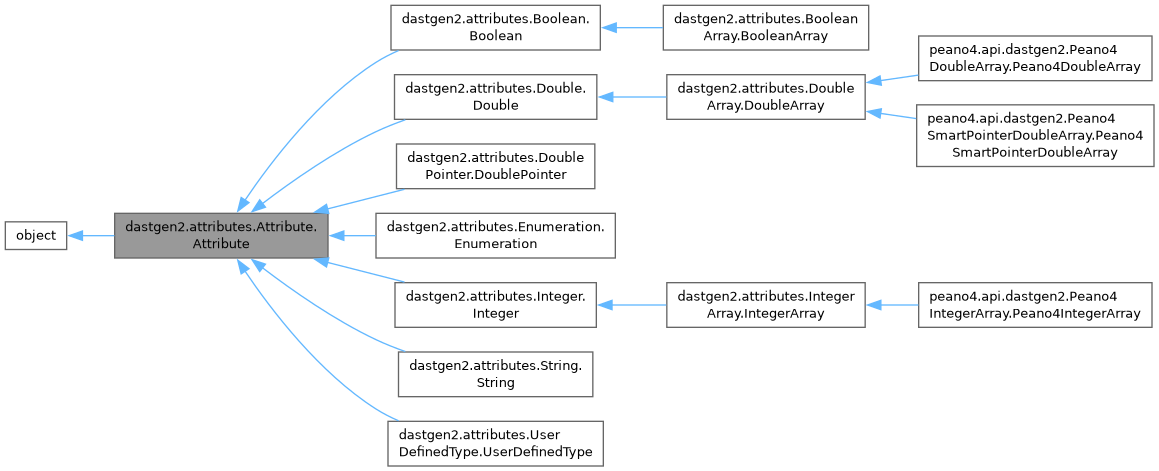
Represents one attribute. More...
Data Structures | |
| class | Qualifier |
| classifies attribute qualifiers. More... | |
Public Member Functions | |
| __init__ (self, name, ifdefs=[], qualifier=Qualifier.NONE, initval=None, expose_in_header_file=False) | |
| name: String This is a plain string which has to follow the C++ naming conventions, i.e. | |
| get_public_fields (self) | |
| Return string that is to be embedded into the public part of the class definition. | |
| get_methods (self, _full_qualified_class_name, for_declaration=True) | |
| Return sequence of methods that are defined for this attribute. | |
| use_default_copy_constructor (self) | |
| If this routine returns False, the generator will create a copy constructor copying each attribute over via a setter/getter combination. | |
| get_constructor_arguments (self) | |
| Return list of tuple of arguments for the constructor. | |
| get_plain_C_attributes (self, for_constructor=False) | |
| Return list of n-tuples. | |
| get_first_plain_C_attribute (self) | |
| For MPI for example, I need to know the first attribute. | |
| get_attribute_declaration_string (self) | |
| Construct the string used for variable declaration using the output of get_plain_C_attributes(self). | |
| get_accessor_name (self) | |
| Generate the accessor name used throughout dastgen2 to create variables, function names, etc. | |
| get_method_body (self, signature) | |
| I hand in the method signature (see get_methods()) and wanna get the whole implementation. | |
| name (self) | |
| I expect that there's at least one setter/getter pair. | |
| get_native_MPI_type (self) | |
| Return native (built-in) MPI datatype. | |
| get_to_string (self) | |
| Return string representation of attribute. | |
| get_includes (self) | |
Data Fields | |
| bool | use_data_store = False |
| ifdefs = ifdefs | |
| qualifier = qualifier | |
| expose_in_header_file = expose_in_header_file | |
Protected Member Functions | |
| _is_static (self) | |
| _is_const_static (self) | |
| _is_const (self) | |
| _is_constexpr (self) | |
Protected Attributes | |
| _name = name | |
| _initval = initval | |
Represents one attribute.
This is the superclass of all attributes tied
Definition at line 8 of file Attribute.py.
| dastgen2.attributes.Attribute.Attribute.__init__ | ( | self, | |
| name, | |||
| ifdefs = [], | |||
| qualifier = Qualifier.NONE, | |||
| initval = None, | |||
| expose_in_header_file = False ) |
name: String This is a plain string which has to follow the C++ naming conventions, i.e.
it is case-sensitive and may not contain any special characters besides the underscore. If also has to be unique within the enclosing data model. However, this uniqueness is a C++ constraint. A DaStGen model can hold the same attribute multiple times, as long as their ifdefs are different and hence mask them out, i.e. ensure that only version is "active" at any compile run.
ifdefs: [String] A set of strings which have to hold at compile time to determine if this attribute does exist or not.
qualifier: self.Qualifier An additional qualifier.
initval: str or None Initial value. The type depends on underlying type. But you can always pass in a string that evaluates to the correct type.
expose_in_header_file: Boolean Flag that determines if an attribute's setters and getters should have an implementation within the header or if the generated C++ code should strictly separate declaration and definition and stick the latter into a separate implementation and hence object file.
Definition at line 28 of file Attribute.py.
|
protected |
Definition at line 90 of file Attribute.py.
References qualifier.
|
protected |
Definition at line 86 of file Attribute.py.
References qualifier.
|
protected |
Definition at line 94 of file Attribute.py.
References qualifier.
|
protected |
Definition at line 82 of file Attribute.py.
References qualifier.
| dastgen2.attributes.Attribute.Attribute.get_accessor_name | ( | self | ) |
Generate the accessor name used throughout dastgen2 to create variables, function names, etc.
Definition at line 259 of file Attribute.py.
References _name.
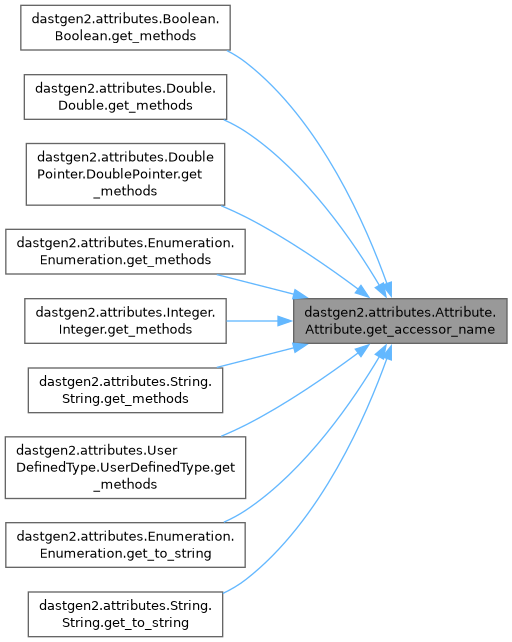
Referenced by dastgen2.attributes.Boolean.Boolean.get_methods(), dastgen2.attributes.Double.Double.get_methods(), dastgen2.attributes.DoublePointer.DoublePointer.get_methods(), dastgen2.attributes.Enumeration.Enumeration.get_methods(), dastgen2.attributes.Integer.Integer.get_methods(), dastgen2.attributes.String.String.get_methods(), dastgen2.attributes.UserDefinedType.UserDefinedType.get_methods(), dastgen2.attributes.Enumeration.Enumeration.get_to_string(), and dastgen2.attributes.String.String.get_to_string().
| dastgen2.attributes.Attribute.Attribute.get_attribute_declaration_string | ( | self | ) |
Construct the string used for variable declaration using the output of get_plain_C_attributes(self).
This is a list of tuples, each tuple containing two, three, or four entries.
See get_plain_C_attributes(self) for more details.
Definition at line 211 of file Attribute.py.
References get_plain_C_attributes(), and ifdefs.

| dastgen2.attributes.Attribute.Attribute.get_constructor_arguments | ( | self | ) |
Return list of tuple of arguments for the constructor.
The first tuple entry is the name, the second one the type. By default, I take them from the plain C attributes, but you can alter this behaviour.
Reimplemented in dastgen2.attributes.BooleanArray.BooleanArray, peano4.api.dastgen2.Peano4DoubleArray.Peano4DoubleArray, peano4.api.dastgen2.Peano4IntegerArray.Peano4IntegerArray, and peano4.api.dastgen2.Peano4SmartPointerDoubleArray.Peano4SmartPointerDoubleArray.
Definition at line 137 of file Attribute.py.
References get_plain_C_attributes().

| dastgen2.attributes.Attribute.Attribute.get_first_plain_C_attribute | ( | self | ) |
For MPI for example, I need to know the first attribute.
If you map your attribute onto multiple data types, it is one type that represents the whole thing.
Reimplemented in dastgen2.attributes.BooleanArray.BooleanArray, dastgen2.attributes.DoubleArray.DoubleArray, dastgen2.attributes.IntegerArray.IntegerArray, peano4.api.dastgen2.Peano4DoubleArray.Peano4DoubleArray, peano4.api.dastgen2.Peano4IntegerArray.Peano4IntegerArray, and peano4.api.dastgen2.Peano4SmartPointerDoubleArray.Peano4SmartPointerDoubleArray.
Definition at line 202 of file Attribute.py.
References get_plain_C_attributes().

| dastgen2.attributes.Attribute.Attribute.get_includes | ( | self | ) |
Reimplemented in dastgen2.attributes.UserDefinedType.UserDefinedType.
Definition at line 309 of file Attribute.py.
| dastgen2.attributes.Attribute.Attribute.get_method_body | ( | self, | |
| signature ) |
I hand in the method signature (see get_methods()) and wanna get the whole implementation.
Reimplemented in dastgen2.attributes.Boolean.Boolean, dastgen2.attributes.BooleanArray.BooleanArray, dastgen2.attributes.Double.Double, dastgen2.attributes.DoubleArray.DoubleArray, dastgen2.attributes.DoublePointer.DoublePointer, dastgen2.attributes.Enumeration.Enumeration, dastgen2.attributes.Integer.Integer, dastgen2.attributes.IntegerArray.IntegerArray, dastgen2.attributes.String.String, dastgen2.attributes.UserDefinedType.UserDefinedType, peano4.api.dastgen2.Peano4DoubleArray.Peano4DoubleArray, peano4.api.dastgen2.Peano4IntegerArray.Peano4IntegerArray, and peano4.api.dastgen2.Peano4SmartPointerDoubleArray.Peano4SmartPointerDoubleArray.
Definition at line 268 of file Attribute.py.
| dastgen2.attributes.Attribute.Attribute.get_methods | ( | self, | |
| _full_qualified_class_name, | |||
| for_declaration = True ) |
Return sequence of methods that are defined for this attribute.
Each entry is a tuple. Its first entry is the signature of the function (not including the semicolon), the second entry is the return type.
for_declaration: Boolean if True, assume we want method names for function declaration, not definition. Some generators might - for example - add additional annotations for the declaration such as Clang attributes. The most frequently used use case for this flag is the static annotation. To make a function a class function, you have to declare it as static. But the definition does not allow you to repeat that static keyword again.
Reimplemented in dastgen2.attributes.Boolean.Boolean, dastgen2.attributes.BooleanArray.BooleanArray, dastgen2.attributes.Double.Double, dastgen2.attributes.DoubleArray.DoubleArray, dastgen2.attributes.DoublePointer.DoublePointer, dastgen2.attributes.Enumeration.Enumeration, dastgen2.attributes.Integer.Integer, dastgen2.attributes.IntegerArray.IntegerArray, dastgen2.attributes.String.String, dastgen2.attributes.UserDefinedType.UserDefinedType, peano4.api.dastgen2.Peano4DoubleArray.Peano4DoubleArray, peano4.api.dastgen2.Peano4IntegerArray.Peano4IntegerArray, and peano4.api.dastgen2.Peano4SmartPointerDoubleArray.Peano4SmartPointerDoubleArray.
Definition at line 108 of file Attribute.py.
| dastgen2.attributes.Attribute.Attribute.get_native_MPI_type | ( | self | ) |
Return native (built-in) MPI datatype.
Return None if there's no direct mapping. The actual result is not a string only, but a list of tuples from native type to cardinality.
Reimplemented in dastgen2.attributes.Boolean.Boolean, dastgen2.attributes.BooleanArray.BooleanArray, dastgen2.attributes.Double.Double, dastgen2.attributes.DoubleArray.DoubleArray, dastgen2.attributes.DoublePointer.DoublePointer, dastgen2.attributes.Enumeration.Enumeration, dastgen2.attributes.Integer.Integer, dastgen2.attributes.IntegerArray.IntegerArray, dastgen2.attributes.String.String, dastgen2.attributes.UserDefinedType.UserDefinedType, peano4.api.dastgen2.Peano4DoubleArray.Peano4DoubleArray, peano4.api.dastgen2.Peano4IntegerArray.Peano4IntegerArray, and peano4.api.dastgen2.Peano4SmartPointerDoubleArray.Peano4SmartPointerDoubleArray.
Definition at line 288 of file Attribute.py.
| dastgen2.attributes.Attribute.Attribute.get_plain_C_attributes | ( | self, | |
| for_constructor = False ) |
Return list of n-tuples.
The tuple can either host two, three or four entries. The list itself may contain arbitrary many tuples, as one attribute logically can map onto multiple technical attributes. For example, when declaring an array, also declare an integer variable containing its length.
for_constructor: bool whether the return value of this function is intended for use in the constructor method of the DataModel. If true, will omit (optionally provided) initialization values in the attribute string.
The first triple entry always is the name, the second one the type. Type has to be plain C.
The first triple entry always is the name, the second one the type. Type has to be plain C. The third entry is a C++ attribute, i.e. a string embedded into [[...]].
The first triple entry always is the name, the second one the type. Type has to be plain C. The third entry is a C++ attribute, i.e. a string embedded into [[...]]. The fourth attribute is a list of ifdef symbols that have to be defined to use this attribute. The list of symbols is concatenated with an and. You can return an empty list. All symbol definitions can also be expressions such sa DEBUG>0 or defined(DEBUG).
Please note that these latter ifdefs are something completely different than the base class ifdefs. The base class ifdefs are to be used if you want to switch attributes on and off. The attributes here are used to switch between realisation variants.
Arrays can be modelled by adding a cardinality ("[15]" for example) to the first triple entry, i.e. the name.
Reimplemented in dastgen2.attributes.Boolean.Boolean, dastgen2.attributes.BooleanArray.BooleanArray, dastgen2.attributes.Double.Double, dastgen2.attributes.DoubleArray.DoubleArray, dastgen2.attributes.DoublePointer.DoublePointer, dastgen2.attributes.Enumeration.Enumeration, dastgen2.attributes.Integer.Integer, dastgen2.attributes.IntegerArray.IntegerArray, dastgen2.attributes.String.String, dastgen2.attributes.UserDefinedType.UserDefinedType, peano4.api.dastgen2.Peano4DoubleArray.Peano4DoubleArray, peano4.api.dastgen2.Peano4IntegerArray.Peano4IntegerArray, and peano4.api.dastgen2.Peano4SmartPointerDoubleArray.Peano4SmartPointerDoubleArray.
Definition at line 149 of file Attribute.py.
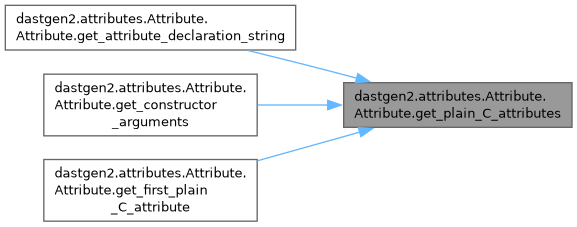
Referenced by get_attribute_declaration_string(), get_constructor_arguments(), and get_first_plain_C_attribute().
| dastgen2.attributes.Attribute.Attribute.get_public_fields | ( | self | ) |
Return string that is to be embedded into the public part of the class definition.
Most attributes don't add anything here, but some (alike enumerations) need to.
Reimplemented in dastgen2.attributes.Enumeration.Enumeration.
Definition at line 97 of file Attribute.py.
| dastgen2.attributes.Attribute.Attribute.get_to_string | ( | self | ) |
Return string representation of attribute.
Should be something that can be streamed via << into a sstream. So the result has to be of type string.
Reimplemented in dastgen2.attributes.Boolean.Boolean, dastgen2.attributes.BooleanArray.BooleanArray, dastgen2.attributes.Double.Double, dastgen2.attributes.DoubleArray.DoubleArray, dastgen2.attributes.DoublePointer.DoublePointer, dastgen2.attributes.Enumeration.Enumeration, dastgen2.attributes.Integer.Integer, dastgen2.attributes.IntegerArray.IntegerArray, dastgen2.attributes.String.String, dastgen2.attributes.UserDefinedType.UserDefinedType, peano4.api.dastgen2.Peano4DoubleArray.Peano4DoubleArray, peano4.api.dastgen2.Peano4IntegerArray.Peano4IntegerArray, and peano4.api.dastgen2.Peano4SmartPointerDoubleArray.Peano4SmartPointerDoubleArray.
Definition at line 299 of file Attribute.py.
| dastgen2.attributes.Attribute.Attribute.name | ( | self | ) |
I expect that there's at least one setter/getter pair.
Definition at line 279 of file Attribute.py.
References _name.
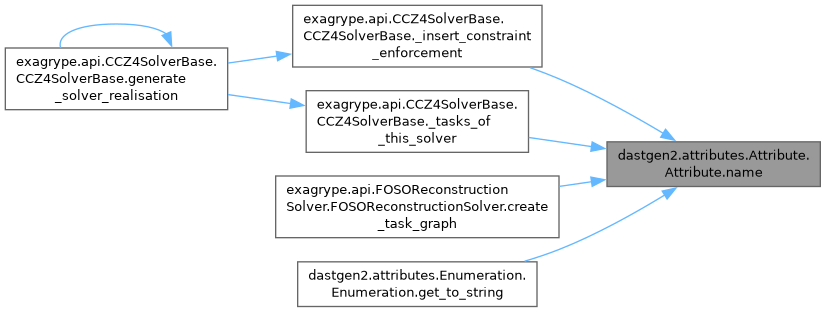
Referenced by exagrype.api.CCZ4SolverBase.CCZ4SolverBase._insert_constraint_enforcement(), exagrype.api.CCZ4SolverBase.CCZ4SolverBase._tasks_of_this_solver(), exagrype.api.FOSOReconstructionSolver.FOSOReconstructionSolver.create_task_graph(), and dastgen2.attributes.Enumeration.Enumeration.get_to_string().
| dastgen2.attributes.Attribute.Attribute.use_default_copy_constructor | ( | self | ) |
If this routine returns False, the generator will create a copy constructor copying each attribute over via a setter/getter combination.
Reimplemented in dastgen2.attributes.BooleanArray.BooleanArray, dastgen2.attributes.DoubleArray.DoubleArray, dastgen2.attributes.IntegerArray.IntegerArray, peano4.api.dastgen2.Peano4DoubleArray.Peano4DoubleArray, peano4.api.dastgen2.Peano4IntegerArray.Peano4IntegerArray, and peano4.api.dastgen2.Peano4SmartPointerDoubleArray.Peano4SmartPointerDoubleArray.
Definition at line 127 of file Attribute.py.
|
protected |
Definition at line 69 of file Attribute.py.
Referenced by dastgen2.attributes.Boolean.Boolean.get_plain_C_attributes(), dastgen2.attributes.Double.Double.get_plain_C_attributes(), dastgen2.attributes.DoublePointer.DoublePointer.get_plain_C_attributes(), dastgen2.attributes.Integer.Integer.get_plain_C_attributes(), dastgen2.attributes.String.String.get_plain_C_attributes(), and dastgen2.attributes.UserDefinedType.UserDefinedType.get_plain_C_attributes().
|
protected |
Definition at line 65 of file Attribute.py.
Referenced by api.Tree.Tree.__str__(), exahype2.api.Solver.Solver.__str__(), solvers.aderdg.ADERDG.ADERDG.__str__(), solvers.api.Solver.Solver.__str__(), solvers.elliptic.AMRMarker.AMRMarker.__str__(), solvers.elliptic.ConstrainedPoissonEquationForMarkerOnCells.ConstrainedPoissonEquationForMarkerOnCells.__str__(), solvers.fv.FV.FV.__str__(), solvers.rkdg.RungeKuttaDG.RungeKuttaDG.__str__(), solvers.fv.EnclaveTasking.EnclaveTasking._enclave_task_name(), dastgen2.attributes.Enumeration.Enumeration._enum_name(), solvers.aderdg.ADERDG.ADERDG._generate_kernels(), solvers.aderdg.ADERDG.ADERDG._init_dictionary_with_default_parameters(), solvers.fv.FV.FV._init_dictionary_with_default_parameters(), solvers.rkdg.RungeKuttaDG.RungeKuttaDG._init_dictionary_with_default_parameters(), solvers.aderdg.ADERDG.ADERDG._interpolate_face_data_default_guard(), solvers.aderdg.SingleSweep.SingleSweep._interpolate_face_data_default_guard(), solvers.aderdg.ADERDG.ADERDG._load_cell_data_default_guard(), solvers.fv.FV.FV._load_cell_data_default_guard(), solvers.rkdg.RungeKuttaDG.RungeKuttaDG._load_cell_data_default_guard(), solvers.aderdg.ADERDG.ADERDG._load_face_data_default_guard(), solvers.fv.FV.FV._load_face_data_default_guard(), solvers.rkdg.RungeKuttaDG.RungeKuttaDG._load_face_data_default_guard(), solvers.aderdg.ADERDG.ADERDG._provide_cell_data_to_compute_kernels_default_guard(), solvers.fv.FV.FV._provide_cell_data_to_compute_kernels_default_guard(), solvers.rkdg.RungeKuttaDG.RungeKuttaDG._provide_cell_data_to_compute_kernels_default_guard(), solvers.aderdg.ADERDG.ADERDG._provide_face_data_to_compute_kernels_default_guard(), solvers.fv.FV.FV._provide_face_data_to_compute_kernels_default_guard(), solvers.rkdg.RungeKuttaDG.RungeKuttaDG._provide_face_data_to_compute_kernels_default_guard(), solvers.aderdg.SingleSweep.SingleSweep._restrict_face_data_default_guard(), solvers.aderdg.ADERDG.ADERDG._store_boundary_data_default_guard(), solvers.aderdg.ADERDG.ADERDG._store_cell_data_default_guard(), solvers.fv.FV.FV._store_cell_data_default_guard(), solvers.rkdg.RungeKuttaDG.RungeKuttaDG._store_cell_data_default_guard(), solvers.aderdg.ADERDG.ADERDG._store_face_data_default_guard(), solvers.fv.FV.FV._store_face_data_default_guard(), solvers.rkdg.RungeKuttaDG.RungeKuttaDG._store_face_data_default_guard(), exahype2.api.Solver.Solver._unknown_identifier(), solvers.aderdg.ADERDG.ADERDG._unknown_identifier(), solvers.elliptic.AMRMarker.AMRMarker._unknown_identifier(), solvers.elliptic.ConstrainedPoissonEquationForMarkerOnCells.ConstrainedPoissonEquationForMarkerOnCells._unknown_identifier(), solvers.fv.FV.FV._unknown_identifier(), solvers.rkdg.RungeKuttaDG.RungeKuttaDG._unknown_identifier(), solvers.fv.FV.FV.add_actions_to_checkpoint_solution(), solvers.fv.EnclaveTasking.EnclaveTasking.add_actions_to_create_grid(), solvers.fv.EnclaveTasking.EnclaveTasking.add_actions_to_init_grid(), solvers.aderdg.ADERDG.ADERDG.add_actions_to_plot_solution(), solvers.elliptic.ConstrainedPoissonEquationForMarkerOnCells.ConstrainedPoissonEquationForMarkerOnCells.add_actions_to_plot_solution(), solvers.fv.FV.FV.add_actions_to_plot_solution(), solvers.rkdg.RungeKuttaDG.RungeKuttaDG.add_actions_to_plot_solution(), solvers.fv.EnclaveTasking.EnclaveTasking.add_entries_to_text_replacement_dictionary(), solvers.rkdg.SeparateSweepsWithEnclaveTasking.SeparateSweepsWithEnclaveTasking.add_entries_to_text_replacement_dictionary(), api.solvers.CollocatedLowOrderDiscretisation.CollocatedLowOrderDiscretisation.add_implementation_files_to_project(), api.solvers.DiscontinuousGalerkinDiscretisation.DiscontinuousGalerkinDiscretisation.add_implementation_files_to_project(), solvers.aderdg.ADERDG.ADERDG.add_implementation_files_to_project(), solvers.api.CollocatedDLinearDiscretisationWithPointJacobi.CollocatedDLinearDiscretisationWithPointJacobi.add_implementation_files_to_project(), solvers.api.CollocatedMG.CollocatedMG.add_implementation_files_to_project(), solvers.api.ContinuousGalerkinDiscretisationGaussLobattoWithBlockJacobi.ContinuousGalerkinDiscretisationGaussLobattoWithBlockJacobi.add_implementation_files_to_project(), solvers.elliptic.AMRMarker.AMRMarker.add_to_Peano4_datamodel(), solvers.elliptic.ConstrainedPoissonEquationForMarkerOnCells.ConstrainedPoissonEquationForMarkerOnCells.add_to_Peano4_datamodel(), api.solvers.CollocatedLowOrderDiscretisation.CollocatedLowOrderDiscretisation.add_to_plot(), exahype2.api.AuxiliaryVariables.AuxiliaryVariables.argument_name(), solvers.aderdg.SingleSweep.SingleSweep.create_action_sets(), solvers.fv.rusanov.LocalTimeStepWithEnclaveTasking.LocalTimeStepWithEnclaveTasking.create_action_sets(), solvers.fv.rusanov.SubcyclingAdaptiveTimeStepWithEnclaveTasking.SubcyclingAdaptiveTimeStepWithEnclaveTasking.create_action_sets(), solvers.fv.rusanov.SubcyclingFixedTimeStep.SubcyclingFixedTimeStep.create_action_sets(), solvers.fv.rusanov.SubcyclingFixedTimeStepWithEnclaveTasking.SubcyclingFixedTimeStepWithEnclaveTasking.create_action_sets(), solvers.rkdg.SeparateSweeps.SeparateSweeps.create_action_sets(), solvers.fv.SingleSweep.SingleSweep.create_data_structures(), exahype2.api.AuxiliaryVariables.AuxiliaryVariables.delta_argument_name(), get_accessor_name(), dastgen2.attributes.BooleanArray.BooleanArray.get_constructor_arguments(), peano4.api.dastgen2.Peano4DoubleArray.Peano4DoubleArray.get_constructor_arguments(), peano4.api.dastgen2.Peano4IntegerArray.Peano4IntegerArray.get_constructor_arguments(), peano4.api.dastgen2.Peano4SmartPointerDoubleArray.Peano4SmartPointerDoubleArray.get_constructor_arguments(), dastgen2.attributes.BooleanArray.BooleanArray.get_first_plain_C_attribute(), dastgen2.attributes.DoubleArray.DoubleArray.get_first_plain_C_attribute(), dastgen2.attributes.IntegerArray.IntegerArray.get_first_plain_C_attribute(), peano4.api.dastgen2.Peano4DoubleArray.Peano4DoubleArray.get_first_plain_C_attribute(), peano4.api.dastgen2.Peano4IntegerArray.Peano4IntegerArray.get_first_plain_C_attribute(), peano4.api.dastgen2.Peano4SmartPointerDoubleArray.Peano4SmartPointerDoubleArray.get_first_plain_C_attribute(), dastgen2.attributes.String.String.get_method_body(), dastgen2.attributes.BooleanArray.BooleanArray.get_methods(), dastgen2.attributes.DoubleArray.DoubleArray.get_methods(), dastgen2.attributes.IntegerArray.IntegerArray.get_methods(), peano4.api.dastgen2.Peano4DoubleArray.Peano4DoubleArray.get_methods(), peano4.api.dastgen2.Peano4IntegerArray.Peano4IntegerArray.get_methods(), peano4.api.dastgen2.Peano4SmartPointerDoubleArray.Peano4SmartPointerDoubleArray.get_methods(), exahype2.api.Solver.Solver.get_name_of_global_instance(), solvers.aderdg.ADERDG.ADERDG.get_name_of_global_instance(), solvers.elliptic.AMRMarker.AMRMarker.get_name_of_global_instance(), solvers.elliptic.ConstrainedPoissonEquationForMarkerOnCells.ConstrainedPoissonEquationForMarkerOnCells.get_name_of_global_instance(), solvers.fv.FV.FV.get_name_of_global_instance(), solvers.rkdg.RungeKuttaDG.RungeKuttaDG.get_name_of_global_instance(), exahype2.api.Solver.Solver.get_name_of_solver_class(), dastgen2.attributes.Boolean.Boolean.get_plain_C_attributes(), dastgen2.attributes.BooleanArray.BooleanArray.get_plain_C_attributes(), dastgen2.attributes.Double.Double.get_plain_C_attributes(), dastgen2.attributes.DoubleArray.DoubleArray.get_plain_C_attributes(), dastgen2.attributes.DoublePointer.DoublePointer.get_plain_C_attributes(), dastgen2.attributes.Integer.Integer.get_plain_C_attributes(), dastgen2.attributes.IntegerArray.IntegerArray.get_plain_C_attributes(), dastgen2.attributes.String.String.get_plain_C_attributes(), dastgen2.attributes.UserDefinedType.UserDefinedType.get_plain_C_attributes(), peano4.api.dastgen2.Peano4DoubleArray.Peano4DoubleArray.get_plain_C_attributes(), dastgen2.attributes.String.String.get_setter_getter_name(), dastgen2.attributes.Boolean.Boolean.get_to_string(), dastgen2.attributes.BooleanArray.BooleanArray.get_to_string(), dastgen2.attributes.Double.Double.get_to_string(), dastgen2.attributes.DoubleArray.DoubleArray.get_to_string(), dastgen2.attributes.DoublePointer.DoublePointer.get_to_string(), dastgen2.attributes.Enumeration.Enumeration.get_to_string(), dastgen2.attributes.Integer.Integer.get_to_string(), dastgen2.attributes.IntegerArray.IntegerArray.get_to_string(), dastgen2.attributes.UserDefinedType.UserDefinedType.get_to_string(), peano4.api.dastgen2.Peano4DoubleArray.Peano4DoubleArray.get_to_string(), peano4.api.dastgen2.Peano4IntegerArray.Peano4IntegerArray.get_to_string(), peano4.api.dastgen2.Peano4SmartPointerDoubleArray.Peano4SmartPointerDoubleArray.get_to_string(), api.solvers.Solver.Solver.name(), name(), exagrype.api.euler.CCZ4WithEuler_OuterAdditiveCoupling.CCZ4WithEuler_OuterAdditiveCoupling.name(), exagrype.api.euler.CCZ4WithEuler_OuterMultiplicativeCoupling.CCZ4WithEuler_OuterMultiplicativeCoupling.name(), exagrype.api.FOSOSolver.FOSOSolver.name(), exagrype.api.scalarfield.CCZ4WithScalarField_InnerCoupling.CCZ4WithScalarField_InnerCoupling.name(), exagrype.api.scalarfield.CCZ4WithScalarField_OuterMultiplicativeCoupling.CCZ4WithScalarField_OuterMultiplicativeCoupling.name(), exahype2.api.AuxiliaryVariables.AuxiliaryVariables.name(), exahype2.api.Solver.Solver.name(), solvers.api.Solver.Solver.name(), solvers.elliptic.ConstrainedPoissonEquationForMarkerOnCells.ConstrainedPoissonEquationForMarkerOnCells.name(), solvers.fv.FV.FV.name(), api.solvers.Solver.Solver.typename(), and solvers.api.Solver.Solver.typename().
| dastgen2.attributes.Attribute.Attribute.expose_in_header_file = expose_in_header_file |
Definition at line 70 of file Attribute.py.
| dastgen2.attributes.Attribute.Attribute.ifdefs = ifdefs |
Definition at line 67 of file Attribute.py.
Referenced by get_attribute_declaration_string().
| dastgen2.attributes.Attribute.Attribute.qualifier = qualifier |
Definition at line 68 of file Attribute.py.
Referenced by _is_const(), _is_const_static(), _is_constexpr(), and _is_static().
| bool dastgen2.attributes.Attribute.Attribute.use_data_store = False |
Definition at line 66 of file Attribute.py.
Referenced by dastgen2.attributes.Boolean.Boolean.get_to_string(), dastgen2.attributes.BooleanArray.BooleanArray.get_to_string(), dastgen2.attributes.Double.Double.get_to_string(), dastgen2.attributes.DoubleArray.DoubleArray.get_to_string(), dastgen2.attributes.DoublePointer.DoublePointer.get_to_string(), dastgen2.attributes.Enumeration.Enumeration.get_to_string(), dastgen2.attributes.Integer.Integer.get_to_string(), dastgen2.attributes.IntegerArray.IntegerArray.get_to_string(), dastgen2.attributes.UserDefinedType.UserDefinedType.get_to_string(), peano4.api.dastgen2.Peano4DoubleArray.Peano4DoubleArray.get_to_string(), peano4.api.dastgen2.Peano4IntegerArray.Peano4IntegerArray.get_to_string(), and peano4.api.dastgen2.Peano4SmartPointerDoubleArray.Peano4SmartPointerDoubleArray.get_to_string().
 1.15.0